
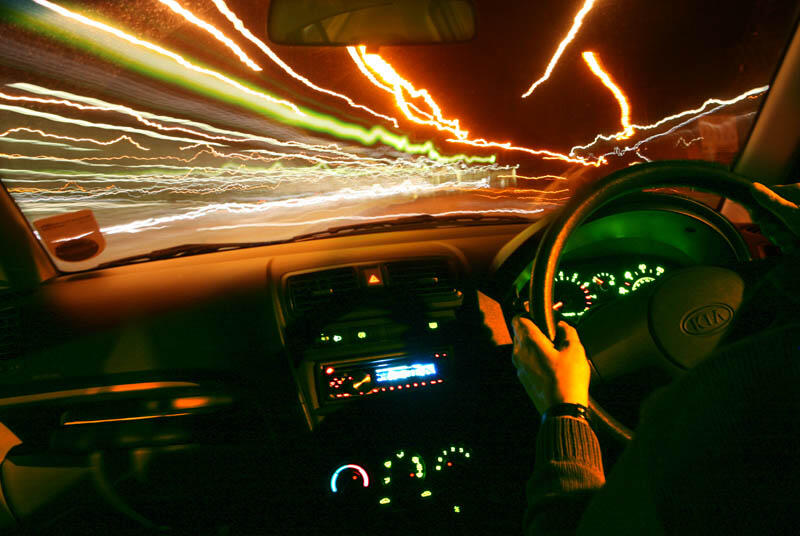

Driving after dark requires a different approach from daytime driving. Reduced visibility, headlight glare, poorly lit roads, and driver fatigue can make hazards harder to identify and give you less time to react.
In India, car driving at night can be particularly challenging because urban roads may combine bright commercial lighting with poorly illuminated stretches. On highways and rural roads, drivers may encounter pedestrians, two-wheelers, trucks, stray animals, sudden potholes and vehicles without adequate lighting.
The solution is not to avoid every night journey. Instead, drivers should understand the limitations of night-time visibility, use headlights correctly, reduce speed when necessary and recognise when they are too tired, or conditions are too poor to continue.


Night driving safety checklist
Before setting out after dark, quickly check:
- Headlights: Ensure low and high beams, indicators and brake lights work correctly.
- Mirrors: Adjust the IRVM and ORVMs before starting.
- Windshield: Clean the inside and outside to reduce glare and reflections.
- Speed: Reduce speed when visibility or road conditions deteriorate.
- Fatigue: Do not begin a night journey if you are already sleepy.
- Glare: Be prepared for high beams from oncoming vehicles.
- Visibility: Check for pedestrians, animals, motorcycles, potholes and unlit vehicles.
The National Safety Council notes that darkness can compromise depth perception, colour recognition and peripheral vision, while oncoming headlights can temporarily impair a driver's vision.
Why night driving is more difficult
During daylight, natural light provides a broad view of the road and its surroundings. At night, your headlights illuminate only part of the environment, while areas outside the beam can become difficult to see.
This creates several challenges.
Reduced peripheral vision
You may not see a pedestrian, cyclist, animal, or motorcycle entering your path from the side until it is relatively close.
Difficulty judging distance
Darkness can make it harder to judge the distance and speed of another vehicle, particularly when it is approaching with bright headlights.
Longer reaction requirements
If a hazard becomes visible later, you have less time to react. This is one reason reducing speed is an important part of safe driving. The National Safety Council specifically recommends slowing down to compensate for limited visibility and reduced stopping time.
Car driving at night: use headlights correctly
When to use low beam
Use low beam when:
- Driving in built-up areas with street lighting
- Following another vehicle
- Approaching oncoming traffic
- Visibility does not require high beam
- Driving on roads where high beam could dazzle others
Your objective is to see adequately without unnecessarily affecting other road users.
When to use high beam
High beam can be useful on dark, poorly lit roads when there is no nearby traffic that could be dazzled.
Switch back to low beam when approaching an oncoming vehicle or when following another vehicle closely.
The National Safety Council similarly recommends switching between high and low beams appropriately because headlights that help one driver see can impair another driver's vision.
Avoid driving permanently on high beam
A common mistake during car driving at night is leaving high beam switched on continuously. This can temporarily blind an approaching driver and make it difficult for them to judge the road.
If another driver is using high beam directly towards you, avoid staring at the headlights.
How to handle glare while driving at night
Glare is one of the most uncomfortable parts of night driving, particularly on Indian roads where high-beam misuse is common.
Do not stare directly at bright headlights
Instead, shift your focus towards the left-side edge or lane marking of your own side of the road while maintaining awareness of the vehicle ahead.
The National Safety Council recommends looking away from bright oncoming headlights rather than directly into them.
Do not completely look away from the road. Your aim is to use the road edge as a visual reference while allowing the bright light to remain in your peripheral vision.
Keep the windshield clean
A dirty windshield can scatter light and increase glare. Clean both sides of the glass, especially before a long night journey.
Check for streaks caused by worn or dirty wiper blades as well.
Keep the dashboard illumination comfortable
Excessively bright interior displays can interfere with dark adaptation. If your car allows it, reduce unnecessary dashboard brightness without compromising visibility of essential controls.
Night driving tips for poorly lit Indian roads
Not every Indian road is consistently illuminated. You may move from a brightly lit city street to a dark stretch within minutes.
Reduce speed when visibility drops
Do not maintain the same speed simply because you know the road.
Reduce speed when:
- Street lighting ends.
- The road surface is damaged.
- There are pedestrians or animals nearby.
- Visibility is affected by rain or fog.
- You are approaching a curve.
- You cannot clearly identify hazards ahead.
Speed should allow you enough time to respond to what you can actually see.
Watch for pedestrians and cyclists
People walking along poorly lit roads may be difficult to spot, particularly when wearing dark clothing.
Be especially cautious near:
- Bus stops
- Railway crossings
- Markets
- Villages
- Roadside shops
- Construction areas
- Residential lanes
Do not assume a pedestrian will always be visible from a distance.
Look for two-wheelers
Motorcycles and scooters may have smaller visual profiles than cars. A two-wheeler can also be difficult to notice when positioned beside or behind your vehicle.
Check your mirrors regularly and be particularly careful before changing lanes or turning.
Night driving on highways
Highway driving at night combines the challenges of darkness with higher vehicle speeds and longer stopping distances.
Trucks and buses can be particularly difficult to judge because of their size and lighting configuration.
Maintain a larger following distance
Leave more space between your car and the vehicle ahead when visibility is limited.
This becomes especially important behind trucks, because they can obscure hazards further ahead.
Do not follow so closely that the vehicle's rear lights become your primary visual reference.
Be cautious around trucks
Large commercial vehicles can have substantial blind spots. Avoid lingering alongside them unnecessarily, particularly on poorly lit roads.
If you need to overtake, make sure you have adequate visibility and space to complete the manoeuvre safely.
Be careful on curves
A dark curve can conceal:
- A stopped vehicle
- A pedestrian
- An animal
- A pothole
- Road debris
- An oncoming vehicle
Reduce speed before the curve rather than braking sharply once you are already inside it.
Sudden potholes, animals and road hazards
Indian roads can present hazards that are difficult to spot after dark.
Potholes
A pothole may become visible only when your headlights illuminate it. Avoid sudden steering movements if another vehicle is beside you.
Stray animals
Cows, dogs and other animals may wander onto roads, particularly around residential and semi-rural areas.
If you see an animal ahead, slow down early. Do not assume it will move in the direction you expect.
Avoid aggressive horn use or sudden swerving.
Unlit or poorly lit vehicles
Watch for parked vehicles, tractors, cycles and other road users with limited lighting.
A dark vehicle can blend into the background until you are relatively close to it.
Night driving tips for fog and poor visibility
Fog can make night driving significantly more difficult because light reflects from water droplets suspended in the air.
Slow down before visibility becomes critical
Do not wait until you can barely see before reducing speed.
Increase the distance from the vehicle ahead and avoid sudden lane changes.
Use appropriate lights
Use the lighting configuration recommended by your vehicle manufacturer for foggy conditions. In many situations, low beams are preferable to high beams because high-beam light can reflect from fog and further reduce visibility.
If your car has fog lamps, use them according to the manufacturer's guidance and local regulations.
Avoid overtaking in dense fog
If you cannot clearly see the road ahead, do not attempt an overtake simply because the vehicle in front is moving slowly.
If visibility becomes extremely poor, find a safe place to stop rather than continuing at an unsafe speed.
Fatigue: know when not to drive at night
Fatigue is one of the biggest reasons to reconsider a night journey.
The National Safety Council identifies night-time and early-morning driving as periods when drowsy-driving risk is particularly relevant.
Do not rely on coffee to fix severe fatigue
Coffee, loud music or opening a window may temporarily make you feel more alert, but they are not substitutes for adequate rest.
If you notice:
- Repeated yawning
- Heavy eyelids
- Difficulty focusing
- Missing turns or road signs
- Drifting within your lane
- Difficulty remembering the last few kilometres
you should stop driving.
The NSC identifies these as warning signs of drowsy driving.
When should you avoid driving at night?
Consider postponing the journey if:
- You are already very tired.
- You have had inadequate sleep.
- Heavy fog makes visibility extremely poor.
- Severe rain prevents you from seeing the road clearly.
- You are unfamiliar with the route and cannot safely navigate it.
- You are affected by alcohol, drugs, or medication that can impair alertness.
Reaching your destination later is safer than continuing when you are not fit to drive.
Common night driving mistakes to avoid
Driving at daytime speeds
A familiar road is not necessarily a safe road at night. Reduce speed when visibility changes.
Using high beam continuously
High beam can improve your visibility on a dark road but can temporarily impair other drivers.
Following too closely
Tailgating reduces your reaction time and makes it harder to see beyond the vehicle ahead.
Looking directly into headlights
Bright headlights can cause temporary visual impairment. Shift your gaze towards your side of the road instead.
Ignoring windshield glare
Interior reflections, dust, and streaks can become surprisingly distracting after dark.
Driving while exhausted
Fatigue can impair attention and reaction time. If you are sleepy, stop.
Night driving tips that can save lives
1. Darkness affects more than brightness
Night-time driving can affect depth perception, colour recognition and peripheral vision—not merely how bright or dark the road appears.
2. A clean windshield can make a noticeable difference
Headlight glare becomes more distracting when the windshield has dirt, streaks or residue. Cleaning the glass is therefore a simple but often overlooked night-driving measure.
3. Fatigue can occur even on shorter journeys
You do not need to be on a long road trip to become dangerously tired. Fatigue can develop during routine night journeys, particularly when driving at times when your body normally expects to sleep.
Final takeaway
Safe night driving depends on recognising that darkness changes the driving environment. Headlights provide only a limited view, glare can temporarily affect your vision, and hazards such as pedestrians, two-wheelers, stray animals and potholes can be harder to detect.
For car driving at night, keep your windshield and lights clean, use low and high beams appropriately, maintain a safe speed, and leave additional following distance. On highway driving at night, be especially cautious around trucks, curves, unlit vehicles, and sudden road hazards.
Most importantly, know when not to drive. Severe fatigue, dense fog, or extremely poor visibility can make postponing the journey the safest decision.
Summarise with AI:
Did you like this article? Leave a rating!

 Loading...

