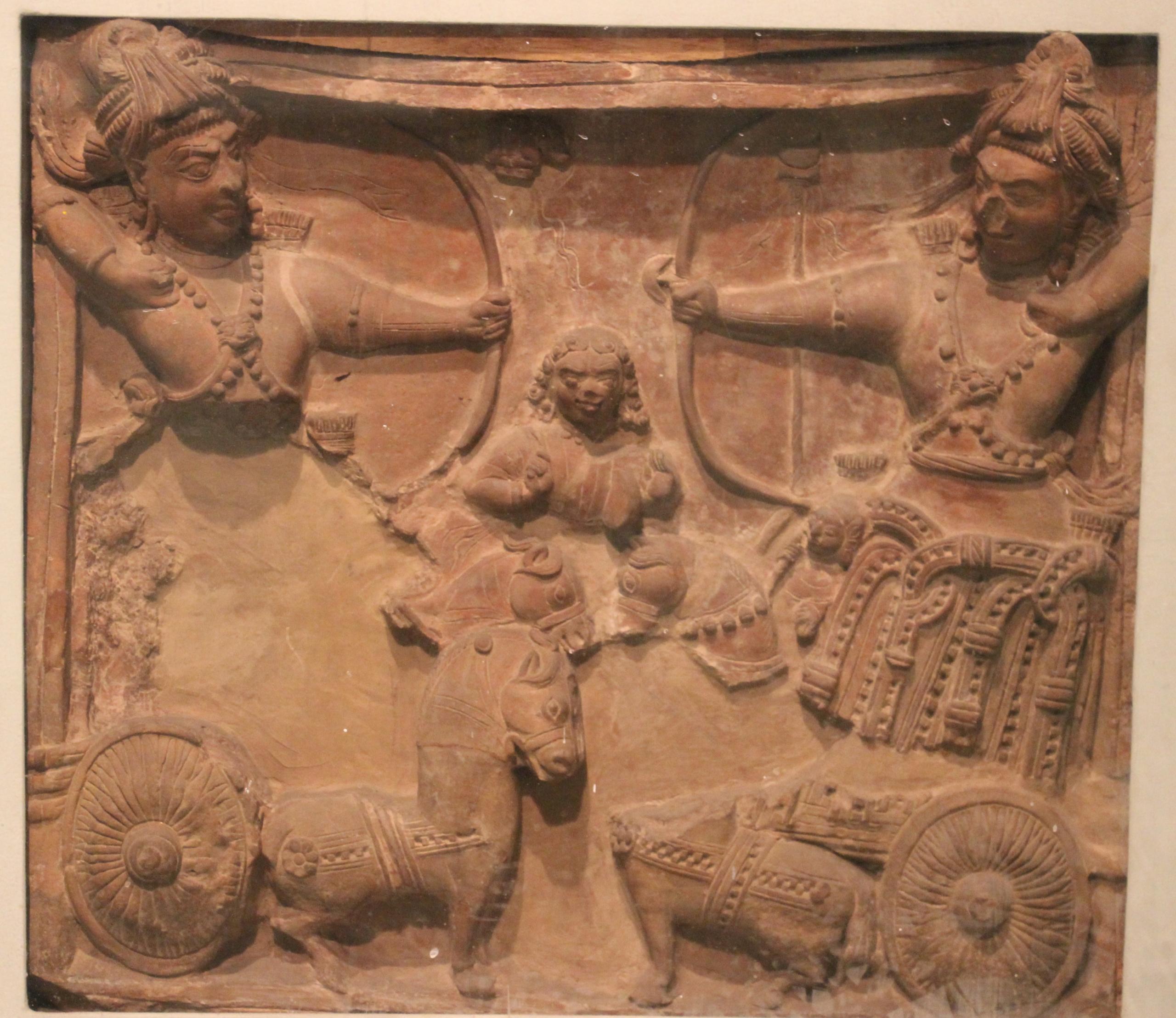

The ancient people of North India were pushed to relocate southward due to the Aryan migration from Central Asia, despite the region's resistance to multiple Western invasions, notably that of Alexander the Great. Chandragupta Maurya expanded his power to encompass all of North India in the fourth century BCE. His son, Ashoka, contributed significantly to the expansion of the Buddhist movement across Asia and India.
Beginning with Muhammad of Ghazni in the 11th century CE, Muslim troops invaded North India throughout the Middle Ages, paving the way for Babur, the first Mughal Emperor of India. North India saw an era of affluence and enlightenment brought forth by the Mughals. Periodically, several strong tribes resisted Mughal control, such as the ferocious Rajasthani Rajputs and the Shivaji-led Marathas, but they were ultimately defeated.





Major Dynasties of Ancient North India
- Maurya Dynasty (c. 321 – 185 BCE)
- Capital: Pataliputra (modern Patna, Bihar)
- Founded by Chandragupta Maurya; expanded under Ashoka, who promoted Buddhism across Asia.
- Shunga Dynasty (c. 185 – 73 BCE)
- Capital: Pataliputra
- Established after the fall of the Mauryas, revived Brahmanical culture and patronized art and learning.
- Kanva Dynasty (c. 73 – 28 BCE)
- Capital: Pataliputra
- Brief rule following the Shungas, eventually replaced by the Satavahanas.
- Kushan Empire (c. 30 – 375 CE)
- Capital: Purushapura (modern Peshawar, Pakistan) and later Mathura
- Cosmopolitan empire that fostered Indo-Greek and Buddhist art; flourished under Emperor Kanishka.
- Gupta Empire (c. 319 – 550 CE)
- Capital: Pataliputra (with secondary centers at Ujjain and Prayag)
- Known as the Golden Age of India, marked by advances in science, literature, and architecture.
- Harsha Empire (c. 606 – 647 CE)
- Capital: Kannauj (Uttar Pradesh)
- Founded by Harshavardhana, promoted Buddhism and education across North India.
- Pala Dynasty (c. 750 – 1174 CE)
- Capital: Pataliputra initially, later Monghyr and Gauda (in Bengal)
- Great patrons of Mahayana Buddhism and founders of Nalanda and Vikramashila universities.
- Rajput Kingdoms (c. 650 – 1200 CE)
- Capitals: Varied by clan — Ajmer (Chauhans), Mewar/Chittor (Sisodias), Kannauj (Gahadavalas)
- Feudal warrior states known for chivalry, fort architecture, and resistance to foreign invasions.
Mauryan Empire - Ancient Dynasty of the Mauryas
As two kingdoms grew in the northeast, the first Indian empire was formed, led by the Mauryan dynasty (c. 321–185 B.C.).
According to the annals of the Greek ambassador Megasthenes, the capital city, Pataliputra (modern-day Patna), was surrounded by a timber wall punctuated by 64 gates and 570 towers, surpassing the splendours of contemporaneous Persian places such as Susa and Ecbatana.
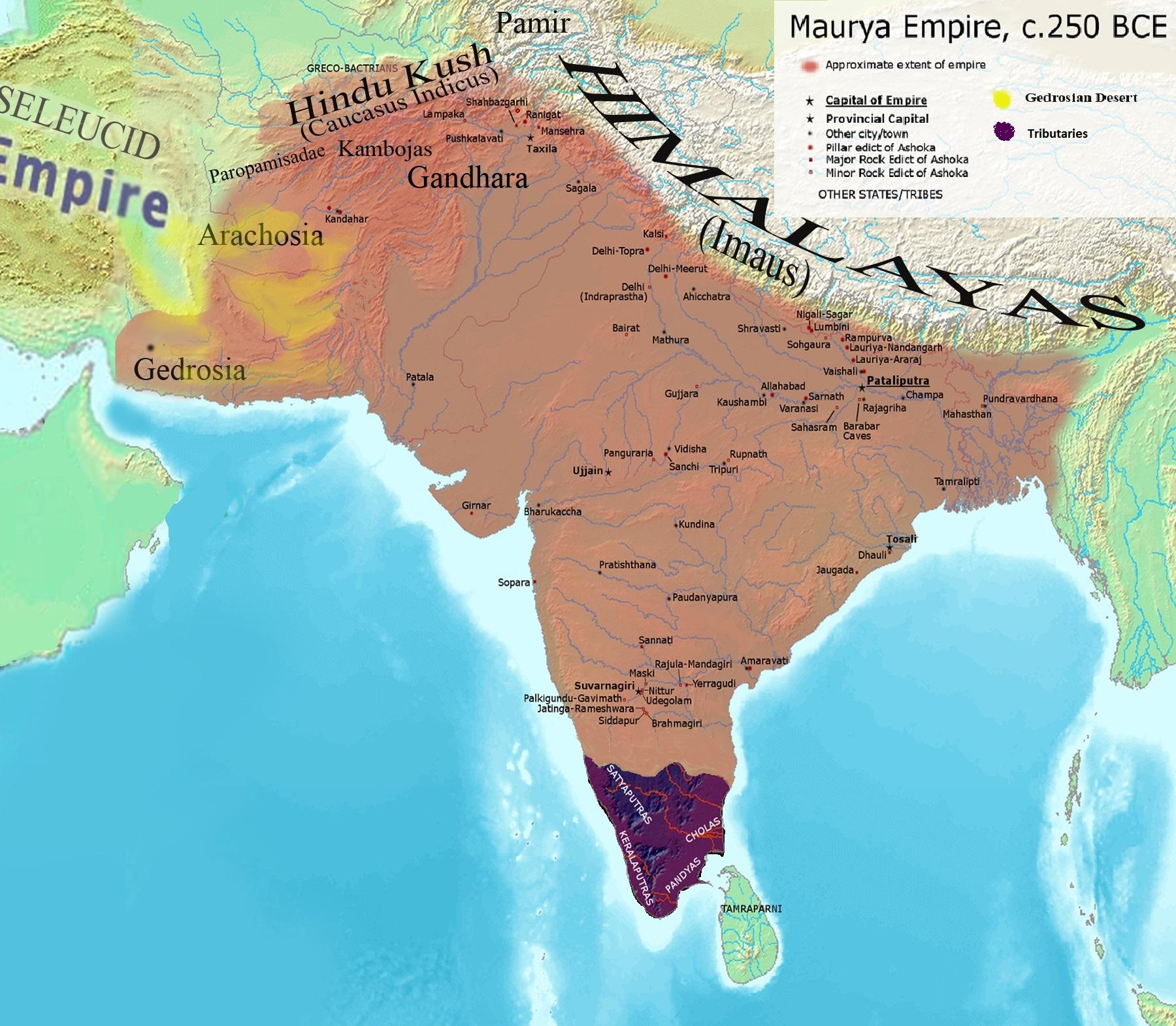
By 303 B.C., Chandragupta Maurya (known to the Greeks as Sandracotta) had taken control of an enormous area that spanned from Bengal in the east to Afghanistan in the west and all the way south to the Narmada River. He owes much of his success to his mentor and prime minister, Kautilya, also known as Chanakya, who penned the Arthashastra, a brutal guidebook on acquiring and holding power.
Chandragupta Maurya founded it around 322 BCE and it lasted until about 185 BCE.
Bindusara, the son and heir of Chandragupta, extended the rule across central and southern India. Ashoka (c. 273-232 B.C.) is the most famous Indian emperor among all the Mauryan emperors. He was the third monarch of Maurya. Many draw comparisons between Ashoka's conversion to Buddhism and the impact of Roman Emperor Constantine the Great's acceptance of Christianity in 313 A.D.
Beginning in 254 B.C., Ashoka had enormous Buddhist decrees carved into caves and rocks around his realm. One describes his seeming failure to gain favour with the Greek kings of Egypt, Syria, Macedonia, Cyrene, and Epirus when he sent religious envoys. Thirteen years later, he engraved seven more decrees into meticulously placed polished sandstone pillars.
Situated at Lauriya Nandangarh, Bihar, one of the best surviving Ashokan pillars is thirty-two feet high with a sitting lion atop it. Furthermore, Ashoka is credited for building 84,000 stupas to store Buddha relics and commemorate important events in the life of Siddhartha Gautama, the founder of Buddhism.
After Ashoka the Great's reign, the next 50 years saw a succession of ineffective kings who were unable to maintain a strong central authority. This ultimately resulted in the downfall of the Maurya Empire. General Pusyamitra Sunga seized power from the Maurya Dynasty in 185 BCE, establishing himself as the ruler and establishing the Sunga Dynasty.
Gupta Empire of India
The travel diaries and writings of Buddhist monks who travelled through this part of the world are the most trustworthy sources of information we have about the Gupta Empire. The travelogues of Fa Hien (Faxian, c. 337–422 CE), Hiuen Tsang (Xuanzang, 602–664 CE), and Yijing (I Tsing, 635–713 CE) are useful in this sense. Srigupta ruled the Gupta Empire from approximately 240 to 280 CE, which comprised only Magadha and probably some of Bengal.
It was established around 240 CE by Sri Gupta and reached its peak under the reign of Chandragupta II (also known as Chandragupta Vikramaditya), who ruled from around 375 to 415 CE.
Like the Mauryas and other Magadha kings before him, Srigupta ruled from Pataliputra, which is close to modern-day Patna. The son of Srigupta, Ghatotkacha, came to the throne between 280 and 319 CE.
Chandragupta I
The Gupta emperors recognized the benefits of retaining a cavalry against the Kushans, and Chandragupta I, Ghatotkacha's son, used his powerful army to good use. Following his marriage to Kumaradevi, Princess of Licchhavi, Chandragupta I inherited extensive iron ore mines near his domain.
Forged iron was utilized to meet domestic needs and eventually became a sought-after commodity for trade thanks to advanced metallurgy. The inability of the territorial lords of various parts of India to stand up to Chandragupta I's superior military power resulted in their forcible submission. By the end of his reign, it was thought that Allahabad was already within the confines of the Gupta Empire.
Samudragupta
The son of Chandragupta I, Samudragupta (c. 335–375 CE), was the next in line for the throne and continued the kingdom's expansion. After seizing the remaining regions of North India, Samudragupta annexed a portion of South India to his dominion by the end of his Southern Campaign. Rajdharma, or the duties of a king, was a subject that Samudragupta took great care to observe.
In addition to being a valiant ruler and an accomplished statesman, he was also a gifted poet and musician. The quantity of gold coins he has in circulation attests to his diversified expertise. An inscription known as the Allahabad Pillar, which was probably commissioned by later Gupta emperors, best captures his humane qualities. Additionally, Samudragupta supported promoting harmony across various religious communities. For instance, he supported and fostered the construction of a monastery in Bodh Gaya for Ceylon's King Meghavarna.
Chandragupta II Vikramaditya
Like his predecessor Samudragupta, Chandragupta II (c. 380–414 CE) was a compassionate ruler, a skillful administrator, and a capable commander. He ousted the Saurashtra satrap to expand his hegemony to the Arabian Sea coast. Because of his bravery, he was given the title Vikramaditya. To maximize his control over the vast empire, Chandragupta II made Ujjain his secondary capital. He also saw to it that the navy was reinforced. The seaports of Tamralipta and Sopara therefore became bustling hubs of maritime trade.

Additionally, he demonstrated strong support for the arts and culture. Nava Ratna (nine diamonds), one of the brightest scholars of the day, was a frequent guest at his court. Numerous hospitals, orphanages, and charitable organizations benefited from his generosity. Rest areas for travellers were located along the side of the road. The Gupta Empire reached its pinnacle during this time, when progress in all spheres was unmatched.
The Gupta dynasty suffered defeat at the hands of the invading White Huns, also known as the Hephthalites. While the dynasty was not entirely wiped out, the White Huns inflicted significant harm on the empire, ultimately contributing to its downfall.
North Indian Dynasties of the Delhi Sultanate
Mamluks
Qutub-ud-Dïn Aybak founded the Mamluk Dynasty in 1206. As a general in the crumbling Ghurid Sultanate, a Persian dynasty that ruled over what is now Afghanistan, Pakistan, Iran, and northern India, he was a Turk from Central Asia. Qutub-ud-Dïn's reign was brief, as was the case with many of his forebears, as he passed away in 1210. Before his passing in 1236, his son-in-law Iltutmish assumed control of the Mamluk Dynasty and successfully founded the Delhi Sultanate.
Khiljis
The second of the Delhi Sultanates, the Khilji Dynasty was named after Jalal-ud-Dïn Khilji, who defeated the last ruler of the Mamluk Dynasty, Moiz ud din Qaiqabad, in 1290. Like many others who came before and after him, Jalal-ud-din Khilji's rule was short. Six years later, his nephew Ala-ud-din Khilji killed him to take over the family.
The Khilji dynasty ruled over the Delhi Sultanate in India for a relatively brief period of time. They held power from 1290 to 1320 AD
Ala-ud-din was not just a dictator but also credited with preventing the Mongols from entering India. Ala-ud-din's 19-year reign saw rapid expansion throughout most of Central and Southern India as a result of his skill as a power-hungry general. To strengthen his treasury and army, he also increased taxes.
Tughlaqs
Ghiyas-ud-din Tughlaq established a nearly century-long dynasty. The heir of Ghiyas-ud-din, Muhammad bin Tughlaq, ruled for 26 years, allowing the Tughlaq Dynasty to expand its power across a large portion of modern-day India between 1320 and 1414. By expanding the dynasty's borders to the southeast coast of modern-day India, he increased its reach to the greatest of all the Delhi Sultanates.
The Tughlaq dynasty ruled over parts of the Indian subcontinent from 1320 to 1414 CE
Sayyids and Lodis
In 1414, the Sayyid Dynasty triumphed in the capital, and Sayyid Khizr Khan was declared the winner. However, the Timur people were known for pillaging and forgetting their conquests, so there was fierce competition for both his reign and the reigns of his three children. Since the fourth sultan abdicated in 1451 to make room for Bahlul Khan Lodi, the founder of the ethnic Pashtun Lodi Dynasty that emerged from Afghanistan, the Sayyid Dynasty was destined to fail from the first.
The Lodi dynasty, also known as the Sultanate of Delhi, was a ruling dynasty during the Delhi Sultanate's peak under the Tughlaq dynasty from 1330 to 1335.
Known for his warlords and horse commerce, Lodi played a significant role in rebuilding northern India after Timur's invasion left it in ruins. The Lodi Dynasty ended in 1526 with Babur's victory over the considerably bigger Lodi army in the First Battle of Panipat, which led to Ibrahim Lodi's death. The Mughal Empire was founded by the Muslim king of Central Asia, Babur, and it dominated India until the British Raj toppled it in 1857.
Suris
After Babur's victory over Ibrahim Lodi in 1540, the Mughals took possession of Delhi. The Delhi Sultanate was again independent after Sher Shah defeated the Mughals at the Battle of Chausa in 1540, but the Mughuls retook Delhi in 1555.
The Warrior Kingdom of the Marathas
The Marathas were a warrior tribe from India that originated mostly in what is now the state of Maharashtra. In the seventeenth century, several Islamic nations dominated subcontinental politics, with the Mughal Empire controlling most of northern India. Five sultanates ruled the Deccan region of central India, but by the 1630s, only three remained in power: Ahmadnagar, Golconda, and Bijapur. These sultanates employed Shahaji Bhosale, a Maratha general.
Shivaji
Shivaji, the son of Shahaji, rebelled against the Bijapur sultanate and captured numerous forts in the Deccan to launch an effort to establish Hindavi Svarajya or the Hindu people's self-rule. He fought the Deccan sultanates, the newly established English East India Company, which was involved in port operations in western India, and the Mughal Empire. With the aid of powerful Maratha warrior families, Shivaji overthrew his first fort in 1645 and went on to establish a stable empire with Raigad as its capital.
Shivaji's son Sambhaji took over the throne in 1680 after his father's death. He governed until 1689, when he was captured and executed by Mughal emperor Aurangzeb. Aurangzeb also captured Sambhaji's son Shahu, which allowed Sambhaji's half-brother Rajaram to succeed to the throne.
Peshwas
Civil war took place in 1707 after Shahu was set free by Bahadur Shah I, the newly appointed Mughal emperor, following the death of Aurangzeb. Soon after, Shahu made it clear that he intended to overthrow Ramanujam's son Shivaji II, who was ruling with Tarabai's help. Shahu designated Balaji Viswanath as Peshwa, or chief minister, in 1713. This was the beginning of the Peshwa era, during which the Peshwa ruled the Maratha empire with total authority.
Third Battle of Panipat
In 1761, Ahmad Shah Durrani, the founder of the Afghan Durrani dynasty, invaded northern India. The Afghan and Maratha forces engaged in combat in the Third Battle of Panipat. Due to long-standing animosities, the Rajputs and other local lords did not help the Marathas, which led to a significant Maratha defeat at Panipat. Even though the conflict ended with a peace treaty, the battle severely diminished the Maratha's dominance in the subcontinent because most of the Maratha force was destroyed.
Anglo-Marathas Wars
The latter Maratha period was defined by wars with the kingdom of Mysore and the East India Company. The First Anglo-Maratha War, fought between 1775 and 1782, ended with the Maratha people on top. Between 1785 and 1787, the First Maratha-Mysore War erupted, inciting animosity toward Tippu Sultan, the de facto ruler of Mysore. After that, in the last two of the four Anglo-Mysore wars, the Marathas sided with the British, which helped tip the scales of power away from Mysore and led to a British victory in 1799.

The British intervention in the chieftains' affairs caused the Marathas to lose a considerable deal of land during the Second Anglo-Maratha War, which raged from 1803 to 1805. The Marathas were the last major force opposing the British in the subcontinent after the Maratha defeat in the Third Anglo-Maratha War, the exile of the Peshwa, Bajirao II, and the direct British dominance over Maratha territory. In 1818, this came to an end. Some areas, including Baroda and Indore, retained their princely status and seeming independence during the British rule.
Summarise with AI:
Did you like this article? Leave a rating!


 Loading...