


In the eighteenth century, the Maratha Confederacy ruled over a sizable chunk of the Indian subcontinent. The official establishment of the empire dates back to 1674 when Shivaji was crowned as the Chhatrapati. It came to an end in 1818 when the British East India Company defeated Peshwa Bajirao II. Much of the credit for eliminating the Mughal Empire's rule over the Indian subcontinent goes to the Marathas.
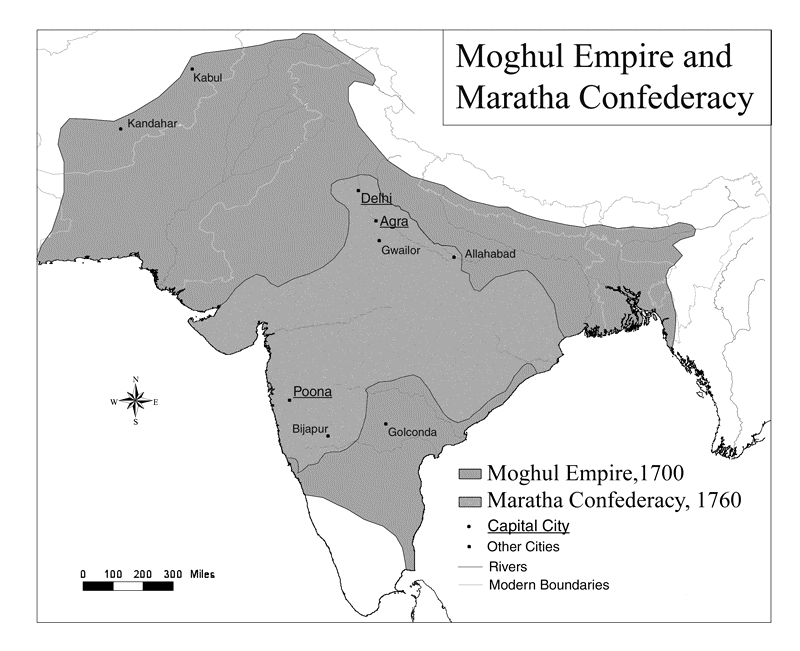
A sizable chunk of India was ruled by the Maratha Empire, sometimes referred to as the Maratha Confederacy, throughout the seventeenth and eighteenth centuries. The ascent of Chhatrapati Shivaji in 1674 marked the official start of the Maratha Empire. The Maratha Empire stretched from Thanjavur in the south to Peshawar in the north at its height. Before their debauchery in the early nineteenth century, the Marathas, who began as a warrior clan originating from the Deccan Plateau, controlled most of the Indian subcontinent.
The Maratha Empire exerted control over a significant portion of the Indian subcontinent during the 17th century. Its official establishment dates back to 1674 when Chattrapati Shivaji Maharaj was crowned, and it came to an end in 1818 following the defeat of Peshwa Bajirao II by the British East India Company.
Delve into the history of the first Muslim Empire of North India, the Delhi Sultanate.





Maratha Empire: A Timeline of Major Events
- 1630s–1650s | Shivaji’s rise: Shivaji began building an independent Maratha kingdom, capturing forts and territories in the Deccan and challenging Mughal and Bijapur authority.
- 1674 | Shivaji crowned: Shivaji was formally crowned Chhatrapati, marking the establishment of the Maratha Empire.
- 1680–1707 | Struggle after Shivaji: After Shivaji’s death, Sambhaji and later Rajaram continued resistance against the Mughals during a prolonged period of conflict.
- 1707–1740 | Rise of the Peshwas: After Mughal emperor Aurangzeb’s death, Shahu I became Chhatrapati, while the Peshwas increasingly took control of administration and military expansion.
- 1740–1761 | Maratha expansion: Under Peshwa Baji Rao I, the Marathas expanded rapidly across central and northern India, becoming a major political power.
- 1761 | Third Battle of Panipat: The Marathas suffered a major defeat against Ahmad Shah Abdali, temporarily weakening their influence.
- 1761–1790s | Recovery and expansion: The empire regained much of its influence under Peshwa Madhavrao I. Powerful chiefs such as the Scindias, Holkars, Gaekwads, and Bhonsles gained increasing autonomy.
- Late 18th century | Maratha Confederacy: The empire evolved into the Maratha Confederacy, a loose alliance of powerful regional states rather than a tightly centralised empire.
- 1802–1818 | Anglo-Maratha Wars: Internal rivalries and conflicts with the British East India Company weakened Maratha power. The Third Anglo-Maratha War ended Peshwa rule.
- 1818 | End of Maratha rule: The defeat of the Marathas marked the effective end of the Maratha Empire and its political dominance.
History of the Maratha Empire
The Marathas were an Indian warrior tribe that spoke Marathi and hailed primarily from what is now the state of Maharashtra. Several Islamic countries dominated subcontinental politics in the seventeenth century, with the Mughal Empire ruling most of northern India.
Five Deccan sultanates ruled over the Deccan region of central India, but by the 1630s, only three—Ahmadnagar, Golconda, and Bijapur—were still in power. A Maratha general named Shahaji Bhosale worked for these sultanates.
Shivaji Maharaj, a renowned warrior king, established a lasting legacy as the founder of the Maratha Empire in the 17th century. On 6 June 1674, he assumed the throne as the Chhatrapati, the "supreme sovereign," with great pomp and show.
According to the Hindu calendar, his coronation took place on the 13th day (Trayodashi) of the first fortnight of the month of Jyeshtha in the year 1596. This significant event not only marked his formal ascension to kingship but also symbolized the recognition of the Maratha Empire as a sovereign and independent entity.
Chhatrapati Shivaji Maharaj's coronation was a pivotal moment that laid the groundwork for the future of the Hindu Empire, strengthening its power and ensuring its enduring heritage. As we celebrate the 350th anniversary of Chhatrapati Shivaji Maharaj's coronation, known as the 'Shivrajyabhishek Sohala' in the Shiva Shaka calendar, we honor his remarkable accomplishments and profound contributions to the establishment of the Hindu Kingdom.
During the ceremony, Shivaji was formally crowned as the Chhatrapati ("paramount sovereign") of the Maratha Empire.
The Maratha Empire, which was a prominent power in India from the late 17th to the early 19th century, had several notable rulers. Here's a list of some significant Maratha kings:
Shivaji Maharaj (1630–1680): The founder of the Maratha Empire and considered one of the greatest warriors and strategists in Indian history.
Sambhaji Maharaj (1657–1689): The eldest son of Shivaji Maharaj, who succeeded him as the second Chhatrapati (emperor) of the Maratha Empire.
Rajaram Maharaj (1670–1700): Son of Shivaji Maharaj and younger brother of Sambhaji Maharaj, who became the third Chhatrapati after the death of his brother.
Shahu Maharaj (1682–1749): Grandson of Shivaji Maharaj, who succeeded Rajaram Maharaj as the fourth Chhatrapati and played a significant role in the expansion and stabilization of the Maratha Empire.
Peshwa Baji Rao I (1699–1740): The first Peshwa (prime minister) of the Maratha Empire under Chhatrapati Shahu Maharaj. He was a brilliant military leader and administrator.
Peshwa Balaji Baji Rao (Nana Saheb) (1721–1761): Also known as Nana Saheb, he was the son of Peshwa Baji Rao I and served as the Peshwa after his father's death.
Peshwa Madhavrao I (1745–1772): The son of Peshwa Baji Rao I and one of the most capable rulers of the Maratha Empire. He initiated reforms and stabilized the empire after a period of turmoil.
Peshwa Narayanrao (1755–1773): The son of Peshwa Madhavrao I, who briefly became the Peshwa but was assassinated at a young age, leading to a succession crisis known as the Narayanrao Peshwa Murder Case.
Peshwa Madhavrao II (1774–1796): The posthumous son of Narayanrao, who became the Peshwa under the regency of Nana Fadnavis. He faced significant challenges from both internal dissensions and external invasions.
The House of Shivaji
The history of Maratha Empire begins with Shivaji, who transformed a regional power in the Deccan into an independent kingdom. The son of Shahaji Bhonsle, Shivaji captured his first fort at Torna in 1645 and steadily expanded his territory by taking forts from the Bijapur Sultanate and challenging Mughal authority. His vision of Hindavi Swarajya, or self-rule, became central to his state-building.
Through military innovation, strategic fortifications, and a strong administrative system, Shivaji established a durable kingdom with Raigad as its capital. In 1674, he was formally crowned Chhatrapati, marking a defining moment in Maratha history.
After Shivaji's death in 1680, his son Sambhaji continued the struggle against the Mughals. Captured and executed by Aurangzeb in 1689, Sambhaji was succeeded by his half-brother Rajaram. The prolonged Mughal-Maratha conflict continued until Aurangzeb died in 1707, ultimately leaving the Marathas stronger and the Mughal Empire weakened in the Deccan.
The Peshwa Era
The next major phase in the history of Maratha Empire began after Shahu, Shivaji's grandson, was released from Mughal captivity in 1707. Shahu appointed Balaji Vishwanath as Peshwa in 1713, beginning the rise of the Peshwas as the empire's most powerful political and military leaders.
Under Peshwa Baji Rao I, appointed in 1720, the Maratha Empire expanded rapidly across the Indian subcontinent. Maratha armies moved into Malwa and Gujarat, reached Delhi in 1737, and extended Maratha influence deep into northern India. The empire's growing power was supported by systems such as chauth, a tribute traditionally set at one-fourth of revenue in territories under Maratha influence.
By the mid-18th century, the Marathas had become one of the most powerful forces in India. The Maratha Empire kings remained important symbols of sovereignty, but real political authority increasingly rested with the Peshwas.
The Third Battle of Panipat
Maratha expansion into northern India brought them into direct conflict with Ahmad Shah Durrani, the Afghan ruler who sought to reassert his influence in the region. On 14 January 1761, the Marathas and Durrani's forces fought the Third Battle of Panipat, one of the bloodiest battles in 18th-century Indian history.
The Marathas suffered a devastating defeat, losing a large part of their army and many senior commanders. The setback temporarily halted their northern expansion and exposed divisions among potential Indian allies. However, Panipat did not end the Maratha Empire. Within a few years, the Marathas rebuilt their power and recovered much of their influence under Peshwa Madhavrao I.
Retrace the history of the first major dynasty of north India, the Mauryas.
The Rise of the Maratha Confederacy
After Panipat, Peshwa Madhavrao I played a crucial role in restoring Maratha power. However, the growing autonomy of powerful chiefs gradually transformed the centralised Maratha Empire into the Maratha Confederacy.
Major houses such as the Scindias of Gwalior, Holkars of Indore, Gaekwads of Baroda, and Bhonsles of Nagpur controlled their own territories while recognising the Peshwa's broader authority. After Madhavrao's death in 1772, internal rivalries further weakened central control, making the Confederacy increasingly decentralised.
The Anglo-Maratha Wars
The final chapter of Maratha history was shaped by three conflicts with the British East India Company. The First Anglo-Maratha War (1775–1782) ended with a Maratha victory and demonstrated that British expansion could still be resisted.
The Second Anglo-Maratha War (1803–1805), however, proved far more damaging. British intervention in Maratha politics and rivalries among the major chiefs allowed the Company to defeat several leading Maratha powers and seize substantial territory.
The Third Anglo-Maratha War (1817–1818) brought the history of Maratha Empire to a close. The British defeated Peshwa Baji Rao II and dismantled the Peshwa's political authority. In 1818, Maratha sovereignty was effectively ended, although some former Maratha territories, including Baroda and Indore, continued as princely states under British paramountcy.

Maratha Legacy
The Maratha Empire was renowned for creating a well-functioning administrative structure and for strongly promoting trade and agriculture. It was also renowned for constructing many forts on India's western coast and a potent navy under Kanhoji Angre. Following the Indian independence movement, Hindu nationalists defined the Marathas as champions of Hindu nationalism against Mughal oppression, and they placed great emphasis on Shivaji and the Maratha kingdom.
Sari-i-Naubat (Senapati) - The supreme military commander
Peshwa - Head of financial and administrative matters
Dabir - Overseer of foreign relations
Panditrao - Leader of religious affairs
Nyayadhish - Head of the judicial system
Amatya - Manager of state finances and expenditures
Surunavis or Chitnis - King's aide in official communication
Waqenavis - Manager of personal and family affairs
Shivaji Maharaj's kingdom was organized into various provinces for taxation and administration. Each province was further divided into Parganas and Tarafs, with the village being the smallest unit. Shivaji put an end to the practice of leasing out land revenue, and instead implemented the direct collection of taxes from the ryots by state officials.
Conquered territories were divided into provinces known as prants, each of which had subedar officers under the command of a sarsubedar. The district was overseen by a Havaldar. Provinces were further divided into Tarafs (districts).
Within the district, there were sub-districts known as Parganas, with Deshpande and Deshmukh serving as the officers in charge of law and order. The Parganas were further divided into villages, including Mauza, Kulkarni, and Patil, each with its own law and order officers.
Guerrilla warfare was honed by the Marathas, who employed it successfully against the Mughals. It has been said that the repair of several temples, like the Saptakoteshwar Temple in Goa, is proof of the Marathas' struggle for Hindu independence. Although the Maratha empire was frequently depicted as a disorganized military organization, its true essence was revolutionary. It did bring about some significant improvements that were started by the brilliant creator, the renowned Shivaji.
- Since Shivaji, the empire's founder, held these principles to be crucial, religious tolerance and pluralism were significant foundational elements of the nation-state from the outset.
- The caste system was not followed by the Maratha Empire, which made it distinct.
- Since its founding, the Maratha Empire had a large number of gifted individuals in its leadership, making it one of the most socially mobile empires. Observe that the Peshwas of the Bhatt dynasty were from ordinary origins, the rulers of Gwalior and Baroda were from ordinary peasant families, the king of Indore was a Dhangar, a shepherd, and Haider Ali Kohari, Shivaji's most trusted secretary, came from an ordinary household.
- Large areas were under the Marathas' military rule. Their policy of religious tolerance served as a crucial check on the growing Mughal influence by giving Hindu interests equal weight.
Important Maratha Empire UPSC Notes
- According to certain historians, the Maratha Navy was instrumental in transforming maritime combat and establishing the groundwork for the Indian Navy.
- The Marathas constructed almost all of the hill forts that dot the terrain of modern-day western Maharashtra.
- The Peshwas of Pune made major improvements to the town in the eighteenth century by erecting bridges, dams, and an underground water delivery system.
- It has been reported that Queen Ahilyabai Holkar was a righteous monarch and ardent supporter of religion. She is recognized for creating and maintaining a large number of temples in Maheshwar, Madhya Pradesh, as well as other parts of North India.
- The Maratha dynasty, which ruled Tanjore (modern-day Tamil Nadu) for a long time, remembered as the city's golden age, was known for its support of the arts. During their reign, culture and art reached unprecedented heights.
- The Maratha chiefs constructed some magnificent palaces, such as the Shaniwar Wada (built by the Peshwas of Pune).
Important Rulers
- Shivaji: In addition to founding the empire, Shivaji was in charge of elevating the Maratha authority to a position of prominence.
- Sambhaji: Following Shivaji's death, Sambhaji, his eldest son, took the throne and carried on his father's territorial expansion.
- Shahu: The Maratha Empire greatly expanded during Shahu's rule, who was also in charge of establishing Peshwa control.
- Tarabai Bhosale: Tarabai presided over the Empire as regent from 1700 till 1708. Much of her credit for preventing the Mughals from entering the region comes from her husband, Chhatrapati Rajaram Bhosale, who passed away.
- Peshwa Balaji Vishwanath: In the eighteenth century, Balaji Vishwanath emerged as the Empire's sixth prime minister. The Maratha Empire grew northward during his tenure.
- Baji Rao: Baji Rao carried on the Maratha Empire's expansion. Throughout the whole of his brilliant military career, which lasted two decades, Baji Rao never lost a fight.
- Balaji Baji Rao: Also known as Nana Saheb, he served as the Empire's most significant prime minister during a time when the real king was reduced to a symbolic role.
- Madhav Rao I: The Empire's fourth Peshwa was Madhav Rao I. At a pivotal moment, following the Marathas' defeat in the Third Battle of Panipat, he became a Maratha Peshwa. Thus, before the British eventually destroyed the empire, Madhav Rao I was mostly in charge of its reconstruction.
Maratha History: FAQs

Who was Chhatrapati Shivaji Maharaj?
Born into a family of administrators, Chhatrapati Shivaji Maharaj was born at Shivneri, a hill fort near Junnar, Poona. His father, Shahji Bhonsale, served in the Bijapur Sultanate's army, while Jijabai, his mother, was a fervent religious follower. As one of the most courageous kings of 17th-century India, Shivaji established the Maratha kingdom.
Before the Delhi Sultanate period, the Gupta Empire took the lead in promoting India's art and architecture.
Why did the three Anglo-Maratha wars happen?
The Anglo-Maratha Wars were three territorial wars fought in India between the Maratha kingdom and the British East India Company. The main causes of the wars were the internal Maratha power struggle and the growing interference of the British in both internal and external Maratha affairs.
Summarise with AI:
Did you like this article? Leave a rating!

 Loading...
