
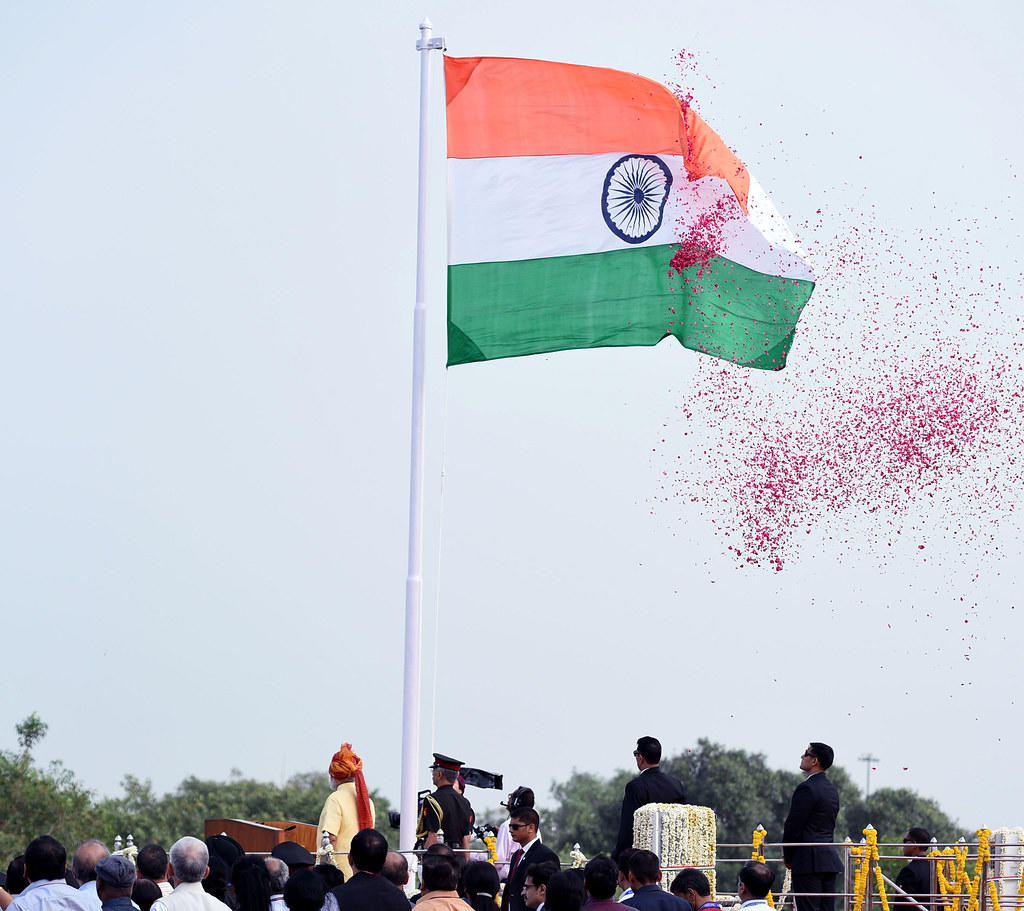

Red Fort is one of India’s most important historical monuments and a powerful symbol of the country’s independence. Built by Mughal Emperor Shah Jahan in the 17th century, the fort served as the main residence of Mughal rulers for nearly 200 years. Today, it holds deep national significance because the Prime Minister of India hoists the national flag there every year on Independence Day and addresses the nation. The Red Fort represents India’s history, freedom struggle, and national unity.
Independence Day is a national holiday in India that is observed every year on August 15th. Independence Day signifies the termination of British dominion in 1947, facilitated by the Indian Independence Act of July 18th in the same year, and the formation of a sovereign and autonomous Indian state. Additionally, it commemorates the anniversary of the division of the subcontinent into two nations, India and Pakistan, which took place at midnight on August 14–15, 1947. In Pakistan, Independence Day is commemorated on the 14th of August.
Independence Day in India is celebrated with flag-hoisting ceremonies, military parades, patriotic songs, and cultural programmes across the country. At the Red Fort, the Prime Minister hoists the national flag and addresses the nation. Kite flying is also a popular tradition, while government buildings in New Delhi are illuminated to mark the occasion.



India's Journey to Freedom at Midnight
Jawaharlal Nehru's speech, which began with the words "At the stroke of the midnight hour, when the world sleeps…", signified the commencement of India's independence. At the break of day, the members of the Constituent Assembly stood up and vowed to devote themselves to the service of a fresh India. Hansa Mehta, an educator and women's rights champion from Gujarat handed the national flag of India to President Rajendra Prasad on behalf of the women of India. Freedom warrior and politician Sucheta Kriplani performed the national anthem.

India's struggle for independence, which liberated one-seventh of the world's population on 15 August 1947, spanned several decades and stands apart from other liberation movements in one defining way: it was largely nonviolent.
While some revolutionaries advocated armed conflict, most independence fighters followed Mahatma Gandhi's philosophy of nonviolent resistance. The movement gained significant momentum after Gandhi's return from South Africa, where his work as an activist and lawyer had left a lasting mark. It began taking concrete shape in the latter half of World War I, building on earlier nationalist efforts.
Of the many events, campaigns, and tragedies that shaped the struggle, five moments stand out as particularly pivotal.
Formation of the Indian National Congress (1885)
The groundwork for organised resistance was laid in December 1884, when British civil officer Allan Octavian Hume convened a gathering in Madras with 17 others. This led directly to the founding of the Indian National Congress (INC) on 28 December 1885. It was established to give educated Indians a platform to engage politically with the British administration. What began as a narrow forum gradually grew into a mass movement — and a launching pad for towering figures like Mahatma Gandhi and Jawaharlal Nehru.
The Jallianwala Bagh massacre (1919)
Following World War I, resentment toward British rule was rising — the colonial government was reluctant to share power with Indians. Punjab saw widespread unrest in April 1919, prompting authorities to ban public gatherings.
On 13 April, Brigadier General REH Dyer ordered his troops to open fire on a crowd of roughly 10,000 unarmed men, women, and children assembled at Jallianwala Bagh in Amritsar.
The exact death toll remains disputed — estimates range from several hundred to around 2,000.
The massacre shocked the nation and exposed the brutal character of British rule.
It convinced many Indians that colonial authority had to be ended.
The Non-Cooperation Movement (1920–22)
Launched by Gandhi, this was one of the first large-scale campaigns for swaraj — self-governance for all Indians. It drew directly on his principles of satyagraha and organised civil disobedience.
What the movement involved
- Boycott of British-run institutions — colleges, courts, and offices
- Surrender of titles conferred by the colonial government
- Refusal to pay taxes
While it fell short of all its goals, it awakened mass political consciousness across India — for many, their first experience of a modern political movement.
The Dandi March (1930)
On 12 March 1930, Gandhi set out from Sabarmati Ashram in Gujarat on a 24-day march to the coastal town of Dandi — in protest against the British salt tax levied on an everyday necessity.
- Tens of thousands joined the march.
- It became one of the most significant acts of civil disobedience in world history.
- It triggered a wave of sustained, nationwide opposition to colonial rule.
The Dandi March was a carefully chosen act of symbolic defiance. By targeting something as basic as salt — taxed by a foreign power — Gandhi turned an everyday grievance into a rallying point for the entire nation.
Subhas Chandra Bose and the INA (1942)
While Gandhi pursued nonviolent resistance, Subhas Chandra Bose took a different path. In 1942, he assumed leadership of the Azad Hind Fauj — the Indian National Army (INA) — and allied with Japan to militarily challenge British rule.
- Historians debate the INA's battlefield impact.
- Its moral and political effect, however, was undeniable.
The 1945 trials of INA officers at the Red Fort dramatically shifted public opinion against the British government. By mid-1946, British authorities recognised that Indian troops were growing restless — and that full independence could no longer be delayed.
Why is Independence Day Celebrated in the Red Fort?
India celebrates its Independence Day every year on August 15 by raising the national flag at the famous Red Fort in Delhi. This significant tradition, established by Prime Minister Jawaharlal Nehru, bears great importance in India's path to independence and freedom from colonial domination.
Historical Significance of Red Fort
The Red Fort, commonly referred to as "Lal Qila" in Hindi, was built under the rule of the Mughal Emperor Shah Jahan. The construction of the building commenced in 1638 and concluded in 1648. The purpose of its creation was to serve as the primary abode for the Mughal emperors. The Red Fort is an exemplary display of Mughal architecture, distinguished by its red sandstone walls and elaborate marble embellishments. The architecture has elements from Persian, Timurid, and Indian styles. In 2007, the Red Fort was officially recognized as a UNESCO World Heritage Site. It is acknowledged for its historical and cultural importance and its excellent architectural craftsmanship.

The Red Fort under British rule
After suppressing the Rebellion of 1857, the British took full control of the Red Fort — but at great cost to its heritage.
- Its magnificent features were dismantled and its Mughal cultural legacy largely erased.
- The fort was repurposed as a British garrison.
Despite reducing Delhi's practical importance, the British acknowledged its deep symbolic weight. The Delhi Durbars and the decision to shift the imperial capital from Calcutta to Delhi both underscored the city's unrivalled political significance.
Delhi as a center of power
From the Delhi Sultanate through the Mughal Empire, Delhi served as the nerve center of subcontinental authority.
- The Red Fort became synonymous with sovereign power.
- Mughal rulers commanded their empire from within its walls.
Even as Mughal authority waned, their association with Delhi gave them symbolic credibility — they continued to be regarded as the supreme rulers of India in name, if not in practice.
The rebellion of 1857
The 1857 Rebellion brought the Red Fort's symbolic power into sharp relief.
- Rebels rallied around the elderly Mughal Emperor Bahadur Shah Zafar.
- The fort became a focal point for indigenous resistance against British rule.
- Its significance as a seat of local authority was firmly re-established.
The INA Trials: Trials that ignited nationalism
Officers of the Indian National Army (INA) were tried for treason at the Red Fort. Rather than undermining nationalist sentiment, these trials galvanised it — cementing the fort as an enduring symbol of defiance against British colonial rule.
Independence and reclamation
As India moved toward independence, the Red Fort took on new meaning.
- Jawaharlal Nehru chose to hoist the national flag at the Red Fort on 15 August 1947.
- The act was a deliberate reclamation of a space long held by colonial power.
- It signaled India's assertion of sovereignty and the culmination of its independence struggle.
Celebration of Independence Day Red Fort
Annually, the Indian Prime Minister unfurls the Indian flag at the Red Fort on Independence Day. Subsequently, the Honourable Prime Minister makes a speech in which he expresses gratitude towards the people of India, recognizing their sacrifices, successes, difficulties, and the government's vision for the country. Raising the national flag symbolizes the progress of the country as a sovereign nation and marks the conclusion of British governance. The ceremony held in the Red Fort serves as a means to commemorate and show respect to the freedom warriors who made the ultimate sacrifice to secure India's independence.
The Independence Day event in the Red Fort includes exceptional cultural performances by performers from all regions of the country. These performances showcase the multifaceted cultural legacy of India via dance, music, and several other traditional art forms. These acts provide a dynamic and nationalistic atmosphere that intensifies the festive spirit of the gathering.
India will commemorate its 80th anniversary of Independence Day on August 15, 2026. The 80th Indian Independence Day in 2026 will be themed as 'Viksit Bharat,' reflecting the government's goal of turning India into a Developed Nation by 2047, which coincides with the 100th anniversary of Independence. This ambitious vision aims to enhance India's worldwide position by focusing on holistic development in several sectors, including infrastructure, technology, education, and healthcare. The theme emphasizes the dedication to promoting economic expansion, societal advancement, and environmentally responsible progress, cultivating a society where all individuals may prosper. This statement embodies the shared desire to construct a successful, inclusive, and resilient India, which acknowledges its rich legacy while embracing contemporary achievements.
Summarise with AI:
Did you like this article? Leave a rating!


 Loading...
