

Every civilization has its origin stories. The ancient Egyptians worshipped Ra, the sun god. Thor was the Norse god of thunder. Arianrhod was the Celtic goddess of the moon and stars. China is no different, and its creation myths fit right into that company.
What sets Chinese mythology apart is how its gods work: how reachable they are, how long their stories run, and how many of them there are. There are only a few true creator-gods, but the wider pantheon is huge. Folk tradition counts well over a thousand deities, and almost every one of them has a job to do. Before we get to who's who, here is a quick roll-call of the figures you'll meet below.
- Pangu, the first being, who pulled heaven and earth apart.
- Nuwa and Fuxi, the sister and brother who made the first people.
- Shangdi, the supreme "Lord Above" of classical Chinese theology.
- Tian, the formless heaven that rules over gods and people alike.
- Huangdi, the Yellow Emperor and mythical founder of Chinese civilization.
- The Jade Emperor, who runs Heaven like a royal court.
- Nezha, the rebellious boy-god and patron of the young.
- The Eight Immortals (Ba Xian), mortals who earned their place among the gods.
- Caishen, the red-robed God of Wealth.
Planning a trip to China, or just curious? Read on to see how these beliefs still shape religion and folk life in China today.
Key Takeaways
- Chinese mythology blends Buddhist, Taoist and Confucian traditions into one shared inheritance.
- The core creation myths tell how Pangu, Nuwa and Fuxi made the world out of chaos and nothing.
- Chinese gods feel human. They get angry and lonely, and many of them were once living people who were later worshipped as gods.
- The pantheon is enormous, and each god has a clear job, from guarding wealth to helping students pass exams.
- Mythology is still part of daily life in China, shaping festivals, rituals and even blockbuster films.


Creation: Pangu, Nuwa and Fuxi
In the beginning there was nothing, just a formless dark. Out of it came an egg, and the egg sat there for 18,000 years while Yin and Yang, the two opposing forces, slowly came into balance. When they finally did, Pangu hatched out. He took up a giant axe and went to work building the world. One swing sent the heavy Yin tumbling down to form the earth, while the lighter Yang drifted up to form the sky. Pangu wedged himself between them and held them apart. When he died, the pieces of his body became the world we know: his eyes turned into the sun and moon, his breath into the wind, his blood into the rivers.
In the I Ching, Yin is drawn as a broken line and Yang as a solid one. These are the building blocks of Fuxi's eight trigrams.
Other versions give the credit to Nuwa, the mother-goddess, and her brother Fuxi. The story goes that Nuwa was lonely, so she shaped little figures out of yellow earth. When making them one by one got too slow, she dipped a string in the mud and flicked it around her. The figures she shaped by hand became the nobles, and the drops flung from the string became everyone else. Nuwa is also the one who repaired the sky after the Pillars of Heaven collapsed, patching the hole and cutting the legs off a giant turtle to prop up the heavens. Fuxi, usually shown with a human head and a snake's body, is remembered as the wise sage who gave people the eight trigrams (bagua), writing, and the first farmed animals.
Who Is the Main God of China?
If any Chinese god deserves to be called a creator, it's Shang Di. He first turns up in writing around 700 BC, but the stories about him go back much further, to the Shang dynasty (roughly 1760 to 1050 BCE).
Also known as Di, Shangdi is the supreme deity or "Lord Above" of classical Chinese theology, and is equivalent to the later concept of Tiān, meaning "Heaven" or "Great Whole".
"Shang Di" is the romanization of two Chinese characters. The first, "Shàng", means high, highest, first, or primordial. The second, "Di", is usually read today as shorthand for "Huangdi", the imperial title first used by Qin Shi Huang about 2,200 years ago and normally translated as "emperor". The word itself comes from the Three "Huang" and Five "Di", a group that includes the Yellow Emperor, the mythical founder of Chinese civilization and ancestor of the Chinese people.
Tian
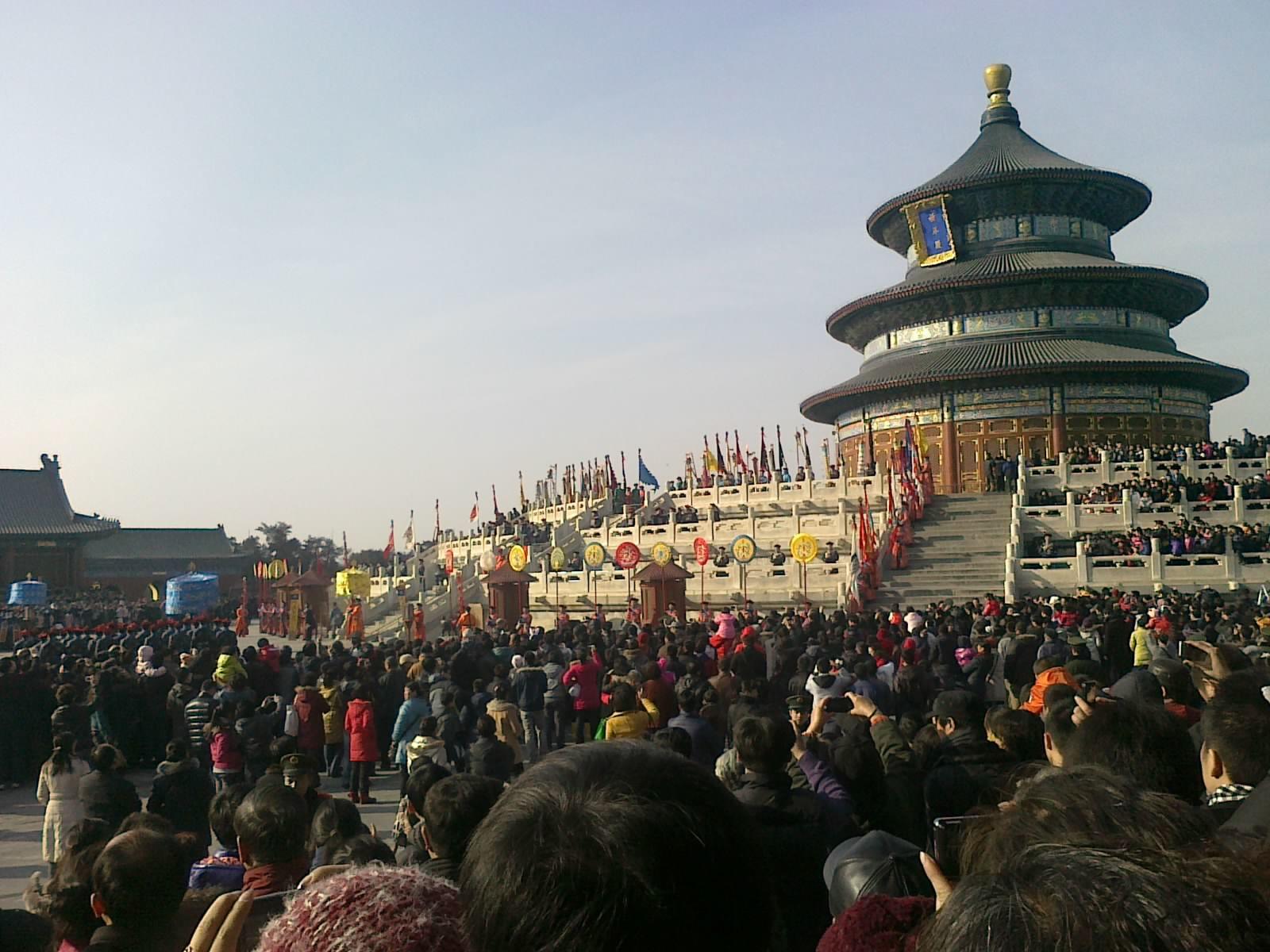
Tian is the god who rules over the lesser gods and over people too. Unlike Shang Di, Tian has no human form at all. The word simply means "heaven", while Shang Di points to the Supreme Ancestor. Somewhere in the Zhou dynasty the line between the two started to blur, until naming Tian came to mean the celestial father as well. For a long stretch people worshipped them as a single being, and that is the idea behind the Temple of Heaven in Beijing.
The Emperors Who Became Gods
Chinese mythology has far fewer purely cosmic gods than most creation myths do. A lot of its most respected figures aren't really gods in the strict sense. They stand for benevolence, good deeds and strong leadership, which is why people worship them. Think of them as something close to saints: real people whose lives everyone was meant to look up to. They are:
- Shaohao, leader of the so-called Eastern Barbarians. A son of the Yellow Emperor, he reigned around 2600 BC.
- Zhuanxu, grandson of Huang Di, the Yellow Emperor.
- Emperor Ku, nephew of Zhuanxu and great-grandson of the Yellow Emperor.
- Yao, Emperor Ku's second son. His elder brother was forced to step aside because he made a weak ruler.
- Shun, the man Yao handed his throne to, thanks to his unusual virtue and devotion.
Shun wasn't even related to Emperor Yao. Yao's own nine sons lived the high life, and he couldn't bring himself to leave power to any of them, so he asked his advisers who else might be fit to rule. They put forward Shun, who had worked his way through a string of government posts. Hang on, though. We're talking about emperors here, not gods. So what is Chinese mythology actually about?
The Yellow Emperor (Huangdi) counts as the emperor of all Chinese people, not only the Han. He stayed a symbol of unity even as dynasties rose and fell.
The Jade Emperor (Yu Huang)
The Jade Emperor stands for supreme authority and wisdom, and he's one of the most revered figures in Chinese mythology. He rules Heaven and presides over a court of important gods. His set-up looks a lot like an earthly government: it's split into bureaus, and each god is put in charge of one particular area. Reporting to him are the Four Heavenly Kings, the Big Dipper star gods, the city and earth gods, and right down to the household gods of the kitchen and the front door.
The Jade Emperor is a vegetarian. Even so, his devotees still bring animal sacrifices, on the logic that his guests would enjoy the food.
Nezha, the Rebel Boy-God
Nezha (say it Nuh-ja) is one of the best-known gods in Chinese mythology. He looks after the young, the misfits and, because he gets around on wheels of fire, professional drivers. His roots aren't actually Chinese. His name is a shortened version of the Sanskrit Nalakuvara, a yaksha prince who arrived in China through Buddhist scriptures during the Tang dynasty. Over time, Taoist and folk tradition adopted him and renamed him the "Third Lotus Prince" and "Marshal of the Central Altar".
Nezha was born to General Li Jing and his wife, Lady Yin, who had gone childless for years. When Lady Yin finally fell pregnant, the pregnancy was anything but normal. She carried the child for three years and six months, then gave birth to a glowing ball of flesh. Li Jing took it for a demon and slashed at it with his sword. The ball split open, and out stepped Nezha, already a fully formed boy with divine powers.
Nezha is hugely popular today. The 2025 animated sequel Ne Zha 2 pulled in over US$2 billion worldwide and became the highest-grossing animated film ever made.
His story turns on themes Indian readers will know well: devotion to one's parents, standing up to unfair authority, and rebirth. In one famous episode he gives his flesh back to his mother and his bones back to his father, destroying his own body before a lotus brings him back to life. People often compare him to Krishna, since both are divine children with miraculous powers who refuse to fall in line.
Deities of the Tao and Buddha
When people say China has a religion, they usually mean Taoism, Buddhism or Confucianism. There's some truth to that. Each one has temples in every city, and people go there to pray and carry out rituals. But all three are closer to philosophies than religions. Kongzi (Confucius), Laozi and the Buddha were wise men, not gods or supernatural beings. There's a nice irony in it, too: these founders preached down-to-earth practicality rather than mysticism, and yet people pray to them as if they were mystics.
The mythical figures in Chinese belief each grant their own kind of favour, and none of them has powers across the board. So you have to know who you're asking. Praying to Guan Yin, a Buddhist goddess, is a plea for mercy and compassion. Making an offering to Xi Wang-Mu, who belongs to the Taoist side, means you're hoping for a long life.

The Eight Immortals (Ba Xian)
The Eight Immortals are some of the most popular figures in Chinese religion. Like other Taoist gods, most of them were real people, born in the Tang or Song dynasty and raised to immortal status through their own piety, cleverness or luck. They almost always appear as a group rather than alone, and the number eight isn't random, since eight is considered lucky. The group includes Zhongli Quan, the senior member; Lü Dongbin, a Taoist master; Li Tieguai, the "Iron-Crutch Li", an ascetic famous for his astral journeys; and He Xiangu, the only woman among them.
Caishen, the God of Wealth
If you've ever been to a Chinese New Year celebration, you've probably seen a figure in a red robe handing out fortune. That's Caishen, the God of Wealth. He's one of the most popular gods in Taoist belief, usually shown riding a black-and-white tiger and carrying a cudgel that can turn a plain rod into solid gold.
So, How Many Gods Are There?
The honest answer is that nobody can give you a precise number. Chinese belief doesn't work like the Abrahamic religions, where there's a clear chain of command. Some gods matter more than others, sure, but one rarely outranks another outright. The pantheon stretches across thousands of years, many ethnic groups and changing borders, and since ordinary people can be made into gods for great deeds, it never stops growing. Depending on where you draw the line, you might count a handful of creator-gods, or over 200 named deities in the classical pantheon, or well past a thousand once you add in every local and household god.
Here are the major foundation deities that hold the whole thing together:
| Deity | Role | Significance |
|---|---|---|
| Pangu | Creator of the universe | Pulled heaven and earth apart. His body became the elements. |
| Nuwa | Creator of humanity | Moulded people from clay and patched up the broken sky. |
| Shang Di | Supreme emperor | The god in heaven. Never shown as a being in the texts. |
| Tian | Heaven itself | A formless force standing for the sky and heaven. |
| Huang Di | The Yellow Emperor | The first ruler, and proof that emperors rule by divine right. |
Whether the real figure is five or five thousand, life is richer for the kings, gods and stories people believe in. Nowhere shows that better than China, the supposedly godless country that somehow has a god for everything, from justice (Gao Yao) to passing exams (Kui Xing), from Gong Gong the Water God to Tu Di Gong, god of the earth.
Summarise with AI:
Did you like this article? Leave a rating!

 Loading...
I like laughing buddha god