
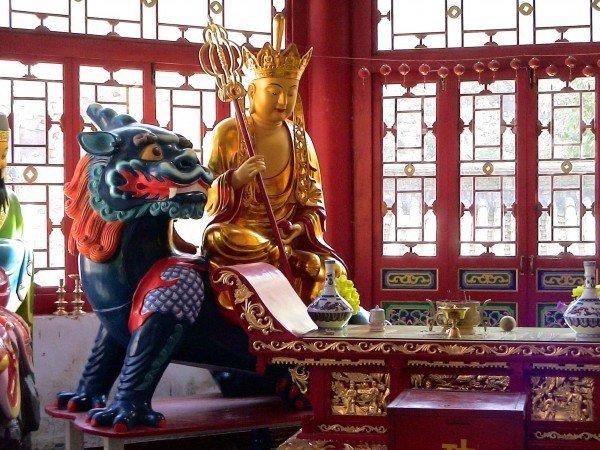

China is often thought of as a country with no religion. That's not true; the Chinese people are fully religious, just not in the way that we are. They may be more religious than we are if you count every god, goddess and deity in their pantheon. Furthermore, China boasts a substantial Muslim population and, with increased exposure to Western cultures, interest in Christianity is growing by leaps and bounds.
There is even a small Jewish population in China; they've been there since around 800 CE. Authentic Chinese gods are nothing like the omniscient, omnipotent God revered in Abrahamic religions. By comparison, the gods of China are pretty hands-off. Still, for operating under such limitations, Chinese mythology's gods are an amazing bunch.
How Many Gods Are There In Chinese Mythology?
There are over 1,000 gods and goddesses in Chinese mythology, encompassing a wide array of deities across various contexts and religions.
Additionally, 200 deities are particularly well known and worshipped, while some sources mention as few as 5 main gods for specific mythological significance.


Creation Myth Gods
People of deep faith tend to resent the term 'creation myth' because it feels like their beliefs are being mocked. Using this phrase, we don't intend to disrespect anyone's beliefs, no matter what they are.
(Chinese: 上帝; pinyin: Shàngdì; Wade–Giles: Shang Ti)
Shangdi, also known as Di, is the name of the supreme deity or "Lord Above" in classical Chinese theology, particularly in Shang theology, and is equivalent to the later concept of Tiān, meaning "Heaven" or "Great Whole".
Every civilization has its origin stories. The Ancient Egyptians worshiped the Sun god Ra, Thor was the Norse god of thunder and Arianrhod is the Celtic goddess of the moon and stars. In this sense, every society has its creation myths so China's mythology fits right in.
Where it differs is in the gods' accessibility, longevity, and number. Chinese mythology has far fewer gods than most other creation myths - five, to be specific.
Shangdi
If any of China's gods could be called a creator, Shang Di would be. He makes his first appearance in literature around 700 BC; stories involving him date much further back - specifically, the Shang dynasty (ca. 1760 - 1050 BCE).
"Shang Di" is the pinyin romanization of two Chinese characters. The first character, "Shàng", means "high", "highest", "first", "primordial"; the second character, "Dì", is typically considered as shorthand for "Huangdi" in modern Chinese, the title of the emperors of China first employed by Qin Shi Huang, roughly some 2200 years ago, and is usually translated as "emperor".
The word itself is derived from Three "Huang" and Five "Di", including the Yellow Emperor, the mythological originator of the Chinese civilization and the ancestor of the Chinese race.
However, "Dì" refers to the High God of Shang, thus means "deity" (manifested god). Thus, the name Shangdi should be translated as "Highest Deity", but also has the implied meaning of "Primordial Deity" or "First Deity" in Classical Chinese.
The deity preceded the title and the emperors of China were named after him in their role as Tianzi, the sons of Heaven. In the classical texts the highest conception of the heavens is frequently identified with Shang Di, who is described somewhat anthropomorphically. He is also associated with the pole star. The conceptions of the Supreme Ruler (Shang Di) and of the Sublime Heavens afterward coalesce or absorb each other.
His name translates to Above Emperor; he is also called the God in Heaven. There are no drawings of him but written texts describe him well. He is male, compassionate and emotional, intellectual and just. No great feats are attributed to him. He fought no wars, he did not lead a people... the clearest picture we get of Shang Di is from texts written during the Han dynasty (206 BCE - 222 CE).
Tian
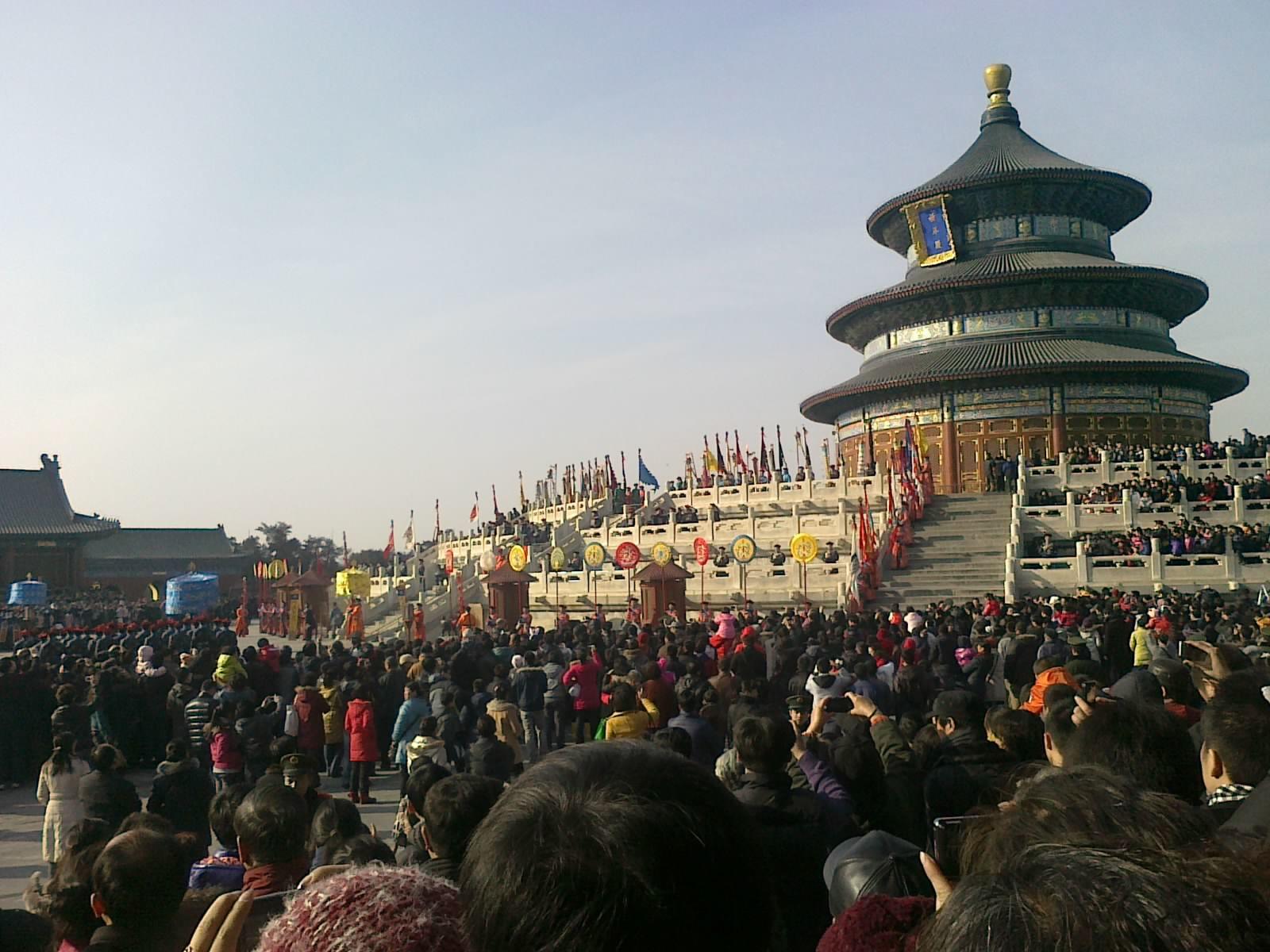
In direct contrast with Shang Di, Tian takes no human form. Literally translated, Tian is heaven - perhaps a more significant concept than in Western religions because, at some point in ancient history, the line separating Shang Di and Tian blurred to the point that referring to Tian implied the celestial father. For a time, they were both worshipped as a single entity; thus the inspiration for the Temple of Heaven in Beijing.
Tian (天) is one of the oldest Chinese terms for heaven and a key concept in Chinese mythology, philosophy, and religion. During the Shang dynasty, the Chinese referred to their highest god as Shangdi or Di. During the following Zhou dynasty, Tian became synonymous with this figure. Before the 20th century, worship of Tian was an orthodox state religion of China.
In Taoism and Confucianism, Tian (the celestial aspect of the cosmos, often translated as "Heaven") is mentioned in relationship to its complementary aspect of Di (often translated as "Earth").
They are thought to maintain the two poles of the Three Realms of reality, with the middle realm occupied by Humanity, and the lower world occupied by demons and "ghosts", the damned. Tian was variously thought as a "supreme power reigning over lesser gods and human beings" that brought "order and calm...or catastrophe and punishment", a deity, destiny, an impersonal force that controls events, a holy world or afterlife containing other worlds or afterlives, or one or more of these.
The word itself is derived from Three "Huang" and Five "Di", including Yellow Emperor, the mythological originator of the Chinese civilization and the ancestor of the Chinese race.
Nüwa
The mother goddess is credited with creating the human race. She was so lonely that she moulded yellow earth into human form, creating for herself a family of dolls. Realizing that she could populate the entire world but was unable to form each one, she raked the yellow earth with string, creating more people. As the story goes, those people she moulded became the nobles because they were created by the mother-goddess's hands. Nuwa also gets credit for repairing the Pillars of Heaven.
Nüwa is a mother goddess, cultural hero, and member of the Three Sovereigns in Chinese mythology. She is revered in Chinese folk religion, Buddhism, Confucianism, and Taoism. Nüwa is credited with creating humanity and repairing the Pillar of Heaven. As the creator of mankind, she molded humans individually by hand using yellow clay. In some stories, she only created nobles and the rich from yellow soil, while commoners were created from brown mud.
Heaven could no longer cover all of the earth and Earth could no longer hold up Heaven because the pillars were broken. All manner of disaster and tragedy unfolded: beasts ate children, rains flooded valleys... Nuwa first patched up heaven and then cut the legs off of a giant turtle to hold up the sky. She killed the black dragon that was tormenting the people of Ji and built dams to halt the floods. Odd how, even though China today is a patriarchy, their mythology includes a very skilled and hard-working woman.
Pangu
Now we meet the first corporeal creature in the pantheon of Chinese gods. Even more interesting is that certain aspects of his story parallel passages in the book of Genesis. In the beginning, there was a formless and primordial nothing. Of this nothing emerged an egg. For 18,000 years it waited, until Yin and Yang, those duelling energy forces were balanced. Once they were, Pangu emerged from the egg. Then, with his giant axe, he set about creating the world. One mighty swing sent the heavy Yin into freefall; it became the earth.
Pangu (盤古), a primordial figure in Chinese mythology and Taoism, is believed to have separated the heavens and the earth, with his body later transforming into various geographic features, including mountains and flowing water.
Yang, now free of the heavy weight of Yin, floated skyward. Pangu took up his station between them to keep them in their proper place. After another 18,000 years passed, Pangu met his end. As he was laid to rest, his left eye became the sun and his right one, the moon. His voice became the thunder and his breath, the wind. His body shaped the land, mountains and valleys. The fur covering his body became the trees, bushes and grass of the earth. His blood became the rivers. Pangu is a relative newcomer to the gods. He first appeared in the literature toward the end of the Han dynasty. Find out how to learn Mandarin London here.
Yu Huang
The Jade Emperor is a god of the Tao belief system. He's the ruler of heaven and earth, as well as the official deity of the human emperors. Because he is one of the most important gods, his court is full of gods and goddesses. To know why Chinese mythology is so important in everyday life, you must understand the Jade Emperor's large role in their creation myths.
Sovereigns and Emperors
Unlike Abrahamic religions, there is no hierarchy in the Chinese belief systems, even though it might seem so. True, some deities are granted more importance but seldom does one god or goddess pull rank on another one. One such exception may be Fuxi, Nuwa's companion and brother. When the great flood struck, the siblings fled to Kunlun Mountain to wait out the storm. When the waters receded, they asked the Jade Emperor for permission to marry.
Once permission was granted, they set about repopulating the earth. Fuxi is one of the Three Sovereigns, those gods one level down from the creator-gods. It's rumoured that he could shape-shift into a dragon but his actual deeds are far more mundane. He taught the people how to hunt and fish with nets, domesticate animals for farming and, quite apart from all of that, he taught them how to write. Fuxi is regarded today as more of a folk hero than a god even though he is formally among the Three Sovereigns of Chinese mythology. The other two are Shennong, the divine farmer who taught ancient people agriculture and medicine, and Huang Di, the Yellow Emperor, generally considered the country's first sovereign.
The Five Emperors
They are not necessarily considered gods but they are the embodiment of benevolence, good deeds and sterling leadership, thus deserving of worship. In comparison to our religious hierarchies, you might think of them as saints - once-living people whose deeds and characteristics everyone should aspire to emulate. They are:
- Shaohao - leader of the so-called Eastern Barbarians. A son of the Yellow Emperor, he reigned around 2600BC
- Zhuanxu - Grandson of Huang Di, the Yellow Emperor
- Emperor Ku - nephew of Zhuanxu and great-grandson of the Yellow Emperor
- Yao - Emperor Ku's second son. His elder brother was forced to abdicate because he was a weak ruler
- Shun-Yao surrendered his throne to Shun because of his extraordinary moral virtue and piety
Shun was not a blood relative of Emperor Yao, whose nine sons lived what we would call the party life. The emperor could not see leaving power to any of them so he asked his advisers who might qualify to succeed him. Shun, who had worked in various ministerial positions, was brought forth. Wait a minute! We're talking about emperors, not about any deity? What is Chinese mythology about, then?

Deities of the Tao and Buddha
When China is credited for having any kind of religion, it is generally Taoism, Buddhism and Confucianism that comes to mind. In some respects, that is correct: they each have a temple in every city and people go there to pray and perform rituals. However, they are all more philosophical than religious; Kongzi, Laozi and the Buddha were wise men, not supreme or supernatural beings. Ancient texts reveal that Confucius and Laozi may have even crossed paths! There is a delicious irony in the fact that the founders of these 'schools' preached pragmaticism, not mysticism and, yet, people pray to them as though they were mystics. Equally ironic is the idea that, although ancient literature proves that these were ordinary mortals who performed no miraculous deeds, nevertheless, their mythology has grown to include entire stables of gods and immortals.
Deities Associated with Taoism and Buddhism
You may pray at a Taoist or Confucianist temple and bow in front of the Buddha's statue but you have to know what you're praying for so your prayer can get to the right god.
Mythical figures in Chinese belief systems each have particular powers or license to grant certain favours but no god or goddess has wide-ranging powers. So, you have to know that praying to Guan Yin (a Buddha goddess) is a plea for mercy and compassion and making an offering to Xi Wang-Mu (associated with Taoism) means you hope for long life.
Confucius, though holding equal footing in China's mythology and more than one temple dedicated to him, has no associated gods. When people worship Confucius or light incense at his statue, they are venerating that great sage, not asking for help with anything. In some Confucian temples, they even let you bang a gong - usually if you donate, first. The human experience is richer and more profound for our belief in our kings, gods and mythologies. Nowhere is that more evident than in China, that supposedly godless country that has a god for everything from justice (Gao Yao) to sitting exams (Kui Xing); from Gong Gong the Water God to Tu Di Gong, god of the earth. Now learn all you need to know about Chinese mythology...
Summarise with AI:
Enjoyed this article? Leave a rating!

 Loading...
I like laughing buddha god