


Drums are the oldest musical instruments on earth — older than any melody, older than any written language. Found in virtually every human civilisation that has ever existed, the drum is the one instrument that belongs to no single culture and to all of them simultaneously. This article traces the full history of drums, from ancient skin-stretched pots to the modern drum kit, with a clear look at traditional drums and their origins across Asia, Africa, Europe, and India.


Major Traditional Drum Types and Their Origins – At a Glance
Before diving into the full history, here is a quick overview of the world's most significant traditional drums and where they come from:
- Modern Drum Kit – United States, assembled in the early 20th century through jazz and ragtime culture
- Frame Drum (Timbrel) – Mesopotamia and Egypt, attested from around 2700 BC; one of the earliest documented drum forms
- Cylindrical Double-Headed Drum – Ancient Egypt, found in the tomb of Djehuti-Baqt, circa 2000 BC
- Chinese Drum (Tao Gu / Gu) – China, earliest archaeological evidence dating to 5500–2350 BC, stretched with crocodile skin
- Kettle Drum (Nakers / Timpani) – Middle East, arrived in Europe via the Crusades in the 13th century
- Tabor (Snare Drum ancestor) – Medieval Europe, first documented use in Switzerland in 1386
- Davul / Bass Drum – Turkey, origins from at least the 14th century, came to Europe with the Ottoman Empire in the 18th century
- Djembe – West Africa (Mali Empire region), between 400 and 800 years old, carved from a single piece of hardwood
- Talking Drum – West Africa (Nigeria, Senegal, Ghana, Benin), an hourglass-shaped pitch-variable drum used for long-distance communication
- Tabla – Indian subcontinent, developed in the medieval period, now central to Hindustani classical music
- Mridangam – South India, one of the oldest drums in Asia, depicted in ancient temple sculptures
Who Invented the Drums?
The very first percussion instruments were probably clappers of some sort - literally two sticks to tap against each other. Over time, the sticks were flattened and even bound together to make crotales and castanets. One of the earliest instruments discovered to date is a type of rasp or skiffle made of incised mammoth bone. The find from Belgium dates to about 70,000 BC.
Even though these were definitely idiophones - or percussion instruments - they weren’t drums yet.
What is a drum?
It is impossible to say who first realised that tapping a stick against something hollow made a louder sound than simply clapping two sticks together.
Drums have a resonance chamber that amplifies the sound - something hollow, whether it be a pot, a gourd, or a hollowed-out piece of wood. Many drums also have a vibrating membrane made of stretched skins or similar. They can be hit with a small mallet (like the bodhran), drumsticks or the hands.
Learn also what a drum set consists of...
China: The Earliest Documented Drums
The earliest archaeological evidence of true drums comes from China. Drums from the Neolithic period, dating to between 5500 and 2350 BC, have been excavated and are believed to have been stretched with crocodile skin. This makes China the drums' origin country in terms of the oldest confirmed physical evidence.
Drums of Ancient Egypt and Mesopotamia
Some of the first archaeologically documented drums come from the early civilisations of Mesopotamia and Egypt. Rectangular frame drums called timbrels - a type of hand drum - are attested since 2700 BC.
Sumerian reliefs from around 2000 BC show large drums about man-high; two priests are sounding them. The earliest named drummer is a priestess named Maram-Sin from about 2280 BC. She served in the temple of the Moon in Ur.
All the Mesopotamian drums are played with the hands, as are the Egyptian drums. In the Nile valley, long drums slung around the shoulders sometimes appear in military parades; dancers and musicians play a frame drum about the size of a tambourine. An actual cylindrical double-headed drum was found in the tomb of Djehuti-Baqt from the Middle Kingdom, dating to around 2000 BC.
However, while these cultures probably had drums as early as the Neolithic Period, the earliest documented finds are from China, dating to 5500-2350 BC. They are stretched with crocodile skin.
Greek and Roman drums
Ancient Greece had frame drums (tympanum), that eventually morphed into the true tambourine in Rome of the 3rd century AD.
Oddly enough, the Romans never seem to have used any sort of kettle drum, only smaller hand drums. The only other percussion instrument they used was hand cymbals and their kin such as crotales.
Are you interested in learning more about modern drum kits?
In ancient Aztec and Mayan civilisations, drums called huehuetl and teponaztli were considered sacred objects — breaking one was punishable by death.
History of Drums Timeline
Medieval and Renaissance Period (500 AD – 1700 AD)
Most of the drum types we still play today were either invented or fundamentally reshaped during the Middle Ages. The Crusades acted as a major channel of cultural and musical exchange, bringing new instruments from the Middle East into European hands.
Most of the major types of drums we play today originated in the Middle Ages or shortly thereafter. Many a new type of musical instrument came from the Middle East, brought back from the Crusades.
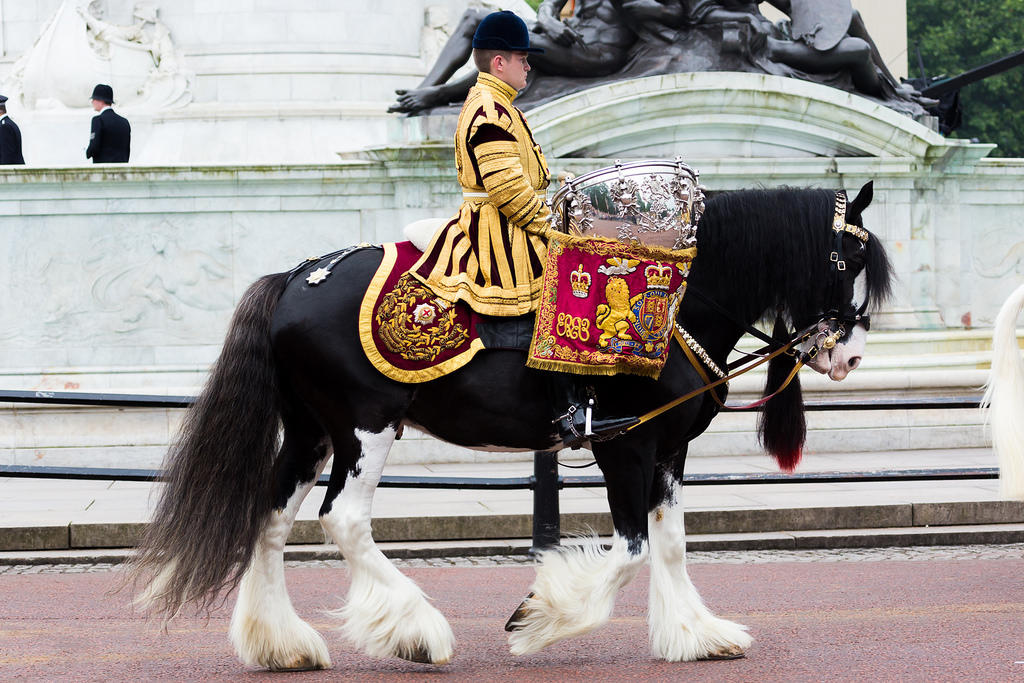
Kettle Drums (Nakers)
The ancestors of the modern orchestral timpani originated in the Middle East, likely as developments of pot drums — ceramic pots with skins stretched over the opening. They arrived in Europe as pairs called nakers during the 13th century. Screw tensioning was added around the 16th century, when kettle drums became a popular pairing for trumpets. By the 17th century, composers were writing increasingly elaborate pieces for them, establishing kettle drums as a staple of orchestral music.
Find more drum classes in South Delhi here on Superprof.
Search for "drum classes near me" now and be part of the drumming history.
Snare drums
Double-sided drums with rope or snare wires strung under the lower skin appear in the Middle Ages. One such is the tabor, a small drum that hung from shoulder and could be beaten with a single drumstick. It was played one-handed while the other hand played a pipe - a small three-holed flute.

The combination of flute and drums was particularly appreciated in the military, though they were played by two different musicians.
The first documented use of this combination of snare drum and fife was in Switzerland in 1386. Over the course of the next centuries, they became a staple of military units. The drums, now larger and played with two drumsticks, gave the proper rhythm for marching while the fife gave the soldiers courage.
The big drums, with snares made of gut, were also used for signalling.
Over the course of the 18th century, snare drums made their way into music halls and, slowly, orchestras.
Through Dixieland and, later, jazz, snare drums acquired their own drum stand and were incorporated into drum sets.
Snares of gut or rope were replaced by metal snares; the shell could be of wood, synthetic materials or metal.
Now there are several different types of snare - the piccolo snare, the marching snare drum (deeper and under more tension with the help of a drum key), the pipe band snare, drum kit snare (a third to half as deep as the marching band snare), caixa malacacheta (used in Brazilian Samba music, it has the wires at the top drum head)… They can be beaten with a drumstick or brushes for different qualities of sound.
Why not discover some of the world's most renown drummers?
Bass drum
The bass drum or kick drum originated in Turkey. Its precursor is the davul, a cylindrical drum with two drum heads, each head hit with two different sticks - one stick with no padding and one rod held very flat. It gave a deeper sound than most traditional drums. It was hung vertically from the neck so both drum heads could be sounded at the same time.
Though the davul or tabl turki is known to have existed since at least the 14th century, the earliest painting of a davul dates from 1502. They were used in the military and in traditional Turkish music.
Modern Period (1700 AD – Present)
The Bass Drum Enters Europe
Bass drums came to Europe with the expansion of the Ottoman Empire in the 18th century and were enthusiastically integrated into military music. Composers started using it in their pieces, such as Mozart’s Abduction from the Serail.
It slowly became an orchestral staple once the hard sticks were replaced with a padded mallet. The orchestra version was generally larger than those for marching. The first drum roll appeared in Berlioz’s Symphonie Phantastique (1830), slowly becoming a common form in classical music. The bass drum was eventually placed on a drum stand where the angle of the head could be adjusted to suit the percussionist’s needs. The rope was replaced by screw tensioning.
For a time in the 19th century, a version called a gong drum, with only one head suspended vertically like gongs, was very popular.
Kick pedals
With the income of jazz, drum kits became popular and the bass drum became part of the drum set of the rhythm section. It was played with a drum pedal that allowed one drummer to play several different instruments at the same time. The foot pedal was invented by a number of creative jazz and even orchestra musicians who made them at home to suit their needs. But to keep up with the quick rhythms of ragtime, a more effective pedal was needed.
Find more drum lessons for beginners here on Superprof.
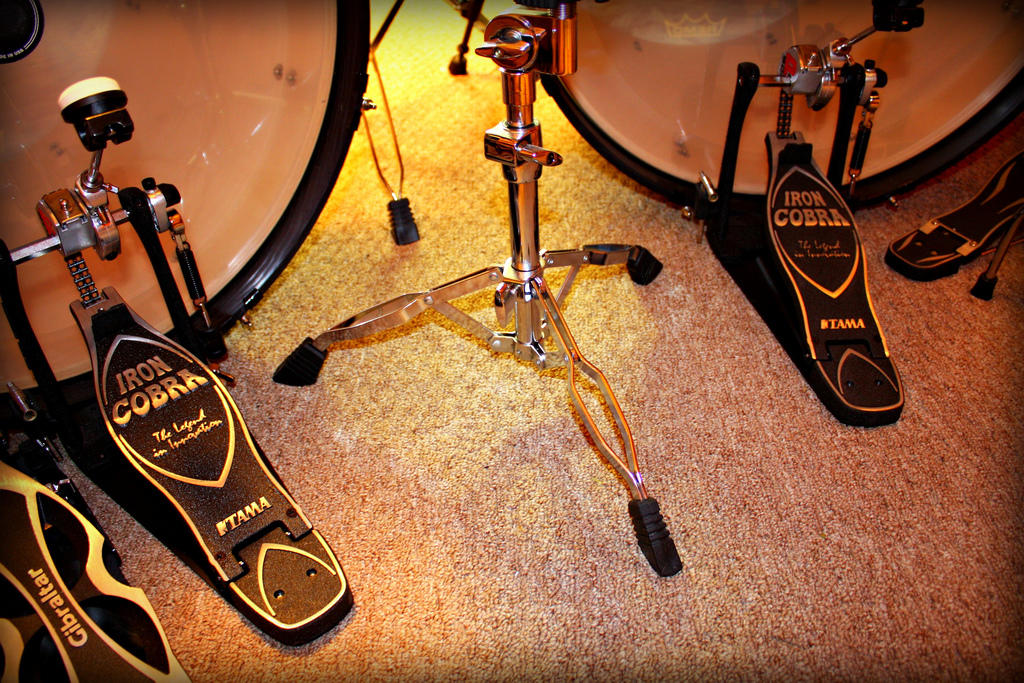
In 1909 the Ludwig Drum Company patented an improved version of a bass drum pedal. Early versions even included a pedal for a cymbal striker for hoop-mounted cymbals.
Drums Origin: Asia and India – A Rich and Ancient Tradition
Asia's contribution to the history of drums is profound and remarkably diverse. Beyond China's prehistoric drums, the Indian subcontinent has one of the richest drumming traditions in the world — one that developed entirely independently of European percussion history.
The Mridangam – South India's Ancient Barrel Drum
The mridangam is one of the oldest drums in Asia. Its name comes from the Sanskrit words mrid (clay) and anga (body), reflecting its origins as a clay drum. Ancient sculptures at temples across South India — including at Nataraja temples in Tamil Nadu — depict the mridangam being played, placing its history at over 2,000 years. Today it remains the primary percussion instrument of Carnatic classical music, made from a hollowed-out jackwood shell stretched with goatskin and layered black paste for tonal precision.
The Mridangam is one of the few drums in the world where both heads are tuned to specific pitches — the right head is tuned to the tonic note (sa) of the accompanying vocalist or instrument.
The Tabla – Hindustani Classical Music's Defining Drum
The tabla is perhaps the most recognised traditional drum of the Indian subcontinent globally. Consisting of two drums — the smaller dayan (played with the dominant hand) and the larger bayan (played with the other) — the tabla is central to Hindustani classical music, thumri, ghazal, and a vast range of devotional and folk forms. Its origins are debated, but most musicologists trace its development to medieval northern India, with the instrument reaching its current form by the 18th century. The black tuning paste applied to the drumhead — called syahi — is one of the tabla's most distinctive features and gives it its uniquely melodic, pitch-specific tone.
Other Asian Drums
- Dhol – A large double-headed barrel drum found across the Indian subcontinent, Pakistan, and parts of Central Asia; used in weddings, festivals, and folk processions
- Taiko (Japan) – A broad family of Japanese drums used in both religious ceremony and the now-globally-famous art of Taiko drumming performance
- Kendang (Indonesia) – A double-headed drum central to Gamelan orchestras and traditional Balinese and Javanese music
History of Drums in Africa – Rhythm as Language
African music and drumming are inseparable — but Africa's contribution to drum history goes far beyond rhythm alone.
The Djembe
The djembe is carved from a single piece of hardwood and stretched with goatskin. Originating in the region of the old Mali Empire — covering modern Guinea, Mali, Burkina Faso, Ivory Coast, Gambia, and Senegal — the djembe is between 400 and 800 years old. Tradition holds that it was invented by the Numu blacksmith caste. It became internationally known in the 1960s when Les Ballets Africains toured Europe, and is today one of the world's most widely played hand drums.
The Talking Drum
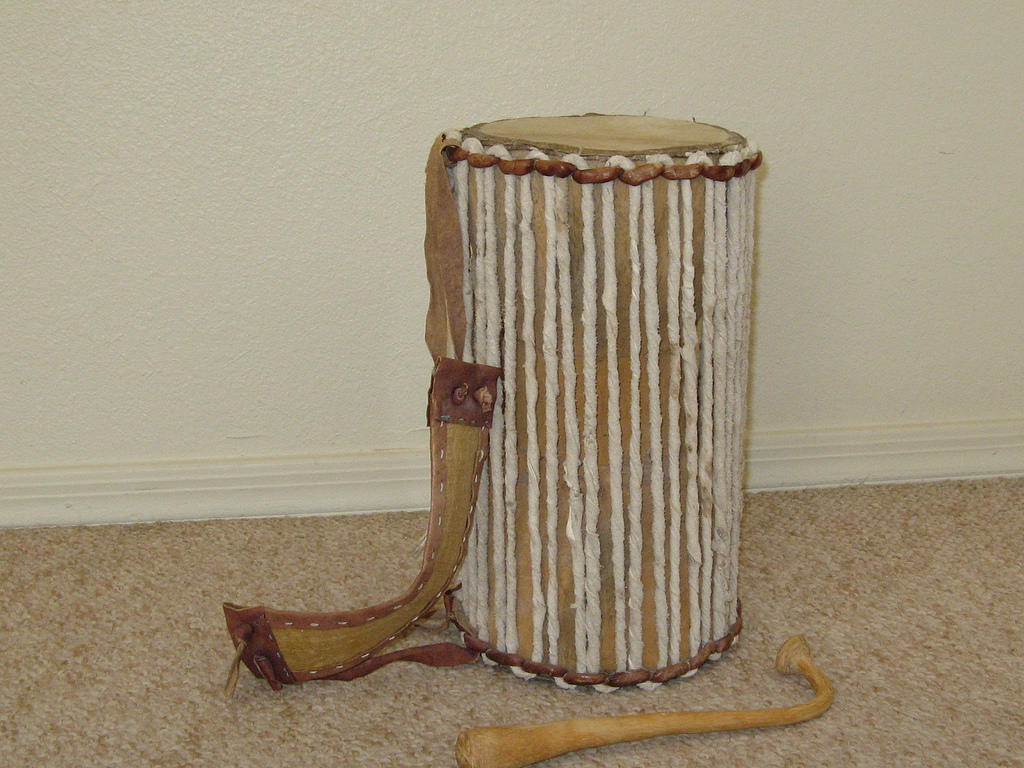
The talking drum is an hourglass-shaped drum with one or two heads connected by leather tension cords. By pressing the cords under the arm, the drummer adjusts the pitch mid-beat to mimic the tonal contours of human speech. Traditional in Nigeria, Senegal, Ghana, Benin, northern Cameroon, and western Chad, the talking drum was used as a long-distance communication system between villages — effectively a percussion-based language with its own vocabulary, phrases, and even a form of drum literature.
How about learning easy drum songs for beginners?
Why Drums Matter: A Universal Instrument
Across every civilisation explored in this article — from ancient Sumeria to medieval Switzerland to 20th century New Orleans — drums have served a consistent set of functions: marking time, communicating across distances, accompanying ceremony, driving collective movement, and expressing what words alone cannot. In 2026, the drum remains one of the most studied, most played, and most culturally diverse instruments in human history.
Now discover more facts about the drums...
Summarise with AI:
Did you like this article? Leave a rating!

 Loading...
