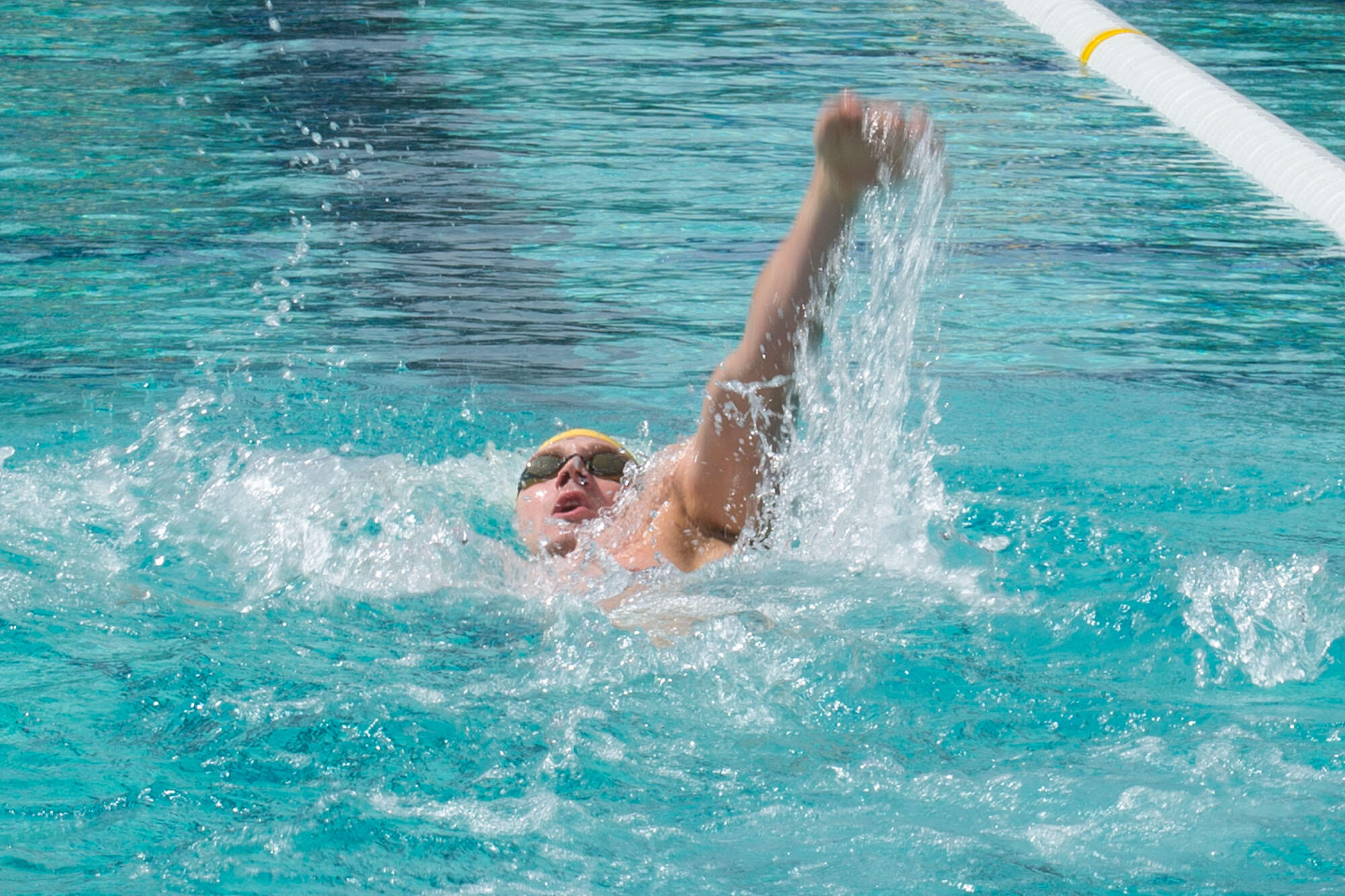


Quick Steps to Learn and Master the Backstroke
Before getting into the detail, here's the streamlined sequence every Indian swimming coach uses when teaching the backstroke — a checklist you can follow whether you're starting at a society pool in Kolkata, a sports club in Mumbai, or a Sports Authority of India training centre:
- Get comfortable floating on your back first — relax your body, drop your hips up to the surface, and breathe normally.
- Practise the flutter kick on your back — hold a kick board on your stomach and kick along the surface.
- Add the alternating arm action — one arm pulls underwater while the other recovers in a windmill motion above.
- Master the hand entry — hand enters the water pinky-first, just outside shoulder line.
- Engage core rotation — rotate the shoulders and hips as a unit to extend your reach.
- Breathe naturally — there's no breath-timing to coordinate; inhale and exhale freely.
- Use a fixed point overhead to swim straight — pool ceiling tiles, lane ropes, or the lifeguard tower.
- Build distance gradually — start with 25-metre lengths, then progress to 50m and beyond.
What Is the Backstroke?
The backstroke — also called the back crawl — is one of the four officially recognised competitive swimming strokes, and the only one performed lying on the back. The face stays out of the water throughout the stroke, which is why backstroke is often described as the most relaxed and beginner-friendly of the four strokes.
In its mechanics, the backstroke is closely related to the front crawl. Both use alternating windmill arm strokes and a continuous flutter kick, and both rely on body rotation along the long axis of the body to generate power. The crucial difference, of course, is orientation — backstroke swimmers face the sky rather than the bottom of the pool. This single change transforms the stroke into something far more accessible: there is no breath-timing puzzle to solve, no underwater exhalation rhythm to master, no anxiety about losing sight of where you are.
For Indian swimmers, the backstroke is the second stroke most commonly learned after the breaststroke. It's a favourite among adult fitness swimmers in cities like Bengaluru, Pune, and Hyderabad — particularly for those with neck or shoulder issues, since the position is gentler on the cervical spine than face-down strokes. It's also one of the four strokes used in the competitive individual medley.
Find safe swimming classes near me for kids on Superprof.
A Brief History of the Backstroke
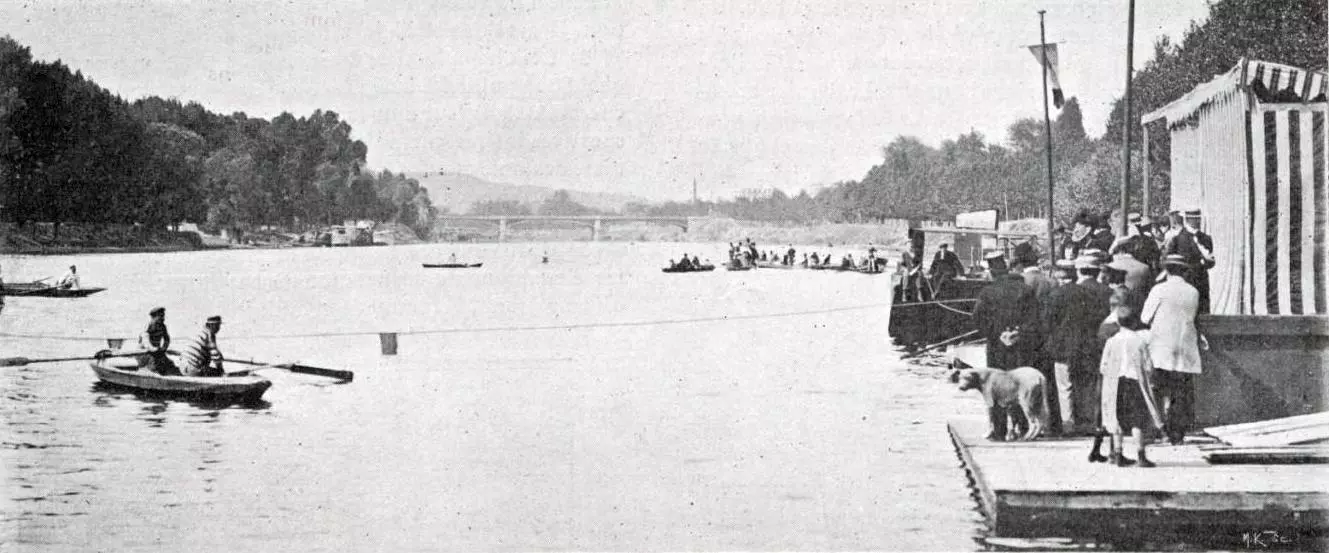
The backstroke has a long swimming history, but it became a formal competitive stroke relatively recently. While variations of swimming on the back have existed for centuries, backstroke first appeared at the Olympic Games in 1900 at the Paris Olympics, where the men's 200m backstroke event was won by Ernst Hoppenberg of Germany. Interestingly, that race took place outdoors in the River Seine, and the event was then dropped from the Olympic programme until the 1960s.
The 100m backstroke became a regular Olympic event in 1908 for men and 1924 for women, and both the 100m and 200m backstroke have featured in every Summer Olympics since.
The stroke went through a major transformation in 1988, when American swimmer David Berkoff introduced what became known as the "Berkoff blast-off" — a technique of dolphin-kicking underwater for as much of the start and turn as possible, gaining significant time over rivals on the surface. By the final of the Seoul Olympics, every medallist was using some version of this technique. World Aquatics (formerly FINA) eventually responded by limiting underwater swimming to 15 metres after the start and each turn, a rule that remains in force today.
Train with patient coaches through swimming classes Chennai.
Backstroke is also the only competitive stroke where swimmers start in the water rather than diving from the blocks, gripping a starting bar or wall before launching themselves backwards.
In India, the backstroke is a regular event at the National Aquatic Championships organised by the Swimming Federation of India, and Indian swimmer Srihari Nataraj has held the senior national record in the men's 100m backstroke for several years, having qualified for the Tokyo 2021 Olympics in this event. He continues to be one of the country's most successful international backstroke specialists.
Learn swimming basics with swimming classes Mumbai.
How Backstroke Differs from the Other Strokes
Understanding what makes the backstroke unique helps you train it more effectively:
- Versus front crawl — the arm and leg actions are similar, but the orientation is reversed. The big difference is breathing: backstroke is continuous and natural, while front crawl requires precise rotation timing.
- Versus breaststroke — breaststroke uses simultaneous, symmetrical arm and leg movements with the head bobbing up for a breath. Backstroke uses alternating arm movements with the face permanently above water.
- Versus butterfly — butterfly is the most physically demanding stroke, with simultaneous arm pulls and a dolphin kick. Backstroke is far more relaxed and sustainable for long distances.
If you're already comfortable with the front crawl, you'll find the backstroke's rhythm familiar — the main new challenge is staying oriented and swimming in a straight line while looking up at the sky.
Why Backstroke Is Suitable for Beginners
There are several reasons why Indian swimming coaches recommend backstroke as one of the early strokes to learn — particularly for adult beginners who feel anxious about face-in-water swimming:
- No breathing problem. The face is always above the water, so the swimmer never has to coordinate inhalation with arm strokes.
- Lower anxiety. Anyone who has felt panicked while learning to swim knows the value of being able to breathe whenever they want. Backstroke eliminates this entirely.
- Easier on the neck and shoulders. Lying on the back removes the spinal compression that comes from lifting the head to breathe in front crawl or breaststroke.
- Builds core stability. Maintaining a stable supine position trains the core deeply — a benefit that transfers to all other strokes.
- Shared mechanics with front crawl. Once you've learned to backstroke, transitioning to the front crawl is significantly easier, because the arm and kick patterns are nearly identical.
For learners who are nervous about swimming face-down, backstroke can be the gateway that builds water confidence and unlocks every other stroke.
Body Position: The Foundation of a Good Backstroke
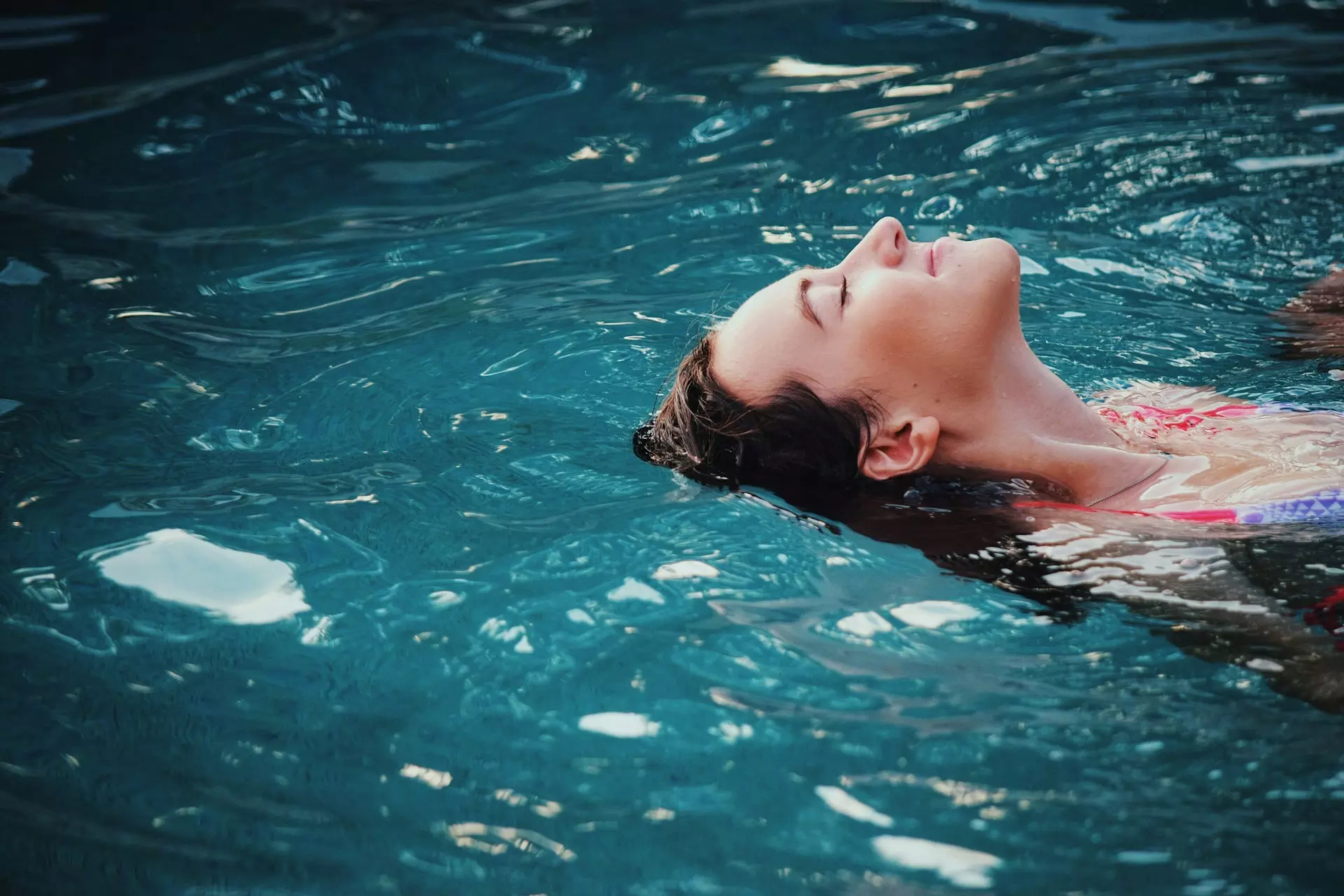
A strong backstroke starts with the right body position. Many beginners struggle because they let their hips sink — the moment your hips drop, your body angles into the water and you fight massive drag.
Here's what a good backstroke body position looks like:
- Body flat and horizontal in the water, parallel to the surface.
- Head still and supported by the water — looking straight up at the ceiling, not lifted forward.
- Hips at the surface, never dropping below shoulder level.
- Ears submerged — water should cover the ears; only the face stays exposed.
- Streamlined alignment — body kept narrow, with rotation driven from the core.
The most common cue Indian coaches use is: "push your chest up and your hips up." Imagine someone is gently lifting your torso to the ceiling. This naturally lifts the hips and creates the flat, low-drag position that defines a good backstroke.
Book structured swimming classes in Lucknow for beginners.
The Arm Action: Pull, Push, Recover
The backstroke arm cycle has three distinct phases:
- Entry and catch. Your hand enters the water pinky-first, just outside the line of your shoulder. The little-finger entry reduces splash and drag dramatically.
- Pull and push. Your arm bends at the elbow as it pulls through the water alongside your body, sweeping past your hip in a powerful S-curve. Your hand finishes the stroke deep beside your thigh.
- Recovery. Your arm exits the water thumb-first, then rotates as it swings overhead to enter the water again pinky-first.
A common mistake among beginners is pulling with a straight arm. This wastes power. The strongest backstrokers always have a bent elbow during the pull — typically forming a 90-degree angle as the hand passes the shoulder.
Just as importantly, the arms must be coordinated with body rotation. As one arm pulls down through the water, the same shoulder rotates downward with it. As the other arm recovers above water, that shoulder rotates upward. Done correctly, the body looks almost as if it's rotating around a central skewer.
The Flutter Kick
The backstroke uses the same continuous flutter kick as the front crawl. The motion originates from the hips, not the knees. Toes stay pointed, ankles remain flexible, and the legs alternate up and down in a quick, steady rhythm.
A strong backstroke kick produces a small, consistent splash at the surface — not big eruptions of water. If your kick is splashing dramatically, your knees are bending too much, which means you're losing power.
Useful drills for kick development include:
- Kick board on belly drill — kick on your back with a kick board held on your stomach.
- Streamline kick drill — kick on your back with arms extended overhead, hands stacked, focusing on staying flat and stable.
- Vertical kick drill — kick in deep water with your body upright and arms crossed at your chest, training kick power and core stability.
Breathing in the Backstroke
This is where the backstroke shines. There is no special breathing technique to learn — just inhale and exhale naturally as you swim. That said, more advanced swimmers do develop a breathing rhythm, often coordinating their breath with their arm cycle (e.g. inhale on one arm's recovery, exhale on the other's). This rhythm helps stabilise the stroke at higher speeds and prevents short, panicky breathing during racing.
For everyday recreational swimmers in India, simply breathing comfortably is more than enough.
Common Mistakes Indian Beginners Make in Backstroke
A few errors come up again and again with backstroke learners:
- Lifting the head to look forward. Causes the hips to sink immediately. Always look straight up.
- Sinking hips. A sign of weak core engagement or poor body position. Push the hips up to the surface.
- Straight-arm pull underwater. Robs you of power. Bend the elbow during the pull.
- Hand entry across the body. The hand should enter just outside shoulder line, not across the centreline.
- Drifting into the lane rope. Comes from poor head and core stability. Use overhead reference points to stay straight.
Tips to Improve Your Backstroke Faster
Once your basics are steady, these refinements will lift your stroke to the next level:
- Train rotation, not just arms. Practise drills like the 6-kick switch (kick six times on one side, then switch) to feel the rotation that drives every powerful backstroke.
- Build core strength. Planks, dead bugs, and rotational core work directly improve hip stability and stroke efficiency.
- Use overhead reference points. Pick a fixed feature of the pool ceiling, lane line, or rooftop to stay straight while swimming.
- Master the backstroke flags. Most Indian competition pools have flags strung 5 metres from each wall. Count strokes after the flags to time your turns perfectly.
- Practise the open turn and flip turn. A clean turn can save full seconds in any race; even fitness swimmers benefit from being able to turn smoothly.
Learn the Backstroke With a Coach on Superprof
The backstroke is one of the most beginner-friendly strokes to start, but one of the most subtle to master. Tiny technical issues — head position, kick depth, hand entry angle — make enormous differences in how the stroke feels and performs. A qualified instructor can identify and fix these in a single session, often saving you months of trial and error.
Superprof connects swimmers across India with verified swimming coaches, many of whom have competitive backgrounds, formal Swimming Federation of India certification, and years of teaching experience across all ages and levels. Browse coach profiles, compare reviews, and book your first session today.
Summarise with AI:
Did you like this article? Leave a rating!

 Loading...