

If you’re purposely learning English as a teen or adult, you have the opportunity to choose which type of English you want to learn. As children, we are limited to what adults decide. As a result, many kids learn a North American/US-centric type of English because it tends to be more widespread in different industries.
However, if you plan on living in the UK or working with people from there, it can be a good idea to learn how to listen and speak in British English!
Furthermore, many Indians who know English are taught a variation of British English due to the British colonialism in India’s history. Tweaking pronunciation and learning some new vocabulary can help British English-taught Indians to communicate with Brits and other Europeans more easily.





Which British Accent Do You Want to Learn?
First, let’s acknowledge all the different main English accents out there. The top 10 countries where English is the primary language in 2021 and their population were:
- United States — 332,915,073
- United Kingdom — 68,207,116
- Canada (except for Quebec) — 38,067,903
- Australia — 25,788,215
- Liberia — 5,180,203
- Ireland — 4,982,907
- New Zealand — 4,860,643
- Jamaica — 2,973,463
- Trinidad and Tobago — 1,403,375
- Guyana — 790,326
Just in these countries, you can tell that there is a huge swath of different accents, dialects, vernaculars, slang, and colloquialisms. This list doesn’t even include countries where English is not the main language but is considered a lingua franca, like India, Pakistan, Nigeria, Philippines, Tanzania, South Africa, and Kenya.
So, when you learn a British accent, keep in mind that there will still be a lot of native English accents you may not understand!
Discover engaging English classes in Delhi with experienced tutors.
Regional Accents
In the UK itself, there are also around 40 different dialects. Essentially, each country in the UK has its accent.
When people want to learn a British accent, they are typically referring to an English accent, as opposed to an Irish, Scottish, or Welsh accent.
More specifically, many people who want to learn an English accent are likely referring to “Received Pronunciation” aka “The Queen’s English.” This is the “posh” British accent.
Other popular and recognizable English accents are Yorkshire, Cockney, and Estuary.
You will most likely want to learn RP (Received Pronunciation) English first since it’s widely recognized, even if the people you’re speaking with don’t naturally have the accent. It also has a very formal and professional quality that makes speakers sound intelligent.
In this article, we will be talking about the RP accent because it’s versatile and recognizable.
Find Spoken English classes in India, and learn more about the English language.
British Dialects
| English Dialects | Where is it spoken |
|---|---|
| Scottish | Scotland - Visit Edinburgh & Glasgow |
| Geordie | Newcastle - One of the most distinctive accents in England |
| Scouse | Liverpool - Home to one of the biggest football clubs in the world. |
| Yorkshire | Yorkshire County - Spoken in Leeds, York & Shieffield |
| Welsh | Wales - Travel to Cardiff & Bristol to hear it! |
| Brummie | Essex - Derived from Brummagem and Bromwichham |
| Cockney | East London Heritage! |
| Mancunian | Manchester - Home to Manchester United, one of the biggest clubs in England & the world. |
| West Country | Spoken in Gloucestershire, Dorset, Somerset, Devon and Cornwall |
How to Recognize British English
I’m sure you’ve watched a show or film or two over the years that feature the RP accent.
Harry and Hermione from Harry Potter, Elizabeth Swann, Gov. Swann, and Com. Norrington from Pirates of the Caribbean, V from V for Vendetta, the elves in The Lord of the Rings, the Lannisters in Game of Thrones, and everyone in Pride & Prejudice, Bridgerton, Downton Abbey, and The King’s Speech all feature RP English accents.
So, you probably already know what the accent sounds like!
Received Pronunciation English vs Other Accents
How can you determine if what you’re listening to matches the accent you want to learn?
Making sure you stay mostly consistent with your British accent is vital for sounding coherent when you’re talking to a British person. If you mix together too many different elements from different accents, you may not be understood and cause quite a confusion.
The definite features of RP English are:
- Non-Rhoticity: RP is a non-rhotic accent, which means that the "r" at the end of words and syllables is not pronounced. For example, "car" would be pronounced as "caah."
- Clear Vowel Sounds: RP speakers tend to have very clear, precise, and distinct vowel sounds. There is a distinction between long and short vowels. For instance, the "a" in "bath" and "trap" is pronounced differently.
- Use of the Glottal Stop: RP speakers may use the glottal stop (represented by the symbol /ʔ/) in certain positions. In RP English, it is only used when another consonant immediately follows it.
For example, in RP English, the “t” in “football” becomes a glottal stop, but the “t” in “water” is pronounced. - Tendency Towards Pronouncing "H": RP speakers typically pronounce the "h" sound at the beginning of words, as opposed to dropping it. For example, they would say "herb" with a clear "h" sound.
Lack of Pronunciation of Intrusive "R": In some British accents, there's a phenomenon called intrusive "r," where an "r" sound is inserted between certain words ending in a vowel and words beginning with a vowel. In RP, this is generally avoided. For instance, an RP speaker would say "law and order" while a different accent like Estuary would say “lawr an’ order.”
Join English speaking online classes to learn American or British English, and go abroad to study and work with ease!
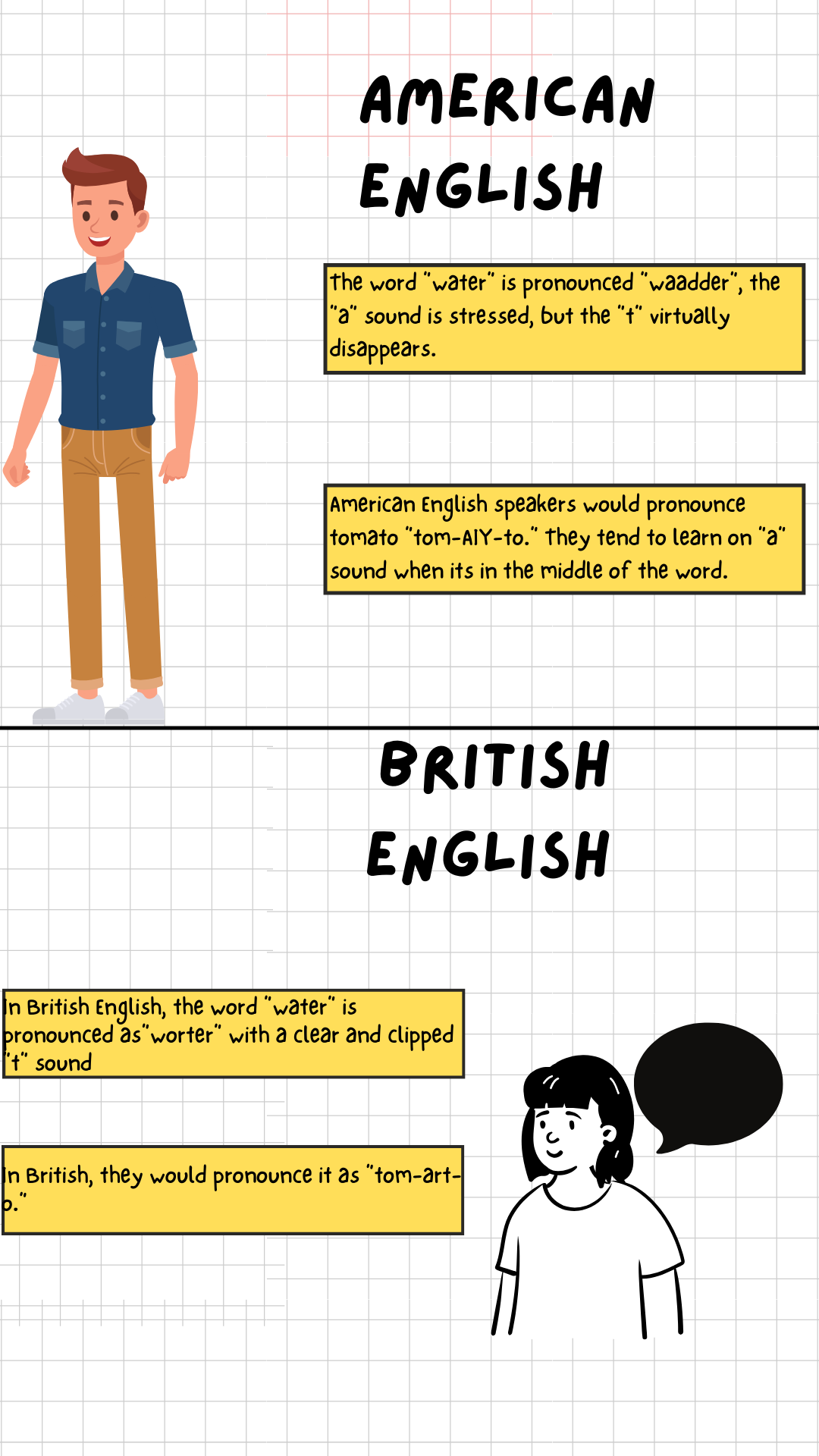
American English Vs British English
Tuning Your Ears
How can you get more experienced with understanding a British accent?
Learning to tune your ears to any new language or accent takes patience, time, and practice.
You need to learn a new sound dictionary so well that you can instantly understand words you already know, but that sound totally different from what you’re used to.
For example, “law and order” in PR might sound like “law and daughter” if you’re not used to the accent.
Watch and Listen to Film and TV
One of the very best ways to get familiar with any accent is to watch a lot of films and TV with your target accent. Even if you need to put subtitles on in order to understand, you simply must have more exposure to the accent so your brain can start making the connections it needs to comprehend the sounds.
Watch any of the media listed earlier in this article for practice. Make sure you’re paying attention while you watch! If you aren’t listening well, you won’t learn very much.
You must also watch the speakers’ mouths when they talk to understand how they are making the sounds. It will help you speak better yourself and will help you understand others better face-to-face.
Listen to Podcasts
Another great tool is podcasts. You can listen to a podcast that is specifically about learning the PR accent, or you can simply listen to whatever subject you enjoy, as long as it’s being talked about by a person with your target accent.
Watch YouTube
On YouTube, you can watch videos of native speakers doing just about anything! Just like with podcasts, you can watch videos of any subject that interests you, and you’ll still be learning.
Alternatively, you can watch videos that are meant to educate people like yourself who are learning how to master the accent. They can tell you how to move your mouth and tongue as well as what sounds are needed in order to sound authentic.
Take Note of Vocabulary
Luckily, a lot of British English overlaps with Indian English. However, there are some words that are not the same, and you'll need to learn what to say or avoid saying. Simply by listening to all these resources, you can pick up a fair amount of vocabulary and notice which words people tend to say, and which ones they tend to leave out.
Practice speaking with a native or a coach to improve your accent! | Photo by Yan Krukau on Pexels
How to Learn British English
So, how do you go from listening to British English to speaking it?
There are several techniques you can use to start working on your British accent.
Here are some great tools to learn British English for beginners.
Record Yourself
Practice narrating your day, talking about something you enjoy, or repeating lines of dialogue from movies that feature the PR accent. Record yourself speaking so you can listen back and identify areas where you might be having trouble.
While it might make you feel a little self-conscious (most of us dislike the sound of our voices), it’s an incredibly useful practice for self-evaluation.
British ESL Resources
There are a lot of free resources available for practising your British English!
The only downside is that there may not be many opportunities to test your accent. Instead, the resources are mostly aimed at teaching English as a language in general.
You can find resources on bbc.co.uk.
Speak with Natives
Sign up for an app like SpeakNative or HelloTalk to begin practicing with native English speakers!
If you find someone with your target accent, you can learn more about how to program your brain and mouth to speak the same way as your chat partner. Even if they don’t naturally speak in your target accent, they may be able to help you improve if they know a lot about the accent.
Speaking with a native is also a great way to improve your vocabulary! You'll learn which words to say and which ones are uncommon. One thing to notice is that in Indian English, words like "updation" can be common, and though they appear to be proper English, they are not in the British vocabulary.
Over time, you'll learn which words are exclusively Indian English, and you'll know what to say instead to make your idea known to other Brits.
Hire a Coach
For professional practice, you can hire an accent coach to guide you to speaking your chosen accent faster and easier.
Many actors will utilize an accent coach to make sure they sound convincing for movies and TV, so why can’t you hire one to achieve the accent you want?
Having a professional coach is helpful because they will know the technical science and methodology behind teaching someone how to speak differently. You can find a qualified accent coach on Superprof.
British English is, fortunately, one of the most recognizable accents in the world right now. It will take time and practice, but you, too can master the British accent if you put your mind to it!
Summarise with AI:
Did you like this article? Leave a rating!

 Loading...