

The piano is one of the most popular instruments in the world, and a big reason is the music written for it. Over four centuries, composers have filled the instrument's repertoire with everything from strict Baroque fugues to dreamy modern pieces you might hear in a film or on a study playlist.
This article is about the composers and the music they wrote, not about performers. If you are looking for the great performers of the instrument, read our separate guide to the famous pianists. Here, we walk through the best composers for piano music period by period, with the works that made them famous and the pieces learners usually start with. The list isn't exhaustive, so feel free to suggest your own favourites in the comments!




Famous Piano Composers at a Glance: The Four Musical Periods
Western classical music is usually divided into periods. Knowing which period a composer belongs to tells you a lot about how their music sounds and how it should be played.
| Period | Approximate dates | What the music sounds like | Key piano composers |
|---|---|---|---|
| Baroque | c. 1600–1750 | Interweaving melodies (counterpoint), steady rhythms, lots of ornamentation; written for harpsichord, clavichord and organ | Johann Sebastian Bach, George Frideric Handel, Domenico Scarlatti, François Couperin |
| Classical | c. 1750–1820 | Clear, balanced melodies over simple accompaniment; the sonata becomes the central form | Joseph Haydn, Wolfgang Amadeus Mozart, Ludwig van Beethoven, Muzio Clementi |
| Romantic | c. 1820–1900 | Emotional, expressive and often virtuosic; short character pieces and big concertos | Frédéric Chopin, Robert Schumann, Franz Liszt, Johannes Brahms, Pyotr Ilyich Tchaikovsky, Edvard Grieg |
| Modern | c. 1890 to today | New harmonies and colours, from Impressionism to jazz influences and minimalism | Claude Debussy, Maurice Ravel, Sergei Rachmaninoff, Erik Satie, George Gershwin, Ludovico Einaudi |
Below, we look at some of the most important names from each period. For a list of individual works, see our guide to famous piano pieces.
Baroque Piano Composers (c. 1600–1750)
The modern piano didn't exist for most of the Baroque period. Its ancestor, the fortepiano, was invented in Italy around 1700 and was still a novelty when Bach died. Baroque keyboard music was written for the harpsichord, clavichord and organ, but it translates beautifully to the piano and remains a cornerstone of every pianist's training.
Johann Sebastian Bach
Johann Sebastian Bach (1685–1750) is the towering figure of Baroque keyboard music. His writing is built on counterpoint: two, three or even four independent melodic lines played at the same time, which makes his music an unbeatable workout for coordination between the hands.
His most influential keyboard work is The Well-Tempered Clavier, two books of preludes and fugues in all 24 major and minor keys (48 in total). Other essential works include the Goldberg Variations, the six Partitas, the French and English Suites and the Italian Concerto.
For learners, Bach's two-part Inventions and three-part Sinfonias are classic study pieces. Many beginners also meet the well-known Minuet in G from the Notebook for Anna Magdalena Bach, although scholars now attribute it to Christian Petzold.
Classical Period: Where the Best Piano Composers of All Time Took Shape (c. 1750–1820)
The Classical period is when the piano replaced the harpsichord as the main keyboard instrument. Its ability to play soft and loud (the instrument's full name, pianoforte, means "soft-loud") opened up new possibilities, and the composers of Vienna made the most of them.
Joseph Haydn
Joseph Haydn (1732–1809) is part of what is often called the "Classical Viennese Trinity", alongside Mozart and Beethoven. He is known as the father of the symphony and the string quartet, but he also wrote more than 50 keyboard sonatas, along with piano trios and keyboard concertos.
With so many great piano composers, it's hard to make such a short list | Image source: Tama66
Haydn's sonatas are full of wit and surprise, and many of them are well within reach of intermediate students. He was also a mentor figure: he influenced Mozart and, for a time, taught a young Beethoven.
Wolfgang Amadeus Mozart
Wolfgang Amadeus Mozart (1756–1791) was a child prodigy who was composing keyboard pieces by the age of five. In a short life of just 35 years, he wrote 18 piano sonatas and more than 20 piano concertos, works that are still seen as models of balance and elegance.
Highlights include the Sonata in A major, K. 331, which ends with the famous "Rondo alla Turca", the Fantasia in D minor, K. 397, and Piano Concertos No. 20 and No. 21. The Sonata in C major, K. 545, often nicknamed the "easy sonata", is a favourite with students, though playing it well is anything but easy! Haydn himself told Mozart's father that his son was the greatest composer he knew.
Ludwig van Beethoven
Ludwig van Beethoven (1770–1827) is the bridge between the Classical and Romantic periods. His early works follow in the footsteps of Haydn and Mozart, while his later music is far more personal, dramatic and experimental. Remarkably, he kept composing even as he gradually lost his hearing.
His 32 piano sonatas are sometimes called the "New Testament" of piano music (with Bach's Well-Tempered Clavier as the "Old Testament"). They include the "Pathétique", the "Moonlight" and the "Appassionata", as well as the enormous "Hammerklavier". He also wrote five piano concertos, the last nicknamed the "Emperor", and the Diabelli Variations.
Almost every piano learner knows Für Elise, but Beethoven's influence goes far beyond the keyboard. The "Ode to Joy" from his Ninth Symphony is now the anthem of the European Union.
Romantic Period: Famous Composers Who Wrote for Piano (c. 1820–1900)
The 19th century was the golden age of the piano. Instruments became louder and sturdier, pianos appeared in middle-class homes across Europe, and composers poured their deepest feelings into the instrument, from intimate miniatures to thundering concertos.
Robert Schumann
Robert Schumann (1810–1856) is one of the high points of German Romanticism. He hoped to become a concert pianist, but a hand injury ended that dream, and he turned his energy to composing instead.
His piano music is imaginative and often tells a story through a set of short pieces. Kinderszenen ("Scenes from Childhood"), which includes the famous "Träumerei", Carnaval and Kreisleriana are among his best-known works, along with the Piano Concerto in A minor and the Fantasie in C. His Album for the Young was written for his own children and is still widely used by students. Schumann was also a master of the German Lied (art song), and his wife, Clara Schumann, was herself a celebrated composer.
Frédéric Chopin
Frédéric Chopin (1810–1849) is perhaps the purest piano composer of all: almost every work he wrote features the piano. Born in Poland, he settled in Paris at the age of 21 and never returned home.
Polish-born Frédéric Chopin spent most of his career in Paris | Image source: Walkerssk
Chopin turned small forms into great art. His output includes 21 nocturnes, 27 études, 24 preludes, four ballades, four scherzos, and dozens of mazurkas, polonaises and waltzes inspired by Polish dances. His études were among the first to treat technical exercises as concert pieces, and his approach to touch, pedalling and melody helped define modern piano technique. Later composers such as Debussy, Ravel and Rachmaninoff all drew on his example.
Franz Liszt
Franz Liszt (1811–1886) pushed piano writing to its technical limits. Hungarian by birth, he created music that demanded (and showed off) extraordinary skill, and he is often credited with inventing the solo piano recital.

Romantic composers wrote some of the most demanding music in the piano repertoire | Image source: webandi
As a composer, Liszt left a huge body of piano music: the 19 Hungarian Rhapsodies, the Transcendental Études, "La Campanella", the three Liebesträume (No. 3 is the most famous), the travel-inspired Années de pèlerinage and the Sonata in B minor, one of the most ambitious works of the century. He also brought other composers' music to the piano, transcribing all nine of Beethoven's symphonies and writing concert paraphrases on operas such as Verdi's Rigoletto.
Johannes Brahms
Johannes Brahms (1833–1897) was a composer, pianist and conductor of the Romantic period, and a close friend of Robert and Clara Schumann. His music combines Romantic warmth with the tight structures of Bach and Beethoven.
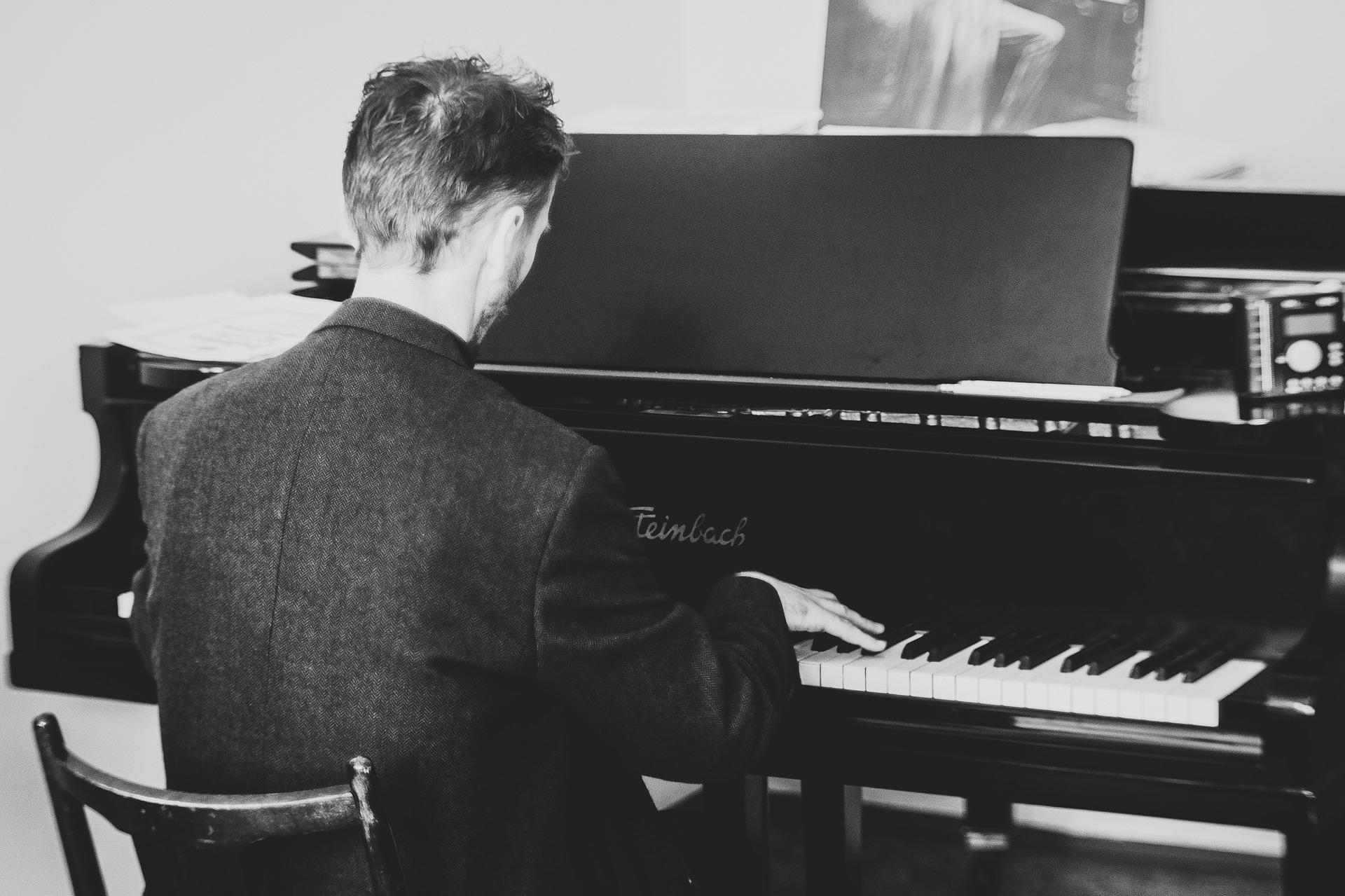
Every symphony starts out with someone writing some music on their own | Image source: coyot
For the piano, Brahms wrote three sonatas, two monumental piano concertos and several sets of variations, including the Variations and Fugue on a Theme by Handel and the Paganini Variations. In later life, he turned to short, reflective pieces (intermezzos, ballades and rhapsodies) collected in Opp. 116–119, which many pianists consider his most personal music. His Hungarian Dances, originally written for piano duet, remain hugely popular.
Brahms was famously reluctant to be compared to Beethoven. He spent around 20 years working on his First Symphony before he felt ready to release it.
Pyotr Ilyich Tchaikovsky
Pyotr Ilyich Tchaikovsky (1840–1893) laid much of the foundation of Russian Romanticism, blending Russian folk melodies with European forms. He is best remembered for his ballets and symphonies, but the piano was central to his work too.
His Piano Concerto No. 1 in B-flat minor, with its unforgettable opening chords, is one of the most popular concertos ever written, even though the pianist Nikolai Rubinstein harshly criticised it at first. For solo piano, The Seasons, a set of 12 pieces, one for each month of the year, and the Album for the Young are rewarding choices for students.
Modern Piano Composers (c. 1890 to Today)
From the late 19th century onwards, composers began to break away from Romantic traditions. Some looked for new colours and harmonies, others drew on jazz, folk music or minimalism, and the piano remained at the heart of these experiments.
Claude Debussy
Claude Debussy (1862–1918) changed the sound of the piano. His music is often described as Impressionist (a label he disliked), because it seems to paint moods and images with sound rather than follow traditional rules of harmony.
"Clair de lune", from the Suite bergamasque, is his best-loved piece. Pianists also treasure his two books of Préludes (24 in all), Estampes, Images and the two Arabesques. Children's Corner, which ends with the lively "Golliwogg's Cakewalk", was written for his young daughter.
Ludovico Einaudi
Ludovico Einaudi (born 1955) is one of the most-streamed classical composers of today. The Italian composer trained in the classical tradition but writes in a minimalist style that blends classical piano with elements of pop and ambient music.
Pieces such as "Nuvole Bianche", "Una Mattina" and "Experience" have found a huge audience online, and his film work, including the soundtracks for The Intouchables and Nomadland, has raised his profile even further. Because his pieces are melodic and built on repeated patterns, they are a popular choice for adult beginners and teenagers who want to play something they already know.
Summarise with AI:
Did you like this article? Leave a rating!

 Loading...

