


Quick List: Einstein’s Contributions to Mathematics and Physics
- Theory of Relativity and spacetime equations
- Mass–energy equivalence formula E=mc2
- Contributions to tensor mathematics in physics
- Work on Brownian motion and probability
- Photoelectric effect calculations
- Development of cosmological equations
- Use of non-Euclidean geometry in relativity
- Mathematical foundations of modern physics
- Influence on quantum mechanics research
- Collaboration with leading mathematicians and physicists
Albert Einstein is a name synonymous with intellectual brilliance and revolutionary scientific thought and stands as one of the most iconic figures in the history of modern science. Born in Ulm, Germany, in 1879, Einstein's prodigious intellect and insatiable curiosity led him to reshape our understanding of the universe. His groundbreaking contributions to theoretical physics, particularly his theory of relativity, forever altered the course of scientific inquiry and garnered him universal acclaim.
Who Was Albert Einstein?
An inquisitive nature and an innate fascination with the mysteries of the physical world marked Einstein's early life. He displayed remarkable mathematical aptitude from a young age, which eventually led him to pursue advanced studies in physics and mathematics. His groundbreaking papers on the photoelectric effect, Brownian motion, and special relativity, published in the early 20th century, catapulted him to international acclaim.
There are only two ways to live your life. One is as though nothing is a miracle. The other is as though everything is a miracle.
Albert Einstein
Einstein's theory of special relativity, encapsulated by the famous equation E=mc², revolutionised our understanding of energy, mass, and the fundamental nature of the cosmos. This theory, along with his later work on general relativity, which provided a new understanding of gravity, earned him the Nobel Prize in Physics in 1921.
Beyond his scientific achievements, Einstein was an outspoken advocate for civil rights, pacifism, and international cooperation. His moral and philosophical reflections extended beyond the realm of equations and theories, making him a symbol of humanistic values.
Throughout his life, Einstein's keen intellect and insatiable curiosity continued to shape our comprehension of the universe. His ideas remain foundational to modern physics and have permeated various facets of human thought and culture. Albert Einstein, a name synonymous with genius, innovation, and a profound understanding of the universe, left an indelible mark on the landscape of both science and humanity.
Albert Einstein's Math Contributions to the World
Albert Einstein made several significant mathematical contributions that revolutionised our understanding of the universe. His work not only changed the course of physics but also had far-reaching implications for mathematics and science as a whole. Here's a more detailed exploration of Albert Einstein's math contributions to the world:
Theory of Special Relativity
Lorentz Transformations: In his 1905 paper on special relativity, Einstein introduced the Lorentz transformations, a set of mathematical equations that describe how coordinates of events change when observed from different inertial frames. These transformations account for the effects of relative motion and are the foundation of the theory of special relativity.
Time Dilation and Length Contraction
Einstein's equations also led to the prediction of time dilation (time passing at different rates for observers in relative motion) and length contraction (objects appearing shorter when moving relative to an observer). These mathematical consequences challenged classical notions of space and time.
Invariance of the Speed of Light
Einstein's postulate that the speed of light is constant for all observers, regardless of their relative motion, is a fundamental mathematical principle in special relativity. It led to the development of non-Euclidean geometries and the concept of spacetime, where time is treated as a fourth dimension.
E=mc²: Arguably, his most famous equation, E=mc², represents the mathematical equivalence of energy (E) and mass (m) connected by the speed of light (c). This equation revolutionized our understanding of the relationship between energy and matter.
Build strong fundamentals with a maths class 10 to understand concepts like these better.
Theory of General Relativity
Einstein Field Equations
In 1915, Einstein introduced the Einstein Field Equations, a set of ten interconnected partial differential equations. These equations describe the curvature of spacetime caused by the presence of mass and energy. They are the mathematical foundation of the theory of general relativity.
Spacetime Curvature
Einstein's equations showed how massive objects warp the fabric of spacetime around them. This curvature results in the gravitational force we experience. The mathematical concept of curvature of spacetime is central to general relativity.
Quantum Mechanics Contributions
Einstein-Podolsky-Rosen (EPR) Paradox
In collaboration with Boris Podolsky and Nathan Rosen, Einstein formulated the EPR paradox in a 1935 paper. This thought experiment challenged aspects of quantum mechanics, particularly the idea of non-locality. While not strictly mathematical, it engaged deeply with the mathematical foundations of quantum theory and prompted discussions about its philosophical implications.
Photoelectric Effect
In 1905, Einstein explained the photoelectric effect, demonstrating that electromagnetic radiation, such as light, is quantised into discrete packets of energy called photons. This work helped establish the concept of quantization and paved the way for quantum theory.
Unified Field Theory
Einstein dedicated much of his later career to the pursuit of a unified field theory that would encompass all fundamental forces in a single mathematical framework. While he did not fully realise this ambition, his work in this area demonstrates his ongoing engagement with mathematical abstraction and the quest for a grand unified theory.
Who was Oppenheimer?
J. Robert Oppenheimer is best known as the scientific director of the Manhattan Project, the secret U.S. programme that developed the first atomic bomb.
A leading theoretical physicist, Oppenheimer made important contributions to quantum mechanics and nuclear physics. He led a team of scientists during World War II, resulting in the first successful atomic bomb test in New Mexico in 1945.
After seeing the destructive impact of nuclear weapons, Oppenheimer reflected on the ethical consequences of his work and later supported arms control and nuclear disarmament.
He later served as Director of the Institute for Advanced Study in Princeton, where he influenced future generations of scientists. Oppenheimer died in 1967 and remains one of the most debated figures in modern scientific history.
Strengthen concepts through structured online maths tuition for class 8 on Superprof.
What was the Relation between Oppenheimer and Albert Einstein
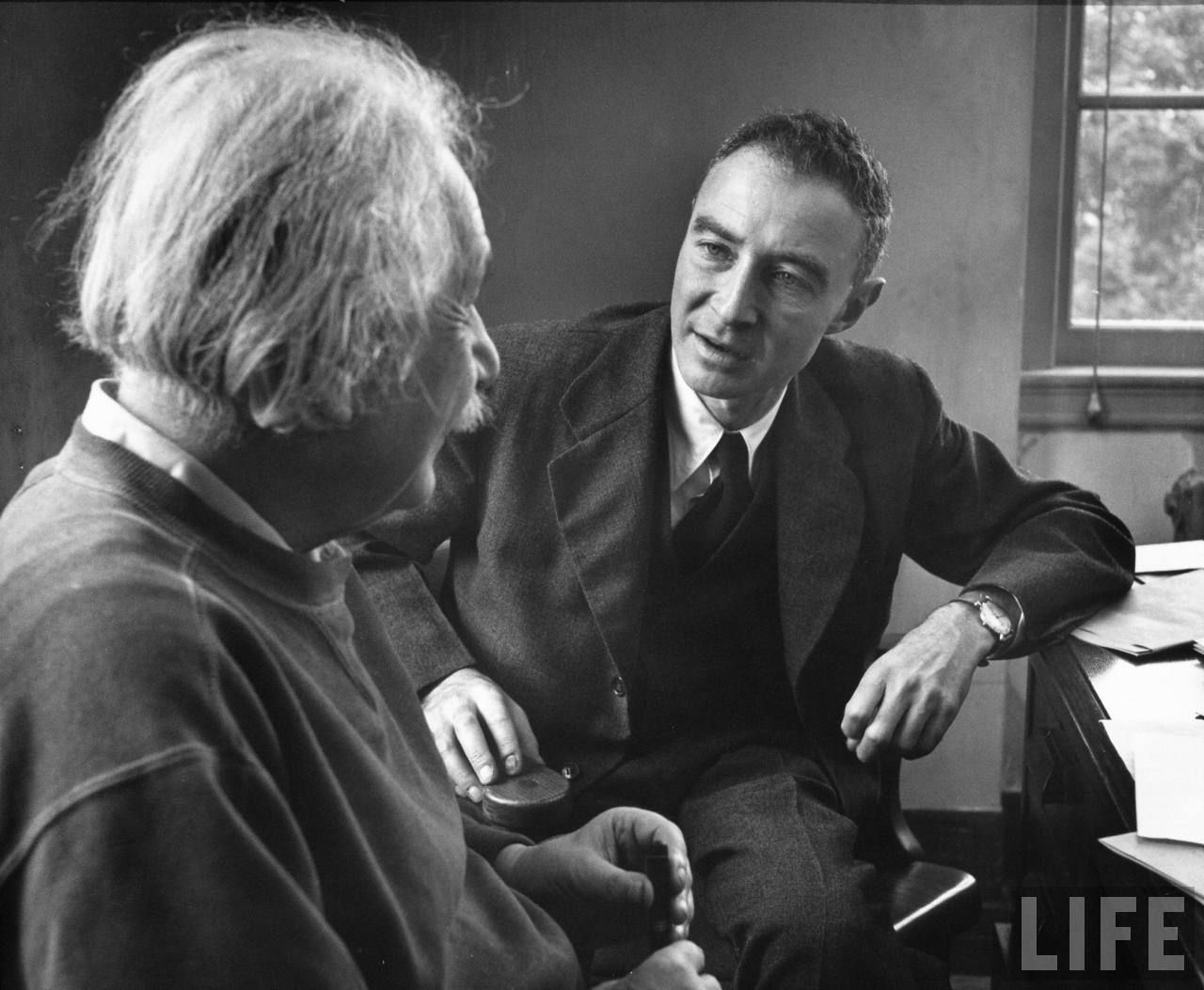
The relationship between J. Robert Oppenheimer and Albert Einstein was one of mutual respect and professional collaboration, particularly during the critical period of World War II and the development of the atomic bomb.
Early Correspondence
The initial connection between Oppenheimer and Einstein was facilitated by physicist Leo Szilard. In 1938, Szilard, deeply concerned about the potential military applications of nuclear fission, drafted a letter to President Franklin D. Roosevelt, co-signed by Einstein. This letter, known as the Einstein-Szilard letter, warned of the potential power of nuclear weapons and urged the U.S. government to initiate its own atomic research program.
Einstein's Role
While Einstein's signature on the letter played a pivotal role in drawing the attention of the U.S. government to nuclear research, Einstein himself did not directly participate in the practical development of atomic bombs. He maintained a role as an advocate for peace and disarmament, often expressing regret about his indirect involvement in the bomb's creation.
Oppenheimer's Leadership in the Manhattan Project:
Robert Oppenheimer, a brilliant theoretical physicist, was chosen to lead the Manhattan Project, a top-secret U.S. government research program, in 1942. He was tasked with assembling a team of scientists and engineers to develop the first atomic bombs.
Oppenheimer's leadership was instrumental in the success of the project. He managed the scientific and technical challenges, coordinated research efforts, and oversaw the construction of the bombs.
Professional Respect
Although Einstein was not directly involved in the project's day-to-day activities, he had immense respect for Oppenheimer's intellect and abilities. Einstein recognised Oppenheimer's leadership and was confident in his ability to navigate the complexities of the ambitious scientific endeavour.
Post-War Years
After World War II, both Oppenheimer and Einstein continued their contributions to science and academia. Oppenheimer served as the Director of the Institute for Advanced Study in Princeton, New Jersey, where he mentored future generations of physicists. Einstein continued his academic work and became a prominent advocate for civil rights, pacifism, and international cooperation.
In summary, the relationship between Oppenheimer and Einstein was characterised by a shared commitment to the advancement of science and a mutual understanding of the gravity of their roles in the development of nuclear weapons. While Einstein's signature initiated the process, it was Oppenheimer who led the practical execution of the Manhattan Project, leaving an indelible mark on the course of history.
Their combined efforts shaped the trajectory of nuclear physics and the complexities of the atomic age.
Summarise with AI:
Did you like this article? Leave a rating!


 Loading...
Nice
Now I have lot of knowledge about einstein
Very very nice 👍👍👏
It was very helpful
It was very helpful every information about Einstein was given in it