
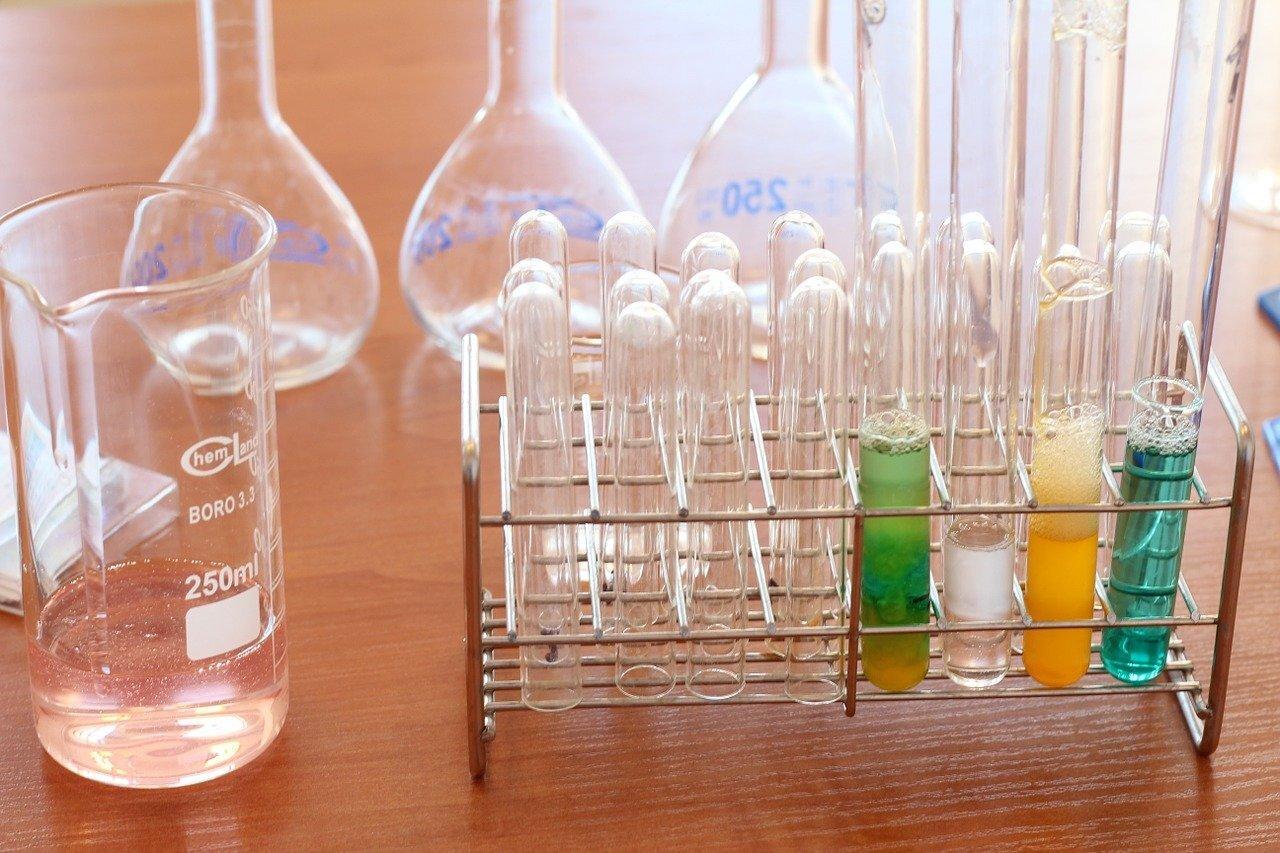

Everything in our surroundings (living or nonliving) has a few chemical and physical properties. Moreover, our body also changes due to the evolution of these properties. So, we can imagine how crucial this course is in our lives. Learning chemistry is not just a requirement; it is also a fun approach to better understanding ourselves and our surroundings. The preparation strategy for CBSE Class 12 Chemistry should be a smart one. Students must create a list of chapter-wise weightage before creating the Class 12 Chemistry study plan.
- Organic Chemistry is one of the scoring topics. According to previous year's question papers on Chemistry, all the questions are directly or indirectly asked from the NCERT books. So, NCERT books should be read properly, and remember well that there is no substitute for hard labor.
- In Inorganic Chemistry, p-block Elements and d-block Elements are important topics. Though it is a tough ask to study both chapters in quick time, it would be ideal to prepare short notes on these chapters and studying them. The questions from inorganic chemistry are directly asked.
- Students should practice the structures of different chemical compounds of p-block elements properly because they are often asked in the board exams. In summary, inorganic chemistry should be read discretely and regularly because students are required to memorize the topics without facing any confusion while attempting the exam.
- The last three chapters, Biomolecules, Polymer, and Chemistry in Everyday Life, should be studied really well. They are quite easy to learn, and students can prepare short notes for these topics so they can be revised at the last minute.
- Physical Chemistry is very important; students must memorize the formula from each chapter to score good marks in Physical Chemistry. Once the formulas are memorized properly, students must attempt the problems by applying the learned formulas. The theory part should also be learned from those chapters as they are often asked in the exam.
- Students must set aside some time to solve the sample papers. It helps in time management and gives an idea of which question should be attempted first. It also builds fundamentals for preparation for JEE and NEET exams.
- Students must ensure that the entire syllabus is completed within one month. Students must then complete regular revisions to secure higher marks in Chemistry.
Discover a private chemistry teacher Kolkata on Superprof.
Class 12 CBSE Chemistry is a scoring subject if the approach towards the exam preparation is planned systematically. Firstly, study the NCERT Chemistry book thoroughly while completing the syllabus, topic-wise. Practicing the previous year's question papers and sample papers helps students to understand their areas of strengths and weaknesses. Check out these top websites where you can find class 12 chemistry resources, including NCERT practice papers that will enable you to ace the chemistry CBSE class 12 paper.


Topper Learning
Browse the e-learning resources on the Topper Learning platform, like sample papers, video lessons, previous year papers, etc. On the portal, chemistry experts present video lessons to help you enjoy learning chemistry topics such as properties of colloids, coordination compounds, aldehydes and ketones, DNA, polymers, etc. Practice likely Chemistry exam questions using the CBSE Class 12 Science sample papers with solutions and previous papers with solutions. Use the NCERT Chemistry Class 12 solutions for chapter-wise revision. MCQs are also beneficial for the quick revision of important Chemistry concepts.
CBSE Class 12 Chemistry introduces you to several laws, reactions, elements, and other concepts. On the TopperLearning portal, you’ll find expert solutions to NCERT textbook questions, sample paper questions, and questions from the previous year's CBSE Class 12 Chemistry exam papers. The Chemistry experts have presented the solutions in a step-wise format to help you understand the solutions. Also, concept notes are added for certain solutions to give you more details about the concept used for answering a question.
Find a chemistry class near me taught by qualified tutors on Superprof.
Khan Academy
Khan Academy offers practice exercises, instructional videos, and a personalized learning dashboard that empower learners to study at their own pace in and outside the classroom. The platform focuses on skill mastery to help learners establish strong foundations, so there's no limit to what they can learn next! The resources for Chemistry class 12 include the following:
- Electrochemistry
- Galvanic cells: Electrochemistry
- Standard cell potentials: Electrochemistry
- Cell potentials at nonstandard conditions
- Chemical kinetics
- Reaction rates and rate laws: Chemical kinetics
- Relationship between concentration and time: Chemical kinetics
- Relationship of reaction kinetics to the concentration of species involved: Chemical kinetics
- Rate law and rate expressions: Chemical kinetics
- Integrated rate equations for zero and first-order reactions: Chemical kinetics
- Temperature dependence of the rate of a reaction
- Haloalkanes & haloarenes
- Free radical reaction: Haloalkanes & haloarenes
- Nucleophilicity & basicity: Haloalkanes & haloarenes
- Sn2/Sn2/E1/E2: Haloalkanes & haloarenes
- Chirality: Haloalkanes & haloarenes
- Enantiomers: Haloalkanes & haloarenes
- Stereoisomeric relationships
- Alcohols, phenols, and ethers
- Alcohol nomenclature and properties: Alcohols, phenols, and ethers
- Synthesis of alcohols: Alcohols, phenols, and ethers
- The reaction of alcohols: Alcohols, phenols, and ethers
- Nomenclature & properties of ethers: Alcohols, phenols, and ethers
- Synthesis & cleavage of ethers
- Aldehydes, ketones, and carboxylic acids
- Introduction to aldehydes and ketones: Aldehydes, ketones, and carboxylic acids
- Reactions of aldehydes and ketones: Aldehydes, ketones, and carboxylic acids
- Aldol condensations: Aldehydes, ketones, and carboxylic acids
- Formation of enolate anions: Aldehydes, ketones, and carboxylic acids
- Naming carboxylic acids: Aldehydes, ketones, and carboxylic acids
- Formation of carboxylic acid derivatives: Aldehydes, ketones, and carboxylic acids
- Nomenclature & reactions of carboxylic acids
- The Solid State
- Crystalline solids and types: The Solid State
- Crystal lattice and unit cells: The Solid State
- The effective number of atoms per unit cell: The Solid State
- Packing and packing efficiency in cubic cells: The Solid State
- Calculations involving unit cell dimensions
My CBSE Guide
Check out the top chemistry courses after class 12.
Class 12 Chemistry Exemplar Solutions
myCBSEguide provides NCERT Exemplar solutions for class 12 Chemistry for free download. We are providing video solutions with each of the Chemistry exemplar questions. It makes this portal unique and very helpful for students. We know that the exemplar problems are not simple questions. Most of them involve higher-order thinking skills. In this scenario, the video solution helps a lot. If a student gets confused at any step, he/she can refer to the video solution to the exemplar questions.
The NCERT Exemplar book answers are available for the following chapters. You can get them from the myCBSEguide App or our Student Dashboard:
- Solutions
- Electrochemistry
- Chemical Kinetics
- Surface Chemistry
- The d- and f- Block Elements
- Coordination Compounds
- Haloalkanes and Haloarenes
- Alcohols, Phenols, and Ethers
- Aldehydes Ketones and Carboxylic Acids
- Amines
- Biomolecules
Learn all you need to know about this valuable science with chemistry online classes on Superprof.
Exemplar Book for Class 12 Chemistry
- Solid States
- Solutions
- Electrochemistry
- Chemical Kinetics
- Surface Chemistry
- General Principle and Processes of Isolation of Elements
- The p-block Elements
- The d-and f-Block Elements
- Coordination Compounds
- Haloalkanes and Haloarenes
- Alcohols, Phenols, and Ethers
- Aldehydes, Ketones, and Carboxylic Acids
- Amines
- Biomolecules
- Polymers
- Chemistry In Everyday Life
Class 12 Chemistry Sample Papers
CBSE releases new model question papers, i.e., CBSE Sample Papers for Class 12 Chemistry, every year. Usually, CBSE issues these sample question papers 3-4 months before the annual board exams. The sample papers of class 12 Chemistry are available on the myCBSEguide App or our Student Dashboard for 100% free download. All these XII Chemistry model papers come with a solution and answer key. If you are searching for some authentic sample question paper for CBSE class 12 Chemistry, you must visit CBSE's official website and myCBSEguide.com.
Chemistry Question Bank
The question paper of class 12 Chemistry will have multiple choice questions, case study questions, competency-based objective questions, and description subjective questions. We at myCBSEguide have the biggest question bank for the class 12 Chemistry curriculum. CBSE keeps changing the board exam syllabus and question paper pattern, so you need the latest question bank. Such question banks must carry the most relevant questions in board exams. You will get the best and most up-to-date question bank for CBSE class 12 chemistry on the myCBSEguide app.
Even if you search for previous year's questions in the myCBSEguide app, you will get the filtered relevant questions for your upcoming board exams.
Class 12 Chemistry Notes Free PDF
Notes help students to revise the whole syllabus in minutes. Good quality notes are always in demand. CBSE Chemistry notes on the myCBSEguide app have all the important facts and formulae. It includes mind maps, infographics, and flow charts that make it easy to understand.
Here, the myCBSEguide app is not only providing sample papers and test papers but also provides revision notes, learning videos, NCERT textbook solutions, NCERT exemplar solutions, and a previous year's question bank. You can get them all from the myCBSEguide App or our Student Dashboard.
Discover chemistry classes taught by qualified tutors here on Superprof.
Vedantu
Access some of the best free CBSE study materials for Class 12 Chemistry, including NCERT Solutions, Revision Notes, Sample Papers, and Previous Year Question Papers in PDF format on Vedantu.
NCERT Solutions for Class 12 Chemistry
Chemistry NCERT Class 12 includes several topics that offer students an in-depth knowledge of different aspects of Chemistry. Solving the NCERT chemistry class 12 PDF can be handy in distinguishing the equations and chemical formulas. The solution offered by Vedantu is available in easily downloadable PDF format. This chemistry class 12 solution comprises sixteen chapters that contain diagrams, illustrations, theoretical questions, and questions related to chemical equations.
All the CBSE Class 12 Chemistry Notes are available in downloadable PDF format at the official website of Vedantu. Once you have downloaded the notes, you can revise them at your pace and convenience, even without an internet connection.
CBSE Class 12 Chemistry Chapter-wise Important Questions
The important questions of Class 12 Chemistry are an ultimate guide for the preparation for the class 12 board exams. Students will get a clear idea about topics ranging from easy to relatively difficult, like Surface Chemistry, Biomolecules, and beyond. The chemistry class 12 important questions cover all essential questions from an exam point of view. The solutions are delivered keeping in mind the age group of the people. The class 12 chemistry important questions are simple yet comprehensive enabling learners to understand the concepts in detail. The important questions of chemistry class 12 are available for free, and students can obtain the solved solutions anywhere. Expert teachers prepare the solutions and questions of the chapters to instantly guide the students in learning the chapter.

CBSE Sample Question Paper for Class 12 Chemistry with Solutions
Solving CBSE Class 12 Sample Papers for Chemistry 2022 helps students prepare for exams by better understanding test trends. In addition, the student becomes familiar with the types of questions and essential chemical themes. As a result, we've made the most current CBSE Class 12 Chemistry Sample Papers 2022 Term 1 available to students, together with the Marking Scheme and Solution PDF.
Previous Year Question Paper for CBSE Class 12 Chemistry
With this resource, students can get a good idea of the paper pattern. They can familiarize themselves with the types of questions that are asked. They can gain insights on which topics are concentrated more upon. They can work on their time management skills and learn to finish their paper faster.
CBSE Class 12 NCERT Books for Chemistry PDF
The NCERT solutions were created to assist students in writing concise responses in board examinations and preparing for objective questions in JEE and NEET. Instead of tackling issues in a predetermined framework, the goal is to guide people toward problem-solving skills. The updated and extensively rewritten NCERT Class 12th Chemistry textbooks syllabus is well known. The NCERT Chemistry Books are created using the most up-to-date exam patterns and CBSE curriculum. NCERT keeps the Chemistry books up to date by using the most recent exam papers from each year.
Find out about the top chemistry schools in the world.
Class 12 Chemistry NCERT Exemplar Chapter-wise Solutions
The NCERT Exemplar for Class 12 Chemistry (Book Solutions) plays a vital role in understanding the Class 12 Chemistry subject. These Book Solutions give a clear picture of Class 12 Chemistry and help score excellent marks in the examination. Students will get ideas regarding the subject's details and learn how to write answers per the NCERT examination pattern.
Summarise with AI:
Did you like this article? Leave a rating!

 Loading...
