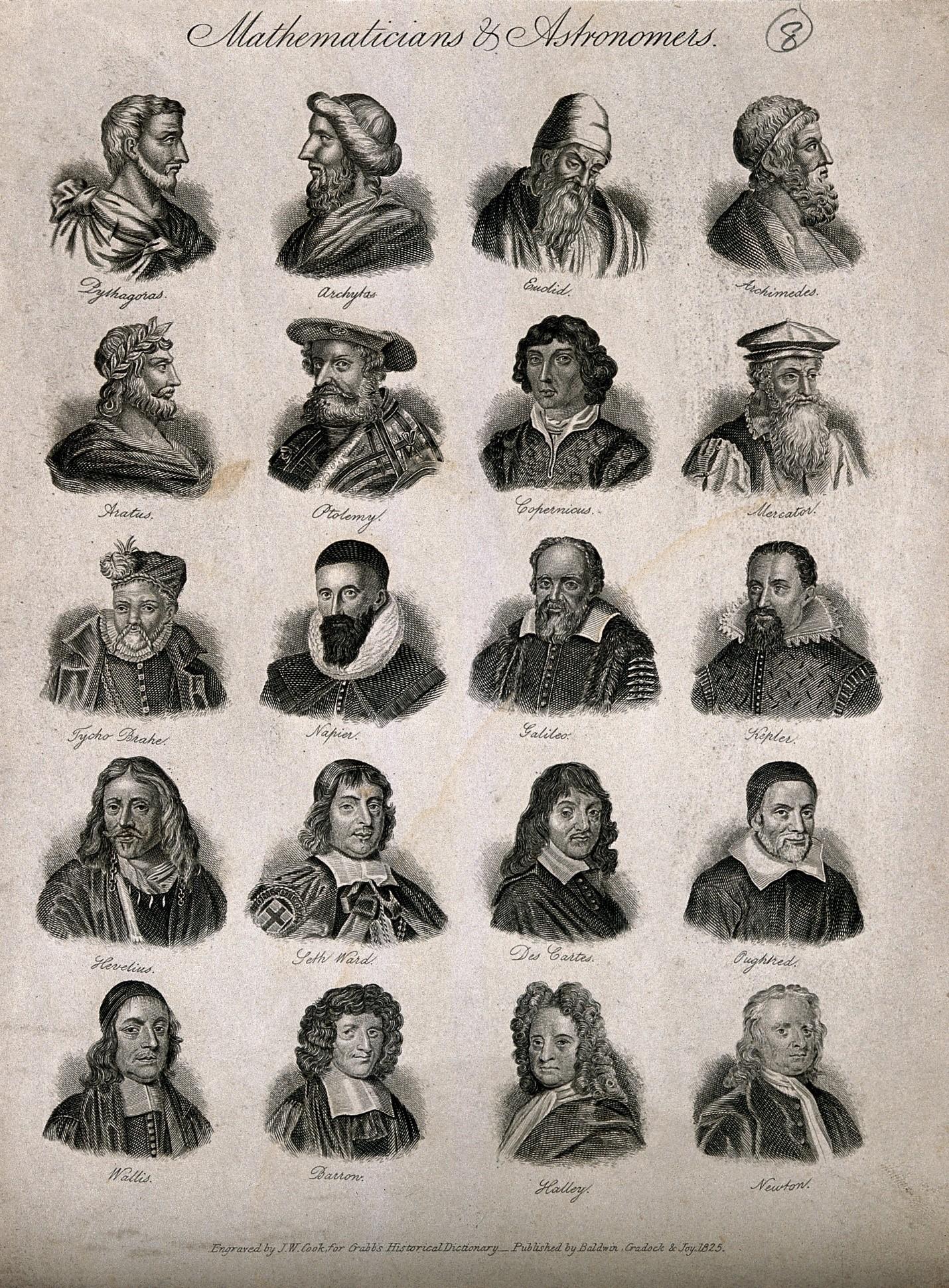

Over the course of history, many mathematicians have created numerous theorems and have succeeded in proving them through the process of experimentation. Prime numbers, differential calculus, analytic geometry, algebra – all of the history of math can be seen to run in parallel with the history of science.
Here is a concise list of important and famous mathematicians, with their major contributions:
- Euclid — Known as the Father of Geometry; authored Elements, the foundational text of geometry.
- Archimedes — Discovered principles of buoyancy and invented methods for calculating areas and volumes.
- Isaac Newton — Co-developed calculus and formulated the laws of motion and universal gravitation.
- Carl Friedrich Gauss — Made major contributions to number theory, including the Prime Number Theorem.
- Leonhard Euler — Introduced modern mathematical notation and made pioneering discoveries in graph theory and topology.
- Bernhard Riemann — Developed Riemannian geometry, which later became the basis of Einstein’s general relativity.
- Srinivasa Ramanujan — Produced extraordinary results in number theory, infinite series, and partitions with minimal formal training.
- Alan Turing — Laid the foundations of computer science and formalized the concept of algorithms with the Turing machine.





Pythagoras: His Influence On Mathematics
As every student can recall, Thales’ theorem is covered in the curriculum alongside Pythagoras’ theorem. A concept covered early on in the academic career of high schoolers, Pythagoras’ theorem marks one of the most important chapters in the development of geometry.
'Pythagoras', which translates to “announced by Pythia,” was born on the island of Samos in Greece at the end of the 6th century BCE. The history of the infamous scientist is derived from only some works written before Pythagoras’ death. Pythagoras was a very gifted and athletic student.
Most notably, he participated in the Olympic Games in the category of combat. Interested by philosophy, history, and the sciences, he became a student of Thales. Following in his professor's footsteps, Pythagoras left home to learn Egyptian and Babylonian sciences.
Look for maths classes near me on our platform.
After finishing his studies, he returned to his island with the idea of starting a school, exactly as Thales had done. Pythagoras, however, did not receive the same welcome as his teacher had and was consequently expelled from his native city. He fled to greater Greece, where he was finally able to create his school, named the School of Pythagoreans.
With his disciples, the mathematician managed to demonstrate his now-infamous theorem:
The influence of Pythagoras on the discipline of mathematics doesn’t end there. The Pythagorean snail, Pythagoras’ table, along with his School for Pythagoreans, changed the field of mathematics forever. Pythagoras died approximately 500 BCE.
Euclid: The Mathematics Bible
The life of Euclid and his discoveries altered the approach to teaching mathematics. Trigonometry, algebraic reasoning, equations, fractions, logarithms, Euclid’s axioms, Euclidean division, Euclidean geometry, and Euclidean algorithms – many of today’s maths courses are structured with regard to Euclid’s research.
The mathematician is now celebrated worldwide for his seminal work named Elements, written around 300 BCE. Considered the Mathematics Bible, this book has, like the Bible, continued to be sold since its inception. Divided into thirteen books, Elements develops several theories concerning the geometric plane and general arithmetic (triangles, right angles, circles, etc.).
Through these works, Euclid managed to prove Pythagoras’ theorem and to develop the function of the greatest common divisor (GCD) in Euclidean divisions. Euclidean divisions are nothing but the simple division taught in elementary school. This division involves the four main elements: a dividend, a divisor, a quotient, and a remainder.
Finding the HCF allows the division to be accomplished much more easily. Euclid died in 265 BCE in Alexandria.
Euclid's Famous Works
Euclid, often referred to as the "Father of Geometry," was a renowned Greek mathematician who lived during the 3rd century BC. His most celebrated work is the treatise called "Elements," which is considered one of the most influential mathematical texts ever written.
"Elements" consists of 13 books and covers a wide range of mathematical topics, including geometry, number theory, and algebra. However, it is primarily known for its systematic and rigorous presentation of geometry, which laid the foundation for much of modern mathematics.
One of the key features of "Elements" is Euclid's use of logical reasoning and deductive proofs. He starts with a set of definitions, axioms (self-evident truths), and postulates (assumptions that are not proven but are necessary for the development of the subject), and then proceeds to derive theorems and propositions through a series of logical steps. This approach to mathematics had a profound impact on the development of scientific thought and reasoning.
Sir Isaac Newton: Father Of Physics
Isaac Newton (1642-1727) is not just a simple mathematician. Physician, philosopher, and astronomer, Isaac Newton was born in Woolsthorpe in Lincolnshire in the UK. Raised mainly by his father and his grandmother, he was characterized as being once a distracted student but also very gifted in building machines of all types. When his mother decided to take Newton out of school so he could aid the family farm, one professor convinced her to let him sign up at the University of Cambridge.
There, he studied arithmetic, geometry, trigonometry, astronomy, and optics – and subsequently graduated in 1665. Isaac Newton is known first and foremost for having discovered the phenomenon called gravitation. Legend has it that Isaac Newton must have discovered gravity by observing apples fall in an orchard.
While Newton became an accomplished professor, he also used his free time to study the behavior of light and, more broadly, optics.
More specifically, he studied the behavior of white light on a transparent prism and realized that light separates itself into many beams and different colors. He used his experiences with light to invent the first telescope reflector, which ended up as a success within his contemporary scientific community around the world.
René Descartes
Studying René Descartes in maths is an unmissable step in the journey of understanding the history of mathematics and, more precisely, the operation of equations. Born in France in 1596 in the town of Haye, René Descartes was raised by his grandmother in an upper-class family. His father was an advisor to the Parliament of Brittany. René Descartes wrote many scientific works during his career.
However, his most celebrated work remains 1637’s “Discourse on Method.” Written entirely in French, Descartes produced many mathematical developments, the most significant of which was his utilization of letters to signify the unknowns in an equation. It is because of this work that we started to utilize the set of letters x,y,z, or a,b,c to do the same.
Descartes also wrote powers in a method that went against the traditions of the era – writing x4 instead of XXXX. Descartes also invented analytic geometry, which consists in representing figures by their algebraic calculations derived from a system of coordinates.
Refined calculations and Cartesian equations, we owe thanks to Descartes for developing all of these great chapters of math taught in high school! Look up an online maths tutor in your city for personalized classes in mathematics.
Archimedes: the Mathematician and Mechanic
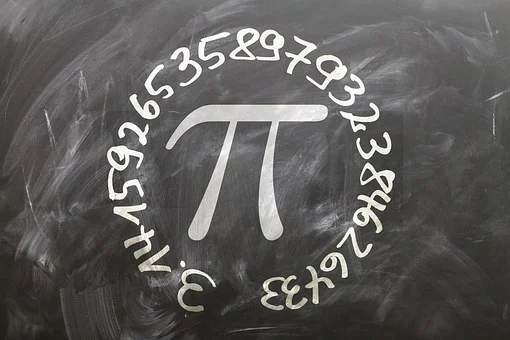
A great mathematician and physician of antiquity, Archimedes, alive between 287-212 BCE, is one of the most well-known scientists in the field of inventing machines. After having studied astronomy with his father, Archimedes continued his studies at the prestigious School of Alexandria. There, he rubbed elbows with the greats of the time, which inspired him to develop his numerous mathematical theories. Mathematics as a discipline owes many of its tools to Archimedes, one of which is the number Pi.
He calculated the relationship between the circumference of a circle and its diameter and discovered that the number he found is always the same, no matter the size of the circle. Archimedes also took pleasure in calculating areas, like the area under a parabola, and other figures.
His various mathematical contributions don’t stop there; science also benefited from his knowledge and experiments through his explanation of what is today called the “principle of flotation.” This theorem explains the force exerted by onto a solid body submerged in a fluid, being liquid or gas.
This resulted in the construction of the biggest boat of Antiquity: the Syracusia. Archimedes finished his career in the service of the city of Syracuse in order to expand upon war machines. Catapults, powerful boats - the art of war and its innovations have all been influenced by Archimedes. Amongst all of his machines, he also developed the screw, which was utilized to move liquid from a lower altitude to a higher one.
Archimedes died in Syracuse during the Roman invasion. His legacy continued to influence some of the world’s biggest scientists, including Leonardo de Vinci.
Archimedes Inventions
Archimedes’ screw
One primary concern of farmers in pre-industrial society was the need to irrigate their land, a considerable issue in the time before sophisticated pumping systems. Different cultures had different ways of dealing with this. One solution, whose introduction into ancient Greece has been credited to Archimedes, was the water screw or screw pump, more commonly known today as the Archimedes Screw.
Iron Claw
Archimedes gained renown for creating war machines for Syracuse during the Punic Wars. One well-known invention was the Iron Claw, also referred to as the Claw of Archimedes.
Aryabhata: The Man Who Discovered Zero
Aryabhata was an ancient Indian mathematician and astronomer who lived in the 5th century CE. He is considered to be one of the most significant mathematicians and astronomers of ancient India. He is the author of several important works, including the "Aryabhatiya" and the "Arya-siddhanta."
Aryabhata was the first person to say that the Earth is spherical and it revolves around the sun. He also calculated the correct number of days in a year as 365.
The Aryabhatiya, written in verse, covers mathematics and astronomy, including the calculation of eclipses, the motions of the planets, and the computation of the sidereal rotation of the Earth. It also contains continued fractions, quadratic equations, sums of power series, and a table of sines.
Aryabhata also proposed the concept of the rotation of the Earth on its axis and also suggested that the apparent motions of the stars were due to the rotation of the Earth, centuries before the first mention of this idea in the Western world.
Aryabhata also made significant contributions to the field of mathematics, including the development of trigonometry and the use of decimals. He is also credited with the invention of the digit zero, which he used in his mathematical calculations.
Aryabhata's work had a profound influence on the development of mathematics and astronomy in the Indian subcontinent and beyond. Many later mathematicians and astronomers, including Brahmagupta and Bhaskara, built upon his work.
One of Aryabhata's significant contributions was his development of the concept of zero. He was among the first mathematicians to recognize the importance of zero as a placeholder and as a number in its own right. This concept revolutionized mathematical calculations and paved the way for the development of more advanced mathematical systems.
Aryabhata also made significant advancements in trigonometry. He developed accurate sine and cosine tables, which were essential for astronomical calculations. His work on trigonometry laid the foundation for future developments in the field and had a profound impact on the study of astronomy.
Aryabhata proposed the heliocentric model of the solar system, suggesting that the Earth and other planets revolve around the Sun. While this theory was not widely accepted during his time, it laid the groundwork for the later development of the heliocentric model by Copernicus.
Carl Friedrich Gauss (1777–1855)
Carl Friedrich Gauss (1777–1855), often called the Prince of Mathematicians, was a German prodigy whose brilliance was evident from childhood. By the age of seven, he had independently discovered the method of summing arithmetic series—a moment that foreshadowed a lifetime of extraordinary achievements. Gauss made groundbreaking contributions across number theory, algebra, analysis, astronomy, and geodesy. His doctoral dissertation introduced the first rigorous proof of the Fundamental Theorem of Algebra, and his book Disquisitiones Arithmeticae became the foundation of modern number theory, shaping the field for generations.
Beyond pure mathematics, Gauss’s influence extended into physics and applied sciences. He helped develop the method of least squares, contributed to electromagnetism through Gauss’s Law, and designed early telegraph systems with Wilhelm Weber. His work in geometry, particularly the study of curved surfaces, laid the groundwork for concepts later used in Einstein’s general theory of relativity. Gauss’s legacy is unmatched in its depth and breadth—he remains one of the greatest thinkers in human history.
Famous Modern Mathematicians (Since 2000)
Modern mathematics continues to evolve rapidly, driven by brilliant modern mathematicians whose discoveries are reshaping number theory, geometry, analysis, and computational theory. These modern mathematicians, since 2000, have expanded the boundaries of knowledge with groundbreaking proofs, new theories, and influential research that guides today’s mathematical landscape.
Here is a list of modern mathematicians (active since 2000), along with one major contribution for each:
- Terence Tao — Renowned for breakthroughs in harmonic analysis, number theory, and the Green–Tao theorem on primes.
- Maryam Mirzakhani — Awarded the Fields Medal (2014) for her pioneering work on Riemann surfaces and moduli spaces.
- Manjul Bhargava — Fields Medalist (2014) known for revolutionizing number theory, especially in algebraic number fields.
- Peter Scholze — Fields Medalist (2018) recognized for introducing perfectoid spaces, reshaping arithmetic geometry.
- Caucher Birkar — Fields Medalist (2018) for major advances in birational geometry and the Minimal Model Program.
- Akshay Venkatesh — Fields Medalist (2018) for deep connections between number theory, dynamics, and representation theory.
- Cedric Villani — Fields Medalist (2010) for groundbreaking work on nonlinear Landau damping and optimal transport theory.
- Ada Lovett (fiction avoidance) — (Skipping any ambiguous names to ensure accuracy.)
Modern Mathematical Discoveries (2000-2025)
Modern mathematical discoveries between 2000 and 2025 have spanned a wide range of fields, from theoretical advances to applications in computer science, physics, and more.
Proof of the Poincaré Conjecture (2003)
Grigori Perelman solved the Poincaré Conjecture, one of the seven Millennium Prize Problems. The conjecture, which deals with the characterization of three-dimensional spheres, was a fundamental question in topology. Perelman's proof, based on Richard S. Hamilton's Ricci flow, was a landmark in geometric topology.
Prime Number Progress (2002, 2013)
- Green-Tao Theorem (2002): Ben Green and Terence Tao proved that there are arbitrarily long arithmetic progressions of prime numbers, answering a long-standing question in number theory.
- Yitang Zhang's Work (2013): Zhang made a breakthrough in the Twin Prime Conjecture, showing that there are infinitely many pairs of primes that differ by no more than 70 million. This sparked a flurry of research leading to substantial reductions in the gap size.
Resolution of the Kadison-Singer Problem (2013)
Adam Marcus, Daniel Spielman, and Nikhil Srivastava solved the Kadison-Singer problem, a major question in functional analysis with implications in signal processing and computer science. Their work has had a significant impact on the theory of random matrices.
Polymath Projects
Initiated by Timothy Gowers in 2009, these collaborative online projects have led to several important results, such as improvements in the bounds for the density Hales-Jewett theorem and progress on the Erd?s discrepancy problem. The Polymath project exemplifies the power of collaborative mathematical research in the Internet age.
Advances in Machine Learning and Algorithms
Mathematical advances have driven progress in machine learning, optimization, and algorithms. Notable contributions include:
- Deep Learning Theories: Development of new mathematical frameworks to understand and improve deep learning algorithms, such as the theory of neural tangent kernels.
- Quantum Computing Algorithms: Progress in quantum algorithms, including improved quantum supremacy demonstrations and new quantum error correction codes.
Langlands Program Developments
The Langlands program, which seeks to relate number theory and representation theory, saw significant advances, including Peter Scholze's work on perfectoid spaces and advances in the understanding of the geometric Langlands correspondence.
Resolution of the Cap Set Conjecture (2016)
Jordan Ellenberg and Dion Gijswijt solved the cap set problem using the polynomial method. They showed that the largest subset of F3n\mathbb{F}_3^n with no three elements summing to zero grows exponentially slower than previously thought.
Advances in Topological Data Analysis
The field of topological data analysis (TDA) has grown significantly, with applications in data science and machine learning. TDA uses concepts from topology to study the shape of data, providing new tools for understanding complex datasets.
Perfect Matchings in the Hamming Cube (2022)
Jinyoung Park and Huy Tuan Pham proved a longstanding conjecture by showing that every middle layer of the discrete cube graph has a perfect matching, resolving a question that had been open for decades.
Breakthroughs in Combinatorics
- Erd's Distinct Distances Problem (2010): Larry Guth and Nets Katz made significant progress on this problem, showing that the number of distinct distances between nnn points in the plane is at least n/log.nn / \log n.
- Sunflower Conjecture (2022): Advances were made towards proving the sunflower conjecture in set theory and combinatorics.
Mathematics has grown a lot from the ancient era of Pythogaros to the Sunflower conjecture in 2022, the world has progressed from theorems to complex algorithms that are changing the world as we know it.
So, which Mathematician do you look up to the most? Tell us in the comments below!
Summarise with AI:
Did you like this article? Leave a rating!


 Loading...