

The Vedas, collectively called Chathurveda, are a collection of four sacred texts from ancient India. They are extremely important in Indian society, Hinduism, history, anthropology, and philosophy.
The Four Vedas at a Glance
- Rig Veda — Ancient hymns of praise exploring the universe and nature.
- Yajur Veda — Ritual formulas guiding priests in performing sacred ceremonies.
- Sam Veda — Collection of chants and melodies derived mostly from the Rig Veda, used in liturgy.
- Atharva Veda — Texts of everyday life, spells and prayers that reflect common social needs.
Each Veda is traditionally divided into four parts: the Samhita, Brahmana, Aranyaka, and Upanishad.
- The Samhita contains hymns and prayers.
- The Brahmana explains rituals and ceremonies.
- The Aranyaka offers meditative teachings from the forest.
- The Upanishad explores spiritual and philosophical truths.
The Atharvaveda stands apart, as it does not include an Aranyaka, focusing instead on practical hymns and everyday wisdom.
People still use the Vedas in their lives to learn about philosophy and spirituality, in addition to utilizing the mantras for religious purposes.
Now that you can name the four vedas, are you ready for a crash course in understanding the basics of the Vedas? Read on!


Who Wrote the Vedas?
The original Vedas were not written but instead were composed. This is because they were strictly an oral tradition. Disciples were meant to learn directly from a guru, who would teach them the true interpretation of the information as well as the correct pronunciation and musicality, something you can’t get when you study alone.
The actual “author(s)” of the Vedas is not 100% clear. It is believed to have been composed by numerous Rishis over thousands of years as they received divine knowledge during intense meditation.
This collection of knowledge was passed on in oral tradition for hundreds or thousands of years before being written, sometime between 1700 BCE (the Rigveda), and 1200 BCE to 900 BCE (the other three Vedas).
The belief that the Vedas are older than we know is reinforced by the history of the person credited with scribing the Vedas for the first time.
The Veda Vyasa (a title meaning the Sage granted by the Divines to write the Vedas) named Krishna Dvaipayana is said, according to Hindu texts, to have been born at the end of the Dvapara Yuga (era or age) which ended around 5,000 years ago.
A person can achieve everything by being simple and humble.
The Vedas
According to legend, he was born immediately after being conceived and instantly grew into an adult. During his lifetime, he was an ascetic, renouncing material possessions and instead focusing on spiritual pursuits.
It’s said he knew that the Dvapara Yuga was ending and that the next Yuga, the Kali Yuga, would be the most difficult of the four Yugas in the Hindu time cycle. To help humanity prepare, he compiled all the major spiritual texts in Hinduism: the Vedas, the Bhagavad Gita, The Mahabharata, The Puranas, and the Brahma Sutras.
It’s theorized by Swami Vivekananda that Vyasa was not actually one person, and was instead many sages who were happy to credit their work to this one person because the sages were not concerned with claiming authorship. Vivekananda says that anyone who ever contributed to writing a new Purana can be considered Vyasa because it is a title, not a name.
The Four Disciples of Veda Vyasa
Veda Vyasa taught the Vedas to his four most trusted disciples so that they may go forth and teach the word to their own disciples, and so on and so forth, spreading the wisdom of the Vedas far and wide.
Each disciple was given a different Veda to preach.
- Rishi Paila taught the Rig Veda
- Rishi Vaishampayana taught the Yajurveda
- Rishi Jaimini taught the Samaveda
- Rishi Sumanthu taught the Atharvaveda
Each of these disciples went on to have their own disciples and in the case of Rishi Vaishampayana, were pivotal in the futures of their respective Vedas.
Rishis Who Contributed to the Vedas
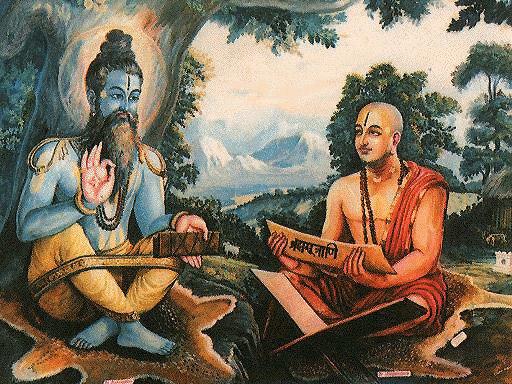
While Veda Vyasa is said to have created the first iteration of the written Vedas, that does not mean that his versions were the end-all versions.
In fact, all four of the Vedas have gone through numerous recensions, being modified and improved as seen fit by different Rishis, which created many different schools - Shakhas - of each Veda.
For a long time, the Vedas were a living text that was moulded to suit the needs of the people who were utilizing the text; one village may have emphasized one type of mantra and another village might have focused on a different aspect.
Generally, Vedic practitioners are happy to let people practice their spiritual and religious beliefs according to whichever Shakha suits them best.
What Are the Names of the Vedas?
The oldest and biggest Veda in the Chathurveda is the Rigveda.
The second written Veda is the Yajurveda.
Third, the Samaveda was written.
Lastly, the Atharvaveda was written.
What Is Each Veda About?
Breaking up the Vedas into their most basic facts is necessary to convey the massive amount of information contained within each Veda.
One thing to know is that “Veda” means “Knowledge,” so each Veda is about the Knowledge of something.
Let’s break down the basics.
Oldest and largest Veda
Rig means “praise”; it’s known as the “Book of Praise”
Mantras are called Riks
Priests: Hota
Focuses on hymns dedicated to gods like Agni, Indra, and Soma
Fun fact: The Rigveda can be organized in different ways — the Mandala Krama is the most popular.
Mantras
Second oldest Veda
Yajus means “practice” or “ritual”
Known as the “Book of Rituals”
Divided into two main shakhas: Krishna (Black) and Shukla (White)
Mantras are called Yajus
Priests: Adhvaryu
Mainly deals with ritual fires and ceremonial procedures
Contains 3,988 mantras (in both shakhas combined)
Fun fact: This Veda provides the chants used by priests while performing sacrifices.
Mantras (in both shakhas combined)
Third oldest Veda
Sama means “melody”; also known as the “Veda of Songs”
Mantras are called Samans
Priests: Udgata
Primarily used in rituals involving music and chanting
Provides the foundation for Indian classical music
Fun fact: Most verses are adapted from the Rigveda but meant to be sung.
Mantras
Youngest of the four Vedas
Atharvan means “fire priest” — symbolizes energy and protection
Known as the “Book of Magical Formulas” or “Knowledge of Magic and Healing”
Contains 20 books and numerous hymns on daily life, health, and spirituality
Priests: Brahman
Focuses on peace, prosperity, and protection through prayers and charms
Fun fact: It stands apart for addressing real-world human concerns, not just rituals.
Mantras (approx.) depending on shakha
What Are the Parts of the Vedas?
Each Veda contains 4 parts: Samhita, Brahmana, Aranyaka, and Upanishad.

Samhitas
When people talk about the information in any Veda, they are typically referring to the information in the Samhita. You could even call any Veda like Rigveda-Samhita, Yajurveda-Samhita, etc.
The Samhitas are the most ancient part of any Veda; they were written first. They contain the mantras, hymns, prayers, etc which are the studied parts of the Vedic text.
Aranyakas
The Aranyakas are the elaboration of the philosophy behind the ritual sacrifices pertaining to that particular Veda.
Brahmana
The Brahmana is the portion of the Veda that contains commentary on the Samhitas.
Upanishad
The Upanishads have recorded conversations between gurus and disciples to clarify ideas, messages, and philosophies in the Samhitas.
Some of the Vedas are “missing” certain sections, but this means that the text of that nature hasn’t yet been rediscovered. It is assumed that there is a document to serve as the missing piece somewhere in an ancient archive, but unfortunately, it remains hidden in the modern day.
Each Veda has its own collection of Samhitas, Aranyakas, Brahmanas, and Upanishads. To list each one would become far too confusing and exhaustive because there are so many shakhas in many different parts of many different Vedas. To list them all would look like a very confusing family tree!
What Is the Purpose of the Vedas?
The Vedas are educational devotional texts mainly meant to educate priests and pandits so they can better serve their communities. This is why such people must spend years and years in intense learning to understand what they need to know to lead ceremonies and rituals effectively.
Nowadays, thanks to the written form of the Vedas and increased literacy in the population, anyone is free to study the Vedas on their own.
This is a major shift from the original format of transmitting the information, which used to be exclusively between guru and disciple and exclusively through spoken words only.
Whether being studied by a priest or a layman, the modern goal of the Vedas is to help inform the reader about spirituality, religion, deities, philosophy, and living a healthy and righteous life.
Each Veda focuses on a different aspect of this wider idea.
The Rigveda focuses on introducing all the deities, setting the stage for our place in the cosmos and the universe, establishing basic information about the nature of reality, and teaching the reader about consciousness and spirituality.
The Yajurveda teaches all about rituals and ceremonies required for spiritual and religious fulfilment. There are numerous rituals to perform for different stages of a person’s life including birth, coming-of-age, marriage, becoming a parent, and death. Additionally, there are rituals to be used for things like blessing a home, repelling negativity, and invoking prosperity; the list goes on! The Yajurveda provides detailed instructions on the who, what, when, where, and how of these rituals.
The Samaveda provides an easier way to memorize the information in the mantras: through song! It teaches the reader how to read mantra in a rhythmic and tonal way, making it much easier to remember than memorizing pages and pages of words. It also teaches meditation and devotion through song.
The Atharvaveda provides actions for people to take in their daily lives. It offers medical advice (which was eons ahead of its time) including surgical procedures, medicinal herbs, and germ theory to help people stay healthy. It offers rituals, ceremonies, incantations, charms, and more that people can use to invoke or repel things as needed. The Brahman priests of the Athurvan school are considered extremely important because they can nullify sins and ward away negativity from ceremonies.
The best way to study the Vedas is to become a disciple to a learned guru, as they did in the beginning since the gurus can understand the deeper truths in the text that we regular folks may not perceive.
What Are the Four Supreme Goals of the Vedas?
The Vedas address the four supreme goals in life, which are known as Purusharthas. These are the goals that are considered to be important to every person in their life; their guiding principles.
Dharma
Dharma pertains to the principles of living a virtuous life aligned with responsibilities and societal norms, emphasizing righteousness, duty, and ethical conduct.
Artha
Artha represents the pursuit of legitimate means to achieve material prosperity, wealth, and success, focusing on economic well-being and fulfilling one's material needs.
Kama
Kama refers to the pursuit of aesthetic, emotional, and sensual pleasures in life, encompassing desires, sensual enjoyment, love, art, relationships, and the appreciation of the senses.
Moksha
Moksha serves as the ultimate aim of spiritual liberation, seeking freedom from the cycle of birth and rebirth (samsara), aiming for union with the divine, realization of the true self (Atman), and understanding the ultimate cosmic reality (Brahman).
Last Thoughts
The Vedas are one of the most influential collections of tomes in history, and even in the modern world.
The compilation of the information, taken from a purely verbal tradition, was revolutionary and surely changed the course of history. It’s also likely that, instead of one man (Veda Vyasa) writing all of the texts, it was actually many different Rishis all writing under the same pen name. Since the Rishis had non-attachment to and recognition that would come with putting their name in, they were simply happy to contribute to their cause even though their name would be lost to time.
How inspiring!
The foundation of Indian society also rests heavily on the Vedas and the knowledge contained within. It is very obviously still a huge part of modern Indian culture and society!
The texts have even influenced and informed people from all over the world, of all different religions and spiritualities, in all different time periods including today.
| Vedic Term | Definition | Vedic Term | Definition |
|---|---|---|---|
| Adhvaryu | Priest who performs Yajurveda rituals (yajna) | Pratyaksha | Perception; Pramana of direct experience of the senses |
| Adhyaayah | Section of the Rigveda made of vargah | Purohit | Chief advisor and guru/priest, traditionally to the King |
| Agnihotra | The practice of making offerings to the Yajna | Purusha | Cosmic being, self, awareness |
| Angiras | Groups of schools and priests | Rajas | Action and energy |
| Anumana | Inference; Pramana of logical reasoning | Recension | Version or edition |
| Anupalabdi | Non-apprehension; Pramana of knowing by absence of evidence | Rigveda | “Rig” means praise; Veda of hymns called “Praise of Knowledge” |
| Anuvaka | Grouping of suktas in the Rigveda | Rk / rg / rik | Mantras of the Rigveda |
| Apaurusheya | Divine wisdom received directly from the gods | Sadhana | Disciplined spiritual practice |
| Aranyageya | Samans meant to be performed alone as meditation | Samans | Mantras of the Samaveda |
| Aranyaka | Section of the Veda focusing on rituals and their symbolic meanings | Samaveda | “Sama” means melody; the “Book of Songs” |
| Arthaapatti | Postulation; Pramana of presumption to fill knowledge gaps | Samhita | Core part of the Vedas containing mantras |
| Arthashastra | Upaveda of the Atharvaveda; treatise on statecraft and policy | Sapta Svara | The seven tones of Indian music: Sa, Ri, Ga, Ma, Pa, Dha, Ni |
| Aryan | People from Central Asia or the Eurasian steppes | Sattva | Mental clarity and balance |
| Ashtakam | Section of the Rigveda with eight Adhyaayahs | Shakha | Recension or branch of a Veda |
| Atharvans | Title given to one steadfast and firm-minded | Shanti | A soothing ritual performed by Atharva priests |
| Atharvaveda | “Athar” means fire; Veda of magical formulas | Shantika karma | Ritual to nullify a mistake during a Yajna |
| Ayurveda | Upaveda of the Rigveda; “Science of Life” | Shloka | A pair of lines in verse |
| Bhaisajya | Medicine | Shruti / Sruti | Works transmitted directly by divine revelation |
| Bhajan | Devotional song | Shruti tones | “Hidden tones” or microtones in Indian music |
| Brahmana | Section of the Veda containing ritual commentary | Shukla | Bright, clear, or pure |
| Chathurveda | The collection of the four Vedas | Soma | Sacred plant, drink, and deity in the Rigveda |
| Dhanurveda | Upaveda of the Yajurveda; treatise on warfare | Sukta / Suktam | Hymn; means “well-said” |
| Dharma | The right way of living that sustains universal order | Talas | Rhythmic patterns |
| Gana | Versatile melodic pattern | Tamas | Ignorance, inertia, lack of clarity |
| Gandharvaveda | Upaveda of the Samaveda; treatise on music and arts | Tantra | Spiritual processes or techniques |
| Gramageya | Samans performed in congregation | Treatise | Systematic written work on a subject |
| Kala Jadoo | Black magic | Udgatri | Singer priest |
| Kanda | Book or division | Upamana | Comparison; Pramana by analogy |
| Kandika | Subsection of a Vedic text | Upanishad | Final section of the Vedas; philosophical dialogue |
| Karma | Ritual and sacrificial actions | Upaveda / Upa Veda | Auxiliary texts associated with the Vedas |
| Krama | Order or sequence | Vargah | Section of the Rigveda made of several Rks |
| Krishna | Dark or disorganized; opposite of Shukla | Varna | Social class or caste |
| Ksattriyas | Warrior class | Veda | Means “Knowledge” |
| Kula / Kulam | Clan or lineage | Veda Vyasa | Sage who compiled the Vedas |
| Mandala | Organizational structure in the Rigveda | Vina | Instrument played by goddess Saraswati |
| Mantra | Sacred utterance or verse emphasizing sound | Yajamana | Patron of a Yajna |
| Mudra | Symbolic movement or posture | Yajna / Yagna / Havan / Homa | Ritual fire ceremony |
| Pandit | Learned scholar in Vedic knowledge | Yajurveda | “Yajus” means ritual; the “Book of Rituals” |
| Paurusheya | Knowledge of human origin | Yajus | Mantras of the Yajurveda |
| Paushtika karma | Ritual to repel negative forces | Yajush | Prose text in the Yajurveda |
| Pramana | Methods of obtaining knowledge | Yantra | Tool or sacred diagram used for spiritual aid |
| Pranayama | Breathing technique | Yuga | Era or age |
| Prapathaka | Chapter within the Brahmana section | — | — |
References
- “Introduction.” Vedic Heritage Portal, vedicheritage.gov.in/introduction/.
- Skree. “The Vedas – Origin and Brief Description of 4 Vedas.” 108 House, 18 Oct. 2021, www.108.house/the-vedas-origin-and-brief-description-of-4-vedas/.
- “Veda Vyasa: The Sage Who Compiled the Vedas.” Hindu American Foundation, 21 Sept. 2020, www.hinduamerican.org/blog/veda-vyasa-the-sage-who-compiled-the-vedas.
- “Veda.” Hindupedia, the Hindu Encyclopedia, 8 Apr. 2023, hindupedia.com/en/Veda.
Summarise with AI:
Did you like this article? Leave a rating!


 Loading...






Brilliant summary and compilation. It cleared all my doubts regarding Vedas.
Thankyou
Thank you for your kind words!