
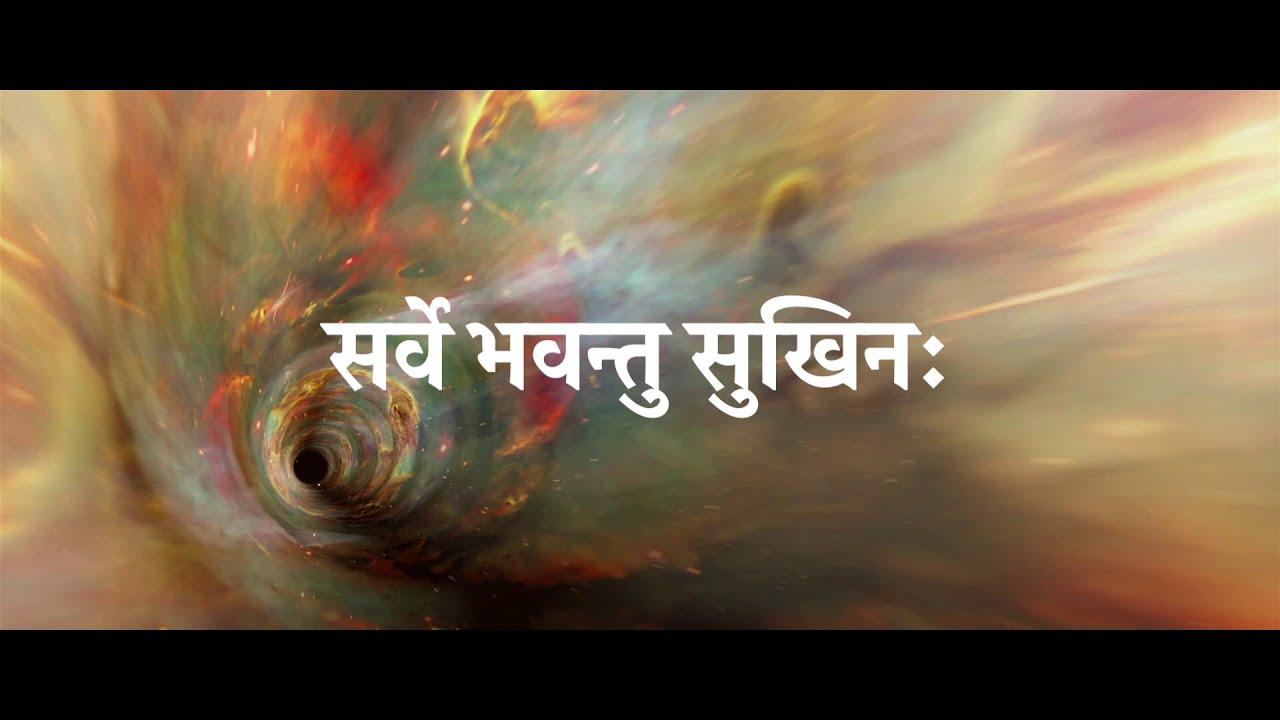

The Om Sarve Bhavantu shloka is a profound peace mantra in Sanskrit that aims to foster peace, harmony, and optimal well-being for all individuals. This mantra is employed to cultivate a state of serene tranquility and overall wellness during a yoga practice. Yoga practitioners utilize this peace mantra to effectively direct the mind toward gaining a broader understanding of life. Let us explore this ancient yoga mantra and what it means.


Meaning of Sarve Bhavantu Sukhinah Shloka
Sarve Bhavantu Sukhinah Shloka Text & Meanings
Verse 1:
|| Om
Sarve Bhavantu Sukhinah
Sarve Santu Niraamayah ||
Verse 1: Meaning
|| Om Sarve Bhavantu Sukhinah; Sarve Santu Niraamayah ||
May all beings be blissful,
May all beings be free from illness.
Verse 2:
|| Sarve Bhadraani Pashyantu
Maa Kashchit Dukha Bhaagbhavet
Om Shanti Shanti Shantihi ||
Verse 2: Meaning
|| Sarve Bhadraani Pashyantu; Maa Kashchit Dukha Bhaagbhavet; Om Shanti Shanti Shantihi ||
May all beings see the good within and on the outside,
May no one cause or undergo suffering,
Peace, peace, peace!
Understand and embrace death with the powerful Sanskrit chant, Mahamrityunjaya mantra.
Different Iterations of the Mantra
The Om Sarve Bhavantu Sukhinah shlokais often known as the Sarve Bhavantu Sukhinah peace mantra. Although the fundamental components of the mantra remain mostly unchanged, there could be differences in how it is spoken and transliterated. Furthermore, alternative designations for this mantra may encompass the Universal Peace Prayer or Shanti Paath. The semantic interpretation of this shloka stays unaltered.
Benefits of the Shloka
The Om Sarve Bhavantu Sukhinah shloka offers several advantages for the mental well-being of the one reciting it as well as the individual listening to it. By incorporating this melodious Yoga mantra into your meditation practice, you can experience several benefits such as the following:
Elicits Empathy
Engaging in the repetition of this mantra can facilitate the awakening of our innate reservoir of love and compassion.
Promotes Optimism
This chant is formidable in fortifying our will for tranquility, optimism, and joy.
Eliminates Avarice and Envy
The mantra aids in the suppression of negative thoughts such as greed and envy.
Search for a professional tutor and take a Sanskrit class on Superprof today.
History of Sarve Bhavantu Sukhinah Shloka
The Sarve Bhavantu Sukhinah shloka is widely referenced in the context of spirituality, dharma, universality, and well-being since it beautifully illustrates the concept of the well-being of everyone.
However, it is remarkable that there is a scarcity of textual references that accurately cite the origins of this passage. The sole citation found in several online sites, and even in several academic articles, attributes this poem to the Brihadaranyaka Upanishad (1.4.14). This assertion is completely incorrect, as the mentioned Upanishad does not include this passage in any manner whatsoever.
From where does this renowned verse originate?
The line can be found in a slightly altered version in the final verse of Garuḍa Purāṇa (2.35.51) and Bhavishya Purāṇa (3.2.35.14). Here, the initial line deviates from its conventional usage and understanding. However, the essence stays nearly the same. The poem found in the Garuḍa Purāṇa is as follows:
सर्वेषां मङ्गलं भूयात् सर्वे सन्तु निरामयाः।
सर्वे भद्राणि पश्यन्तु मा कश्चिद्दुःखभाग् भवेत्।।
sarveṣāṁ maṅgalaṁ bhūyāt sarve santu nirāmayāḥ|
sarve bhadrāṇi paśyantu mā kaścidduḥkhabhāg bhavet||
During a conversation in the Bharatiya Vidvat Parishat Google Group, Hari Parshad Das mentions the आशीर्वचनम् (āśīrvacanam) from a work called इतिहास समुच्चय (itihāsa samuccaya). The poem is presented below:
सर्वे कुशलिनः सन्तु सर्वे सन्तु निराम्याः।
सर्वे भद्राणि पश्यन्तु मा कश्चिद्दुःखभाग् भवेत्।।
sarve kuśalinaḥ santu sarve santu nirāmyāḥ|
sarve bhadrāṇi paśyantu mā kaścidduḥkhabhāg bhavet||
Furthermore, the initial line in this case exhibits variation, yet the essence remains almost the same.
Start each day with the solemn Gayatri mantra.
In the BVP Google Group debate, Prof. Ashok Aklujkar refers to a note in Lakshman Swarup's book that contains the text of a colophon from Uvaṭa's Mantrabhāṣya of Vājasaneya Saṁhitā. Here, the stanza is presented with a little alteration in the final line; however, the overall idea remains almost the same. The following is the text:
शुभं भवतु पाठकलेखकयोः। शिवमस्तु सर्वजगतः।
सर्वे भवन्तु सुखिनः सर्वे सन्तु निरामयाः।
सर्वे भद्राणि पश्यन्तु मा कश्चित्कष्टमाप्नुयात्।।
śubhaṁ bhavatu pāṭhakalekhakayoḥ| śivamastu sarvajagataḥ|
sarve bhavantu sukhinaḥ sarve santu nirāmayāḥ|
sarve bhadrāṇi paśyantu mā kaścitkaṣṭamāpnuyāt||
Based on the information provided in the whole colophon, Uvata is attributed to the latter part of the 11th century CE. Referring to the verse, sarve bhavantu sukhinaḥ, can be done in two ways, as indicated by the information provided above:
- Garuḍa Purāṇa (35.51)
- Aśīrvacanam 2 of itihāsa samuccaya
- Mantrabhāṣya of Uvaṭa
Below are the different versions of the verse:
First line:
1. सर्वे भवन्तु सुखिनः sarve bhavantu sukhinaḥ
2. सर्वेऽत्र सुखिनः सन्तु sarve’tra sukhinaḥ santu
3. सर्वे कुशलिनः सन्तु sarve kuśalinaḥ santu
4. सर्वेषां मङ्गलं भूयात् sarveṣāṁ maṅgalaṁ bhūyāt
Last line:
1. मा कश्चिद्दुःखमाप्नुयात् mā kaścidduḥkhamāpnuyāt
2. मा कश्चित्कष्टमाप्नुयात्mā kaścitkaṣṭamāpnuyāt
3. मा कश्चिद्दुःखभाग् भवेत्। mā kaścidduḥkhabhāg bhavet
The second and third lines are unchanged in all renditions.
Easily learn Sanskrit in Bangalore or wherever you're located when you search for a tutor on Superprof.
When to Recite Sarve Bhavantu Sukhinah Shloka
Undoubtedly, even if one recites this mantra without fully comprehending its significance, one would still experience some advantages. Merely by expressing this message to the cosmos, the energy is being disseminated. Nevertheless, acquiring a more profound comprehension of the significance underlying these words is crucial for attaining the broader advantages of this exquisite prayer.
Sing praises of the Sun God with the mighty Aditya Hrudayam stotram.
While the prayer has its origins in the Hindu tradition, the energy generated by uttering these words is certainly accessible to all individuals, irrespective of their religious affiliation, beliefs, or cultural background. It is not necessary to adhere to any religious beliefs to include these mantras in your routine.
This prayer applies to all people or things. It fosters benevolence and empathy, as well as tranquility and serenity of the mind, body, and soul. We want universal well-being and enjoyment for all beings, encompassing everything in the entire cosmos. We recognize ourselves as an integral component of this collective totality. Thus, when you desire this energy to be bestowed onto everyone and everything, you are desiring it for yourself, as you are an integral component of the collective whole.
Sukha versus Dukha
Sukha, in its literal sense, refers to a state of contentment, well-being, and steadiness. When all elements are in perfect harmony, we encounter Sukha, a state of profound contentment and fulfillment that instinctively draws us towards it. Consider a scenario where a wheel is attached to a cart. When the wheel is properly positioned and balanced, the cart moves without any disruptions. My name is Sukha.
Dukha is the antithesis. Pain, volatility, and anxiety. If the cart wheel becomes misaligned, it will provide a rough ride and may eventually lead to the cart coming to a halt or maybe causing injury to us.
By desiring Sukha, one can counteract Dukha, resulting in the experience of joy, the alleviation of suffering, and the attainment of peace for all sentient beings.
Pashyantu: The Reflective Mirror
We desire for everyone to perceive what is favorable and beneficial, as we are interconnected with all beings and our actions determine the reality we experience. It is important to extend prayers for the well-being of others that align with our desires. We all aspire to lead lives that are both healthy and filled with happiness.
Discover effective online Sanskrit classes when you search for a tutor on Superprof!
Psychosomatic Connection
It seems logical that if our physical well-being deteriorates, whether temporarily or over a prolonged period, we experience a sense of dissatisfaction with ourselves. Experiencing poor health might make it difficult to experience happiness.
Similarly, if we consistently experience stress, discontent, grief, and rage, it might result in a condition of disease or bodily ailments and illnesses. The body and the mind are intricately linked, and by tending to one, we are also tending to the other.
The main point is that when we prioritize our well-being, we are simultaneously prioritizing the well-being of everything else, as there is an interconnectedness among all entities - be it individuals, animals, trees, plants, flowers, rocks, rivers, stars, planets, atoms, or energy quanta. The concept is that every element is intertwined.
Invocation for Peace
After reciting the mantra, we conclude with the ultimate mantra for peace, which is the word "peace": Shantih. Shantih is a term that signifies tranquility and the absence of conflict. Reciting this phrase three times has great importance due to the significance of the number three, which is often regarded as a highly significant numeral. If you contemplate and identify many instances of "trinities," you will quickly realize their abundance.
ॐ: OM
Om is the fundamental origin of all sounds and substances in the cosmos. The fundamental oscillation of all things. Through the act of chanting Om, we purify the surrounding energy and create a conducive environment for the subsequent words to be expressed. The Om chant synchronizes our frequencies with those of each other and the entire world. By calming and focusing our brains, it enhances and empowers the effectiveness of our words and goals.
Lead yourself toward the path of truth with the profound Pavamana Mantra.
Collective Chanting
Chanting has a pervasive impact on all aspects of your being. Meditation greatly benefits from its immense potency. This is not only about mechanically repeating phrases that have been memorized without complete comprehension (although, as previously stated, reciting the words does possess some influence, naturally!). It pertains to comprehending the words you utter and perceive completely. The words resonate with you on an emotional level and evoke a response. The words acquire influence when said with deliberate purpose, and even if there are little inaccuracies, the original aim stays untainted and the message is effectively conveyed.
Chanting enhances mental concentration, enabling us to transcend the limitations of our physical existence and explore the boundless realm of the infinite. Engaging in the act of chanting, particularly in a group setting, may lead to a profound state of absorption and generate remarkable vibrational energy. This experience not only enhances our sense of connection and well-being but also generates positive energy that can be directed forth into the cosmos.
Summarise with AI:
Did you like this article? Leave a rating!


 Loading...
