
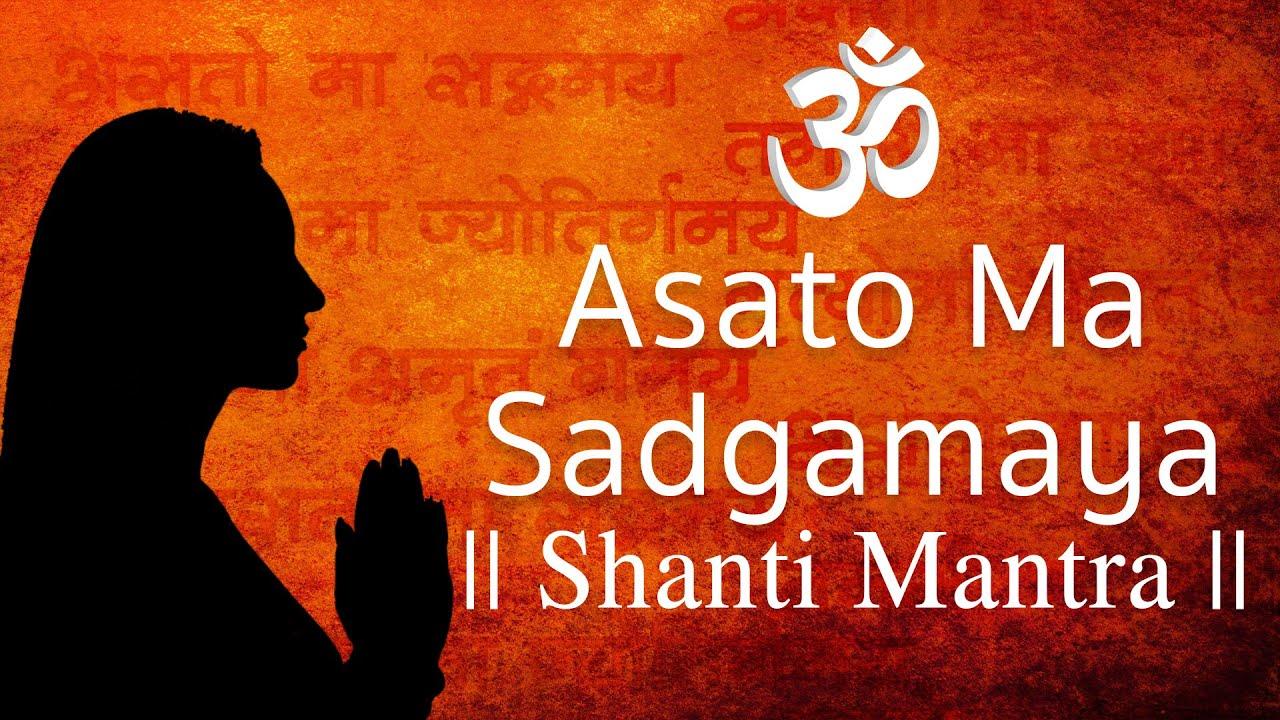

| ॐ असतो मा सद् गमय तमसो मा ज्योतिर्गमय मृत्योर् माम्रतं गमय ॐ शान्तिः शान्तिः शान्तिः Transliteration Om asato ma sadgamaya Tamaso ma jyotir gamaya Mrtyor ma amrtam gamaya Om shanti shanti shanti Translation From unreal, lead me to the real; From darkness, lead me to light; From death, lead me to immortality; Om peace, peace, peace |
The Asatoma Sadgamaya Mantra is a universally applicable prayer that seeks enlightenment and liberation from fear. This chant consists of four potent affirmations of well-being that we project into the Universe. By reciting this mantra, both the one chanting it and the person listening to it want to eliminate negativity in all its manifestations and remain focused on their journey toward a meaningful existence.
Asatoma Sadgamaya Meaning in Detail
The Pavamana mantra starts, like other Sanskrit chants, with the sacred syllable "om". Om is said to embody the Divine in the form of auditory vibrations. The utterance of this sound is universally recognized as the sound of creation itself.
The phrase "Asato ma sad gamaya" translates to "lead us or guide us from ignorance to knowledge." This motivates us to overcome the ignorance that obstructs our perception and prevents us from attaining complete knowledge and understanding, enabling us to exist in a state of omniscience and comprehensive comprehension.
The phrase "Tamaso ma jyotir gamaya" translates to "lead us from darkness to light." The term "jyotir" refers to light, particularly, whereas darkness is used to represent personal negativity. This statement suggests that we have the potential to liberate ourselves from our inner turmoil and transition toward a state of enlightenment.
Mrityor ma amritam gamaya implores that we may be liberated from the constraints of mortality and exist in a perpetual state of immortality.
The phrase "Om shanti shanti shanti" translates to "peace, peace, peace".
Therefore, the complete mantra can be interpreted as:
Guide us from a state of ignorance to a state of knowledge
Guide us from obscurity to illumination
Harmony, tranquility, serenity.
| Word | Meaning |
| Asat | unreal; non-existence; untruth; ignorance |
| Ma | me |
| Sat(Sad) | reality; truth |
| Gamaya | gam means movement; gamaya means to move or lead |
| Tam (tamas) | darkness; ignorance |
| Jyoti (jyotir) | light; clarity; purity |
| Mrityu (mrityor) | death |
| Amrita (amritam) | deathlessness; ambrosia |
| Om | holy word; word of creation; holy vibration; god |
| Shanti | peace |
Invite peace into your life with the ultimate peace mantra, Sarve Bhavantu Sukhinah.
This prayer is a modest entreaty that might be directed towards God, the practitioner's elevated essence, a guru, or a spiritual mentor. These prayers are beneficial for establishing a tranquil atmosphere and for pacifying the mind. The practitioner has the option to vocalize this prayer by singing, chanting, or silently reciting it in a contemplative manner. This mantra can be recited alone, but it is also frequently seen in contemporary recordings played during yoga sessions and collective chanting events known as kirtan.
This mantra is flexible and can be used in many settings:
Morning practice: to begin the day with clarity and intention
Before studying or teaching: to focus the mind
During yoga or meditation: as a centering “opening” or “closing” chant
During stressful periods: to return to calmness and perspective
Before sleep: to settle worries and end the day peacefully
In many traditions, it is recited as a “peace prayer” (Shanti mantra), especially at the start or end of spiritual learning.


Story of Asatoma Sadgamaya Mantra
The Pavamana Mantra, sometimes referred to as pavamāna abhyāroha, is an ancient Indian mantra mentioned in the Bṛhadāraṇyaka Upaniṣad (1.3.28). The phrase "pavamāna" derives from the historical connotation of being cleansed or stretched, which was originally associated with Soma. The term "abhyāroha" is an Upanishadic technical term for prayer, specifically indicating the act of rising. The mantra was first intended to be chanted during the opening commendation of the soma sacrifice by the benefactor financing the sacrifice.
The whole translation of the mantra is as follows: "Guide us away from lack of knowledge towards understanding, from obscurity to illumination, and from mortality to eternal life." This prayer is spoken as a kind of purification, either for one's welfare or for the betterment of humanity.
Every phrase in this prayer promotes the practitioner to embody their highest potential and to dwell in an enlightened state. This mantra does not aim to satisfy the practitioner's worldly desires such as wealth, success, and personal needs. Instead, it motivates the practitioner to transcend the suffering caused by ignorance, darkness, and mortality in this world, and to dwell in the divine realms of wisdom, enlightenment, and eternal life.
Sit comfortably. Close your eyes for a moment.
Take 3 slow breaths to settle your attention.
Chant the mantra slowly, focusing on one line at a time.
Repeat 3, 9, or 108 times—choose what fits your day.
End with a short pause in silence.
The best way to learn Sanskrit for beginners is with a professional tutor, whom you can find on Supeprof!
Why people chant Asatoma Sadgamaya today
Even in modern life—busy schedules, constant screens, information overload—the mantra feels relevant because it names three struggles many people experience:
- Confusion (What is true? What matters?)
- Mental heaviness (Why do I feel stuck or foggy?)
- Fear and insecurity (How do I stay steady when life is uncertain?)
Chanting gives these struggles a direction. It turns vague anxiety into a clear inner request: “Lead me toward clarity.” Over time, many practitioners treat this mantra as a daily reminder to live more consciously.
Benefits of Asatoma Sadgamaya Mantra
Asatoma Sadgamaya is an influential mantra that promotes mental stability and optimism for the one reciting it. The prayer is universally applicable and aids in the comprehension of life's true significance. Attaining stability and peace of mind aids in finding the correct path. Following the path of spirituality can lead to a state of profound bliss and fulfillment. There are several advantages associated with reciting this potent mantra, and a few of them are outlined here.
From the unreal to the real: Help me be honest with myself.
From darkness to light: Help me understand what I’m experiencing.
From death to immortality: Help me live with courage, not fear.
Peace, peace, peace: May there be peace within me, around me, and beyond me.
Understand and embrace death with the powerful Sanskrit chant, Mahamrityunjaya mantra.
- Creates a positive atmosphere: Helps shift the mind away from negativity and toward hope, calm, and optimism.
- Leads to inner clarity (enlightenment): Encourages better understanding of life beyond temporary distractions and confusion. Sing praises of the Sun God with the mighty Aditya Hrudayam stotram.
- Builds goodwill: Often recited as a universal prayer, it promotes positive intentions and a more compassionate outlook. Start each day with the solemn Gayatri mantra.
- Invites wisdom and knowledge: Supports a clearer, more focused mindset—especially when chanted regularly and mindfully.
- Establishes peace: The repeated “Shanti” is associated with inner stillness and emotional balance.
- Guides you toward truth: Reinforces the habit of choosing honesty, clarity, and self-awareness over illusion or doubt.
- Helps conquer fear: Especially fear of loss and death—by strengthening courage, acceptance, and emotional resilience.
Find Sanskrit classes online today when you search for a tutor on Superprof!
Asatoma Sadgamaya is a prayer for transformation. It asks for a life guided by truth, illuminated by understanding, and anchored in fearless peace.
If you are looking for a mantra that feels both spiritual and practical—something you can chant in two minutes but remember all day—this one earns its place in a daily routine.
Summarise with AI:
Did you like this article? Leave a rating!

 Loading...
