

Quick Steps to Learn and Master the Front Crawl
Before we dive into the detail, here's the streamlined sequence every Indian swimming coach uses to teach the front crawl — a checklist you can follow whether you're starting at a society pool in Bengaluru or training at a Sports Authority of India centre:
- Build water confidence first — float face-down comfortably and exhale rhythmically into the water before attempting any stroke.
- Get your body position flat — body horizontal, head in line with spine, hips at the surface, eyes looking straight down.
- Practise the flutter kick at the wall — hold the pool edge and kick from the hips with straight, relaxed legs and pointed toes.
- Add the arm pull — alternating windmill movement with hand entering fingertips-first and a high elbow during the pull.
- Coordinate breathing — turn your head sideways during arm recovery, exhale fully underwater, inhale on the side.
- Practise bilateral breathing — alternate breathing on both sides every three strokes for symmetry and balance.
- Build endurance gradually — start with 25-metre lengths, then progress to longer distances as your technique stabilises.
- Drill, don't just swim — incorporate kick boards, single-arm drills, and catch-up drills into every session.
What Is the Front Crawl?
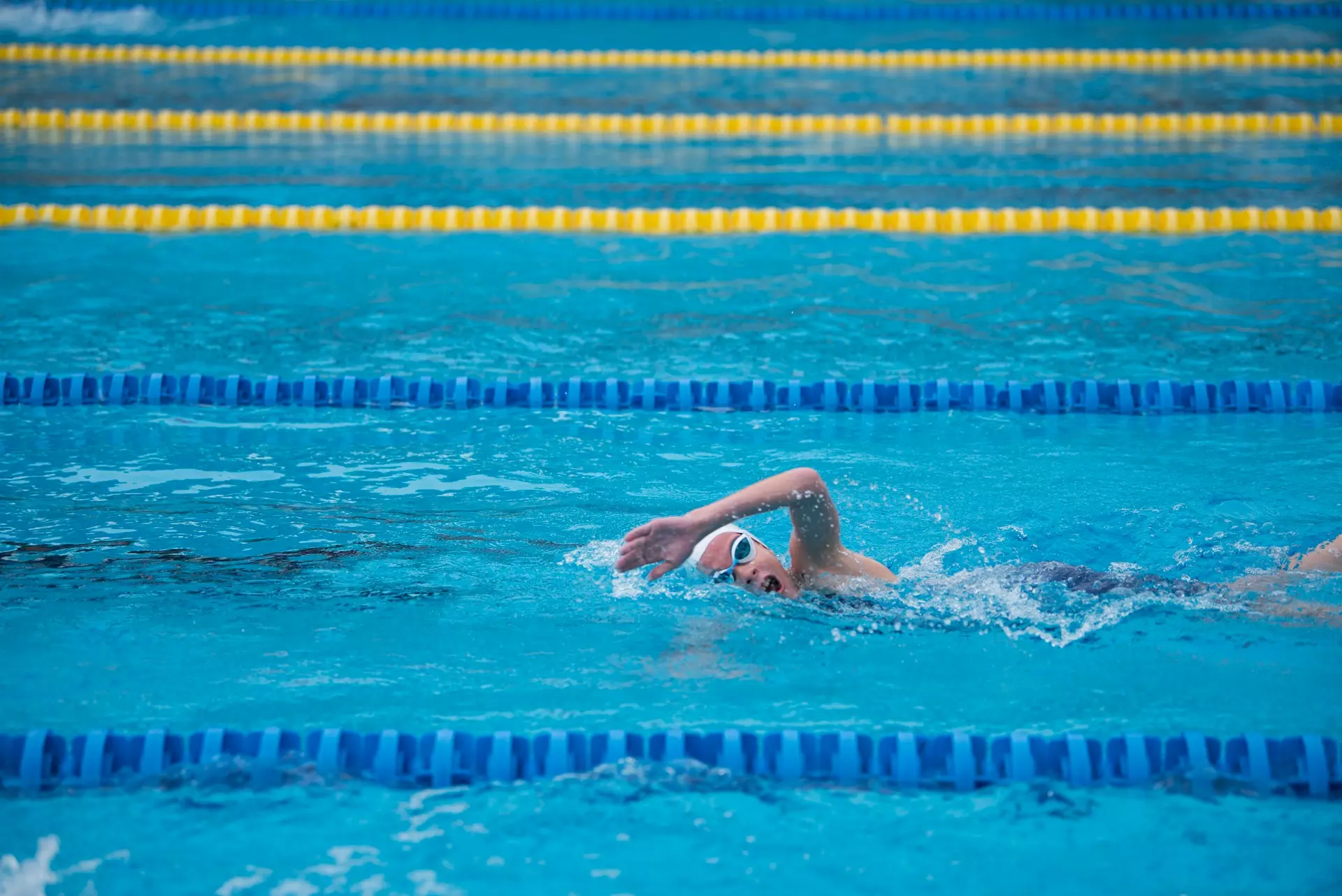
The front crawl is a swimming stroke performed face-down in the water, using alternating windmill-style arm strokes and a continuous flutter kick. It is the fastest and most efficient of the four competitive swimming strokes, and it is the stroke most Indian swimmers think of when someone says the word "swimming." If you've watched the freestyle finals at the Olympics, the Asian Games, or India's National Aquatic Championships, you've watched athletes performing the front crawl.
At the 1924 Paris Olympics, American swimmer Johnny Weissmuller won three gold medals in freestyle swimming events, including the 100-meter freestyle race. Weissmuller's success helped to popularize the front crawl freestyle swimming technique and solidify its status as the fastest and most dominant swimming technique in competitive tournaments.
The stroke gets its name from the way it looks — the swimmer appears to be "crawling" forward through the water, one arm pulling underwater while the other recovers above. The legs perform a rapid flutter kick from the hips, providing both propulsion and stability. Done well, the front crawl is graceful, powerful, and astonishingly efficient — capable of moving the human body through water faster than any other unaided swimming technique.
In India, the front crawl is the stroke most commonly taught after breaststroke, and it is the stroke that most fitness-oriented adult swimmers eventually default to for lap swimming. It is also the foundation of triathlon swimming and open-water competition, both of which have seen significant growth in India over the past decade.
Front Crawl vs Freestyle: Are They the Same Thing?
This is one of the most common questions among beginners, and the answer has a bit of nuance.
Technically, "freestyle" is a category of competitive swimming event, not a stroke. In a freestyle race, swimmers can use any stroke they choose. The front crawl is a specific stroke with defined mechanics. However, because the front crawl is so dramatically faster and more efficient than every other stroke, virtually every competitive swimmer chooses the front crawl in freestyle events. Over time, the two terms have become synonymous in everyday usage.
So when you hear someone say "freestyle stroke" at an Indian swimming pool or training session, they almost always mean the front crawl. The only time the distinction matters is in highly technical contexts — for example, in the freestyle leg of an individual medley, where rules state the swimmer cannot use the strokes already performed (backstroke, breaststroke, butterfly), so they must use a different stroke, which in practice is always the front crawl.
In short: all front crawl is freestyle, but not all freestyle has to be front crawl — even though, in practice, it almost always is.
A Brief History of the Front Crawl
The front crawl has a fascinating history that reflects the global exchange of swimming techniques over nearly two centuries.
The stroke was first witnessed by a wide European audience in 1844, when two Ojibwe swimmers — Flying Gull and Tobacco — competed in a swimming exhibition in London. Flying Gull won decisively using a stroke very similar to what we now call the front crawl. Yet the British, accustomed to the slower breaststroke, considered the technique "unsplashed" and ungentlemanly, and ignored it for several decades.
In 1844 this swimming stroke was first introduced to a wide audience by Ojibwe swimmers
In the late 19th century, British swimmer John Trudgen developed the Trudgen crawl after observing similar techniques in South America. His version combined an overarm pull with a scissor kick, producing significantly faster speeds than the breaststroke.
The modern front crawl really took shape in the early 20th century, when Australian swimmers — particularly Richard "Dick" Cavill — refined the Trudgen by replacing the scissor kick with a continuous flutter kick. The result, known as the Australian crawl, became the template for the stroke as we know it today.
The front crawl's status as the dominant swimming technique was sealed at the 1924 Paris Olympics, where American swimmer Johnny Weissmuller (who later became famous as Tarzan) won three gold medals using the technique. Since then, every major international freestyle record has been set using the front crawl.
In India, the front crawl became the dominant competitive stroke through the 20th century as the country joined the international swimming circuit. Today, all of India's senior national records in freestyle events — held by swimmers like Srihari Nataraj, Sajan Prakash, and Virdhawal Khade — were set using the front crawl.
How the Front Crawl Differs from the Other Strokes
Understanding what makes the front crawl unique helps you train it more effectively:
- Versus breaststroke — breaststroke uses simultaneous, symmetrical arm and leg movements with the head mostly above water. Front crawl uses alternating arm movements with the face submerged, making it faster but harder to learn breathing.
- Versus backstroke — backstroke is performed on the back, while the front crawl is on the front. The arm action is similar, but breathing in front crawl requires careful timing rather than always being out of the water.
- Versus butterfly — butterfly uses simultaneous arm movements and a dolphin kick from the hips, demanding far more strength than the front crawl's alternating, continuous rhythm.
If you're already a confident backstroke swimmer, you'll find the front crawl's arm action familiar — the main new challenge is breathing.
Body Position: The Foundation of a Good Front Crawl
A good front crawl begins not with your arms or legs but with your body position. Coaches in India and worldwide consistently identify body position as the single most important factor in efficient swimming.
Here's what a strong front crawl body position looks like:
- Body flat and horizontal in the water, parallel to the surface.
- Head in line with the spine, eyes looking down at the bottom of the pool, not forward.
- Hips high at the surface, not sinking down toward the floor.
- Core engaged — a relaxed core causes the lower body to drop, dramatically increasing drag.
- Streamlined shape — body kept narrow and aligned, with the kick action driven from the hips, not the knees.
Many Indian beginners struggle with sinking hips because they're tempted to lift their heads to look forward. The fix is counterintuitive but crucial: look straight down. The water should cover the back of your head and the top of your forehead. Trust your body and your peripheral vision to keep you on track.
The Arm Action: Catch, Pull, Push, Recover
The front crawl's arm cycle has four distinct phases:
- Entry and catch — your hand enters the water fingertips-first, just slightly outside the line of your shoulder. The arm extends forward, and you "catch" the water with a high elbow, ready to pull.
- Pull — your bent elbow stays high while your forearm sweeps the water back toward your hip in a strong, smooth motion.
- Push — as your hand passes your hip, you accelerate it backward and outward, finishing alongside your thigh.
- Recovery — your arm exits the water elbow-first and swings forward over the surface in a relaxed, controlled motion to begin the next stroke.
A common mistake among Indian beginners is dropping the elbow during the catch and pull. This dramatically reduces propulsion. The cue most coaches use is "high elbow, fingertips down" — keep the elbow near the surface while pointing your fingers and forearm toward the bottom of the pool.
The Flutter Kick
The front crawl's flutter kick is a continuous, alternating up-and-down movement of the legs. The motion originates from the hips, not the knees. Knees should bend only slightly, and the toes stay pointed.
Common kick mistakes include:
- Bending the knees too much — turns the kick into a bicycle motion that creates drag rather than propulsion.
- Splashing too much — energy that should drive you forward gets wasted into the air.
- Stiff ankles — flexible ankles act like flippers; rigid ankles act like brakes.
A useful drill is the kick board drill — hold a kick board in front of you and focus only on the kick across one or two lengths of the pool. Do this at the start of every training session for the first few weeks.
Breathing in the Front Crawl
Breathing is the single hardest part of the front crawl for most learners — and the part that takes the longest to master. The key principles:
- Exhale fully underwater. Many beginners hold their breath, which leads to panic and bad timing. Continuous bubble exhalation through the nose and mouth keeps you relaxed.
- Turn the head, don't lift it. As your arm starts its recovery, rotate your head sideways just enough that your mouth clears the water. Your goggles should still be partly underwater.
- Time the breath with the stroke. Breathe as the recovering arm passes your shoulder, not before or after.
- Practise bilateral breathing. Most Indian coaches recommend breathing every three strokes — alternating sides — to develop a balanced, symmetrical stroke. Once your stroke is even, you can switch to two-stroke breathing for more oxygen during longer or faster swims.
A useful drill is the side-kick drill — kicking on your side with one arm extended forward and the other resting on your hip — to practise breathing in a stable, low-pressure position.
Tips to Improve Your Front Crawl Faster
Once your basics are solid, these refinements will take your stroke to the next level:
- Improve your catch — the moment your hand and forearm engage the water defines your propulsion. Practise sculling drills to develop a sensitive, powerful catch.
- Build core strength — yoga, planks, and rotational core work translate directly into a more stable, faster stroke.
- Increase stroke rate gradually — use a tempo trainer or a clear count (e.g. 60 strokes per minute) and increase by 1–2 SPM per week.
- Film your stroke — most Indian pools allow waterproof cameras. Reviewing your stroke from above and below water reveals errors no coach can fully describe.
- Train with intervals — 8 × 50m at 80% effort with short rest builds both technique and aerobic capacity.
Learn the Front Crawl With a Coach on Superprof
The front crawl rewards good coaching more than almost any other swimming stroke. A qualified instructor can spot subtle issues — a dropped elbow, a sinking hip, mistimed breath — that you simply can't feel on your own. Superprof connects swimmers across India with verified coaches, many of whom have competitive backgrounds and formal Swimming Federation of India certification. Browse profiles, compare reviews, and book your first session today.
For supporting techniques, see our complete guides to the breaststroke, backstroke, and butterfly, or return to our overview article on the four main types of swimming strokes.
Summarise with AI:
Did you like this article? Leave a rating!

 Loading...