


One may ask, "What is multiplication table?" In mathematics, the multiplication table, also called the times table, gives the multiples of numbers. A multiplication table can be obtained by multiplying a number with a set of whole numbers. Multiplication is one of the basic mathematical operations. Multiplication is the most commonly used approach to creating multiplication tables.
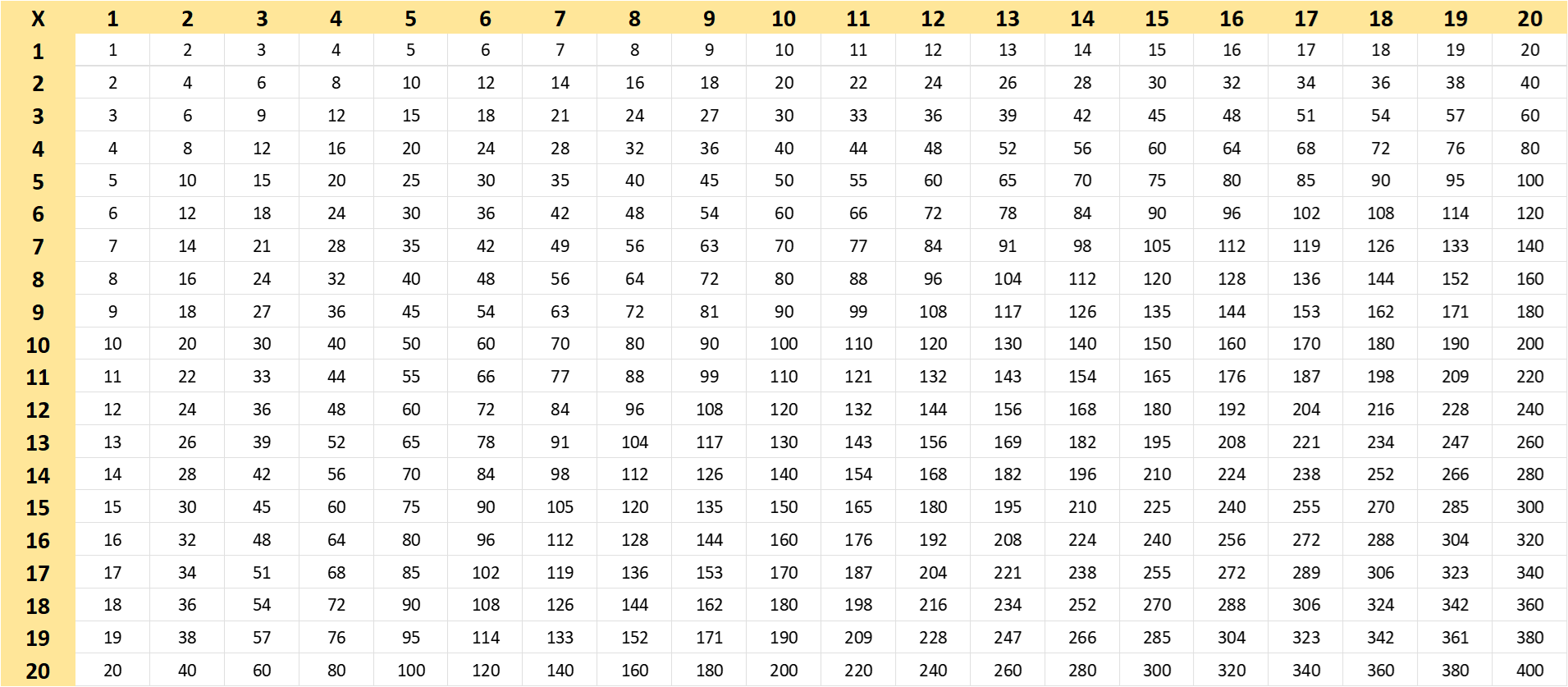
Find out the best ways to learn maths in India.




Importance of Multiplication Table
To facilitate the memorization of maths multiplication tables, it is important to visualize the tables and recite them until you can recall any particular multiple, such as ‘seven of eights are...’. Practicing the tables by writing them repeatedly is another way to memorize them. In fact, by simultaneously reciting the tables, the student can accomplish all three ways of learning the tables – visualizing, reciting, and writing.

As students move from primary to secondary education, performing quick and accurate arithmetic operations becomes extremely important. Whether calculating the least common multiple or calculating the final velocity of an object moving at a certain acceleration, recalling multiples of up to 20 is essential. Also, beyond the table of 20, you must rely on fundamental multiplication if you have to multiply large numbers. This is where Math multiplication tables can come in handy.
Quick Tips to Learn Multiplication Table
- While multiplying any two numbers, the order does not matter (i.e., which number is first or second). The answer should always be the same if we multiply the first number with the second number or the second number with the first number.
- Sometimes, it is difficult to memorize the whole table at once. So learn the multiplication tables in chunks. Also, we can learn the multiplication table easily using some patterns. The patterns will help to remember the product of two numbers.
- Likewise, the 5 times table pattern is 5, 10, 15, 20, 25, 30, … and so on. It should either end with 0 or 5.
- For a times table of 10, just put zero at the end of the given number. For example, 7 × 10 = 70, 11 × 10 = 110.
Get help with online maths tuition from Superprof tutors.
Using Vedic Maths to Learn Times Tables
Vedic maths is a system of mathematics that the Indian mathematician, Jagadguru Shri Bharathi Krishna Tirthaji, discovered between A.D. 1911 and 1918. He printed his findings in a Vedic Mathematics book – Tirthaji Maharaj. Vedic mathematics is also called mental mathematics in the mathematical world.
It is believed that the brain’s capacity and speed of calculations increase fivefold with the practice of Vedic maths.
The importance of Vedic Maths can be explained in various ways. The application of Vedic maths in simplifying numerical problems is often faster than modern methods of calculations. Sometimes, this way of simplifying numerical calculations does not require paper and pen. Thus, learning Vedic maths saves time and improves the interest in learning more applications of maths. Some of the benefits of Vedic mathematics sutras are:
- Calculations become easy and short.
- Simplifications can be done in less time.
- Students undergo less mental stress.
- Results obtained by sutra-based methods can be easily verified with normal procedures.
- The possibility of committing errors by students using these sutras is negligible.
- The use of sutras helps students to improve their knowledge and interest in the subject of mathematics.
- Vedic maths helps to solve hard problems using mental calculations.
Vedic Maths Tricks
Like addition and subtraction, multiplication can also be done using different sutras in Vedic maths. Learn these two simple methods of multiplying numbers.
Method 1
In this method, we can multiply the numbers whose unit digits are added up to 10 or powers of 10. This method of multiplication is referred to as the Sutra Ekadhiken Purvena. It can also be used to multiply two numbers whose last two digits are added up to 100; the last three are added up to 1000. Also, in the case of mixed fractions, the sum of proper fractions must be added up to 1 to apply this multiplication method.
Method 2
If two numbers are to be multiplied and one of these numbers has only 9s, then we can apply this method. This method of multiplying numbers is Sutra Ekanyunena Purvena. Similarly, there are many sutras in Vedic maths to perform the multiplication of numbers.
Practice these and other methods with a mathematics teacher on Superprof.

Easiest Ways to Learn Multiplication Tables
The easiest way to learn multiplication tables is by engaging in various activities that train children’s memory without actively trying to memorize multiplication answers by simple repetition.
Find out the best ways to learn fractions.
Familiarize Yourself With Multiplication Tables
The activities explained below help children familiarize themselves with multiplication tables and feel comfortable using them without the pressure of knowing them by heart, right from the start.

Write a Multiplication Table
Instead of printing and dividing multiplication tables, make one large poster, and write your own multiplication table. Copy the table on a drawing block using color pencils of your choosing. The goal is to write your own multiplication table with the colors you love the most. This is going to increase your involvement and focus on the activity.
Recite the Multiplication Table Forward and Backward
Once you finish writing the multiplication table, read it aloud both ways – forward and backward. Do this slowly and carefully. After this, form pairs with a friend or another student in class or at the maths coaching center and try to recite the multiplication table to your partner without looking at the paper. Help each other out if any one of you gets stuck.
Practice Skip-counting
Skip-counting is probably the best math skill for memorizing multiplication tables without simply repeating the numbers. The wonderful thing about multiplication is that it follows a strict pattern, which you can learn by skip-counting. This way, you will not only learn how to memorize the multiplication table but will also have fun doing it. Skip-counting is counting forward and backward by any number that’s not one. For example, skip-counting by 2 would be 2, 4, 6, 8, 10, etc. Skip-counting by 6 would be 6, 12, 18, 24, and so on.
Train Your Memory
The activities discussed so far encode (initial learning of information) multiplication in kids’ memory. In contrast, the following activities will help you to consolidate and store that information in your long-term memory. While many activities can achieve this, Superprof brings you those that children will enjoy.
Find out the best ways to learn division.
Play Flash Cards
Color flashcards for learning multiplication are an amazing way for children to see the patterns as the numbers double. You will be able to make stronger neuron connections, preventing you from forgetting what they’ve learned.
Here are a few task examples of how to utilize multiplication flashcards:
- Choose a flashcard and then write a related multiplication equation that gives the same answer as the chosen flashcard (learning the commutative property). Repeat the process 10 times or more.
- Choose several flashcards and order them from the highest to the lowest (or lowest to highest) product without looking at the answers.
- Choose a flashcard and write a multiplication array for the equation. Repeat the process 10 times or more.
- Sort the flashcards into even and odd products without looking at the answers.
- Go through the flashcards trying to guess each product, separating the flashcards into two piles – the ones you know and those you don’t know. After this, take the “The ones I don’t know” pile and go through them again, separating them into two piles once more. Repeat the same procedure until no more cards are left in the “The ones I don’t know” pile.

Reinforce Learned Material
When you want to memorize multiplication tables fast, taking things one step further also means implementing passive learning techniques. Use these techniques at home to maximize the effectiveness of times tables learning.
Memorize the “Landmark Numbers” First
Landmark or easy numbers follow the most obvious and easy-to-see pattern, which is why they are a wonderful kickstarter when trying to memorize the multiplication table. Here’s where to start:
- Multiplication with the number 0 is known as the zero-product property because each number multiplied by zero is zero.
- Multiplication with the number 1 is known as the identity property because each number multiplied by 1 gets the same value as before the multiplication.
- Multiplication with the number 2 is the same as adding the number to itself (doubling the number). For example, 4×2 = 4+4, 6×2 = 6+6, etc.
- Multiplication with the number 5 follows a very easy pattern. The product ends up in 5 or 0. For example, 5, 10, 15, 20, 25, 30, 35…
- Multiplication with the number 10 is probably the easiest – simply add 0 to the number. For example, 2 x10 = 20, 4 x 10 = 40, 7×10 = 70, etc.
Make learning fun and efficient with the best maths revision aids.
Learn the 9s Trick
Another number that has an easy pattern when multiplied is the number 9. The second digit in the product is always one number lower than its predecessor. For example: 9, 18, 27, 36, 45, 54, 63, 72, 81, 90. You can also calculate this using your fingers. Put up your hands, fingers spread with the palms turned away from you. Start counting from left to right with the number you wish to multiply by nine.
Summarise with AI:
Did you like this article? Leave a rating!

 Loading...
