


If you know the Hindi language, learning the numbers from 1 to 100 in Hindi is simple.


Hindi Numbers 1 to 10
- 1 – १ – एक (ek)
- 2 – २ – दो (do)
- 3 – ३ – तीन (tīn)
- 4 – ४ – चार (chār)
- 5 – ५ – पाँच (pāñc)
- 6 – ६ – छः (chaḥ / chhah)
- 7 – ७ – सात (sāt)
- 8 – ८ – आठ (āṭh)
- 9 – ९ – नौ (nau)
- 10 – १० – दस (das)
The capacity to count in any language is extremely helpful in communication and also improves language learning. Therefore, studying numbers in Hindi from 1 to 100 is a fantastic technique to learn Hindi if you're interested in doing so.
Hindi Ginti, also known as हिन्दी गिनती, is the term used in Hindi for numbers or counting.
If you're serious about mastering Hindi counting and want personalized guidance, working with one of our numerous Hindi tutors can make a big difference. A tutor can help you practice pronunciation, correct your mistakes in real time, and give you the confidence to use numbers fluently in everyday conversation.
Counting in Hindi 1 to 100
Numerous individuals look up the term "(हिन्दी गिनती) or Hindi Ginti" because counting or numbers are referred to in Hindi as ‘गणना or गिनती’ or "Ganana" or "Ginti." They may just ask what 70 or another number means in Hindi. They'll occasionally type that they'd like to know the Hindi terms for the numbers 1 to 100. This is highly beneficial for kids in particular because they need to know these numbers for their elementary studies.
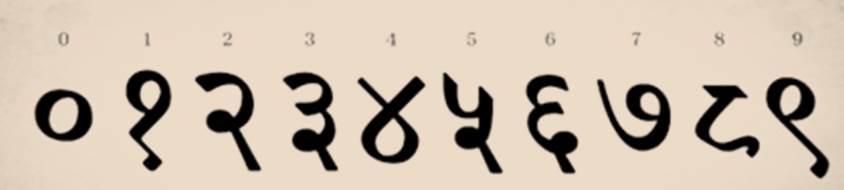
Learning how to count in Hindi can help you in your day-to-day life, especially when you are living in North India.
You will at the very least need to understand Hindi digits 1 through 10 for smooth communication, from acquiring a local recharge to paying bills for the newspapers, asking for the date and time, or sharing your flat number with your neighbors.
Being familiar with the fundamentals, such as the Hindi numerals 1 to 100, might help you bargain successfully whenever feasible because the majority of the working class does not grasp English numbers. Overall, working with numbers in the regional tongue will save you time and effort.
Numbers in Hindi 1 To 100
| Numerals | Tens | Hundreds | Thousands | Millions | Billions |
|---|---|---|---|---|---|
| ० – ० (0) – Shunya | १० – १० (10) – Dus | १०० – १०० (100) – Ek Sau | १,००० – १,००० (1,000) – Ek Hazaar | १,००,००० – १,००,००० (1,000,000) – Ek Lakh | १,००,००,००० – १,००,००,००० (1,000,000,000) – Ek Arab |
| १ – १ (1) – Ek | २० – २० (20) – Bees | २०० – २०० (200) – Do Sau | २,००० – २,००० (2,000) – Do Hazaar | २,००,००० – २,००,००० (2,000,000) – Do Lakh | २,००,००,००० – २,००,००,००० (2,000,000,000) – Do Arab |
| २ – २ (2) – Do | ३० – ३० (30) – Tees | … | … | … | … |
| ३ – ३ (3) – Teen | ४० – ४० (40) – Chalees | ९०० – ९०० (900) – Nau Sau | ९,००० – ९,००० (9,000) – Nau Hazaar | ९,००,००० – ९,००,००० (9,000,000) – Nau Lakh | ९,००,००,००० – ९,००,००,००० (9,000,000,000) – Nau Arab |
| ४ – ४ (4) – Char | ५० – ५० (50) – Pachaas | … | … | … | … |
| ५ – ५ (5) – Paanch | ६० – ६० (60) – Saath | … | … | … | … |
| ६ – ६ (6) – Chhah | ७० – ७० (70) – Sattar | … | … | … | … |
| ७ – ७ (7) – Saat | ८० – ८० (80) – Assi | … | … | … | … |
| ८ – ८ (8) – Aath | ९० – ९० (90) – Nau Sau | … | … | … | … |
| ९ – ९ (9) – Nau | … | … | … | … | … |
Ordinal Numbers in Hindi (1-20) With Pronunciation
| Numbers in Hindi | Ordinal Numbers | Pronunciation |
|---|---|---|
| १ (1) | पहला (pahalā) | Peh – la |
| २ (2) | दूसरा (dūsrā) | D–oo–s–ra |
| ३ (3) | तीसरा (tīsrā) | Tee–s–ra |
| ४ (4) | चौथा (cauthā) | Cho–th–a |
| ५ (5) | पाँचवाँ (pāñcavām) | Pan–ch–wa |
| ६ (6) | छठा (chaṭhā) | Cha–ṭ–aa |
| ७ (7) | सातवाँ (sātavām) | Saa–th–wa |
| ८ (8) | आठवाँ (āṭhavām) | Aa–th–wa |
| ९ (9) | नौवाँ (nauvām) | No–wa |
| १० (10) | दसवाँ (dasavām) | Dus–wa |
| ११ (11) | ग्यारहवाँ (gyārahavīn) | Gaya–r–wa |
| १२ (12) | बारहवाँ (bārahavīn) | Bah–r–wa |
| १३ (13) | तेरहवाँ (terahavīn) | The–r–wa |
| १४ (14) | चौदहवाँ (caudahavīn) | Cho–da–wa |
| १५ (15) | पंद्रहवाँ (pandrahavīn) or Pandra | Pan–dra |
| १६ (16) | सोलहवाँ (solahavīn) | So–la |
| १७ (17) | सत्रहवाँ (satrahavīn) | Sat–ra |
| १८ (18) | अठारहवाँ (aṭhārahavīn) | Aat–ra–wa |
| १९ (19) | उन्नीसवाँ (unnīsavīn) | Unnis–wa |
| २० (20) | बीसवाँ (bīsavīn) | Bis–wa |
How do you say 100 in Hindi?
In Hindi, the cardinal number for 100 is सौ (sauv, pronounced S-Au) but the ordinal number for 100 is सौवां (sauvaṅ, pronounced as S-au-vn)
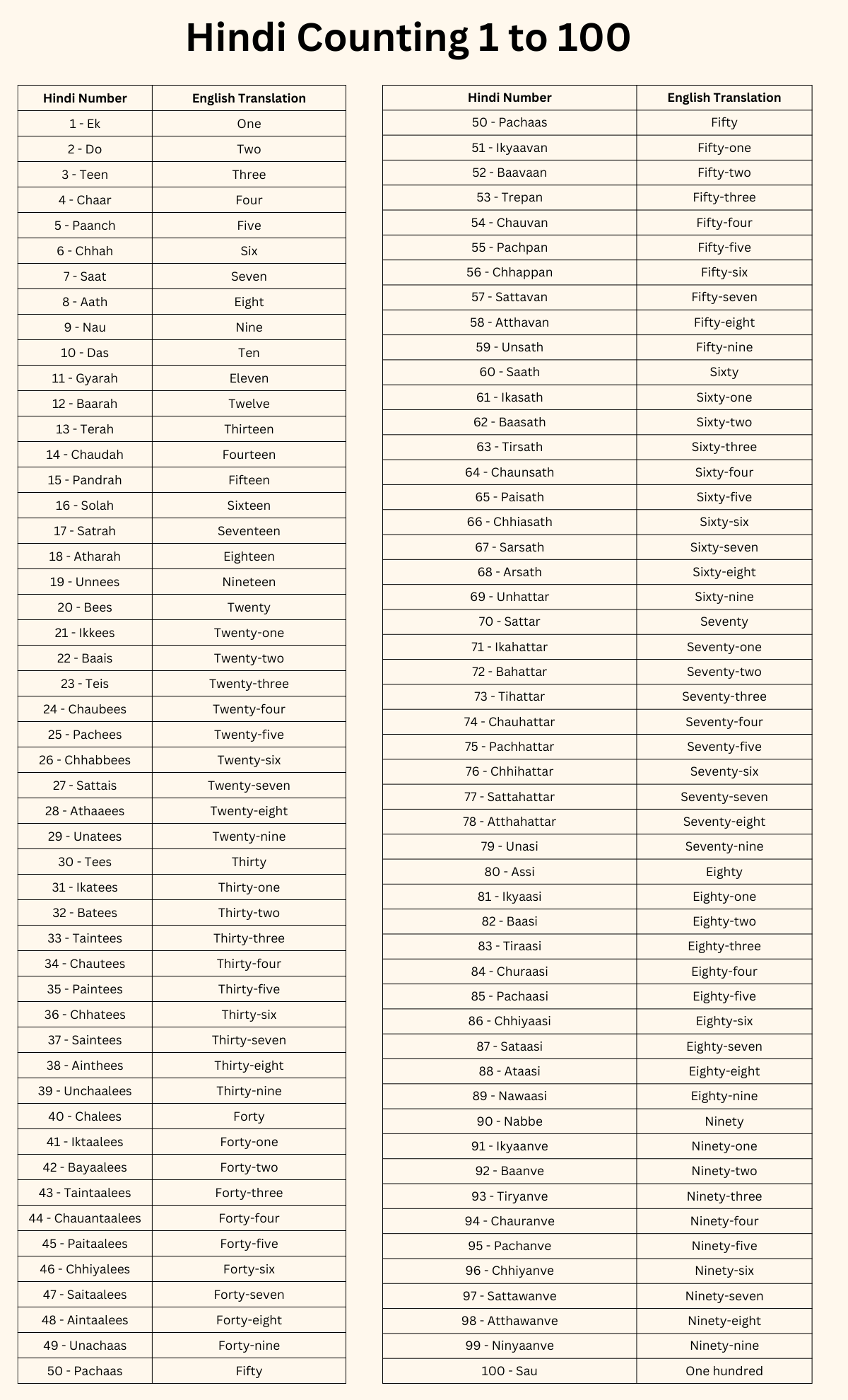
Hindi Numbers 1 to 100 (Cardinal Numbers & Words)
The number names in Indian numerals are written in the cursive Devanagari script and are modeled on the Indian-Arabic numerals. Learn how to count items or money in Hindi with the help of these tables.
How Do You Write 1-10 In Hindi? - 1 से 10 हिंदी नंबर कैसे लिखें?
| Number | गिनती (Hindi Ginti) | शब्दों में (In Hindi Words) | in words | ordinal |
|---|---|---|---|---|
| 1 | १ | एक (ek) | one | पहला |
| 2 | २ | दो (do) | two | दूसरा |
| 3 | ३ | तीन (tīn) | three | तीसरा |
| 4 | ४ | चार (chār) | four | चौथा |
| 5 | ५ | पाँच (pāñc) | five | पाँचवाँ |
| 6 | ६ | छः (chhah) | six | छठवाँ |
| 7 | ७ | सात (sāt) | seven | सातवाँ |
| 8 | ८ | आठ (āṭh) | eight | आठवाँ |
| 9 | ९ | नौ (nau) | nine | नौवाँ |
| 10 | १० | दस (das) | ten | दसवाँ |
10 को हिंदी में कैसे लिखते हैं? (How do you write 10 in Hindi?)
The number 10 in Hindi is written as "दस" (das). It is pronounced as "dus". The word "दस" is derived from the Sanskrit word "दश" (daśa), which also means "ten".
Hindi Numbers 11-20 (ग्यारह se बीस)
| Number | गिनती (Hindi Ginti) | शब्दों में (In words) | Pronunciation |
|---|---|---|---|
| 11 | ११ | ग्यारह (gyārah) – eleven | gya+rah / ग्या+रह |
| 12 | १२ | बारह (bārah) – twelve | ba+rah / बा+रह |
| 13 | १३ | तेरह (terah) – thirteen | te+rah / ते+रह |
| 14 | १४ | चौदह (chaudah) – fourteen | chau+dah / चौ+दह |
| 15 | १५ | पंद्रह (pandrah) – fifteen | pand+rah / पंन्द्र+ह |
| 16 | १६ | सोलह (solah) – sixteen | sol+ah / सोल+ह |
| 17 | १७ | सत्रह (satrah) – seventeen | satrah / सत्र+ह |
| 18 | १८ | अठारह (athārah) – eighteen | atha+rah / अठा+रह |
| 19 | १९ | उन्नीस (unnīs) – nineteen | unn+ees / उन्नीस |
| 20 | २० | बीस (bīs) – twenty | bees / बीस |
Just like number names, learning animal names in Hindi can greatly help in everyday conversations.
15 को हिंदी में नंबर में कैसे लिखते हैं? (How Do You Write 15 In Hindi?) - 15 is written as 15- पंद्रह in Hindi.
Hindi Numbers 21-30 (इक्कीस se तीस)
| Number | गिनती (Hindi Ginti) | शब्दों में (In words) | In words |
|---|---|---|---|
| 21 | २१ | इक्कीस (ikkees) – twenty one | ikkees / इक+ईस / one+twenty |
| 22 | २२ | बाईस (bāees) – twenty two | ba+ees / बा+ईस / two+twenty |
| 23 | २३ | तेईस (teees) – twenty three | te+ees / ते+ईस / three+twenty |
| 24 | २४ | चौबीस (chaubees) – twenty four | chaub+ees / चौब+ईस / four+twenty |
| 25 | २५ | पच्चीस (pachchees) – twenty five | pachch+ees / पच्च+ईस / five+twenty |
| 26 | २६ | छब्बीस (chhabbees) – twenty six | chabb+ees / छब्ब+ईस / six+twenty |
| 27 | २७ | सत्ताईस (sattaees) – twenty seven | satta+ees / सत्त+ईस / seven+twenty |
| 28 | २८ | अट्ठाईस (atthāees) – twenty eight | atthā+ees / अठ्ठ+ईस / eight+twenty |
| 29 | २९ | उनतीस (untees) – twenty nine | un+tees / उन+तीस / one+thirty |
| 30 | ३० | तीस (tīs) – thirty | tees / तीस / thirty |
Hindi Numbers 31-40 (इकतीस se चालीस)
| Number | गिनती (Hindi Ginti) | शब्दों में (In words) | In words |
|---|---|---|---|
| 31 | ३१ | इकतीस (ik-tīs) – thirty one | ik+tees / इक+तीस / one+thirty |
| 32 | ३२ | बत्तीस (bat-tīs) – thirty two | bat+tees / बत्त+ीस / two+thirty |
| 33 | ३३ | तैंतीस (tain-tīs) – thirty three | tain+tees / तैं+तीस / three+thirty |
| 34 | ३४ | चौंतीस (chaun-tīs) – thirty four | chaun+tees / चौं+तीस / four+thirty |
| 35 | ३५ | पैंतीस (pain-tīs) – thirty five | pain+tees / पैं+तीस / five+thirty |
| 36 | ३६ | छत्तीस (chhat-tīs) – thirty six | chhat+tees / छत्त+ीस / six+thirty |
| 37 | ३७ | सैंतीस (sain-tīs) – thirty seven | sain+tees / सैं+तीस / seven+thirty |
| 38 | ३८ | अड़तीस (aṛ-tīs) – thirty eight | ad+tees / अड़+तीस / eight+thirty |
| 39 | ३९ | उनचालीस (un-chālīs) – thirty nine | un+chaalees / उन+चालीस / one+forty |
| 40 | ४० | चालीस (chālīs) – forty | chaa+lees / चा+लीस / four & zero |
Hindi Numbers 41-50 (इकतालीस se पचास)
| Number | गिनती (Hindi Ginti) | शब्दों में (In words) | In words |
|---|---|---|---|
| 41 | ४१ | इकतालीस (iktaalees) – forty one | ikta+lees / इकता+लीस / one+forty |
| 42 | ४२ | बयालीस (bayaalees) – forty two | baya+lees / बया+लीस / two+forty |
| 43 | ४३ | तैंतालीस (taintaalees) – forty three | tain+ta+lees / तैंता+लीस / three+forty |
| 44 | ४४ | चौवालीस (chauwaalees) – forty four | chauwa+lees / चौवा+लीस / four+forty |
| 45 | ४५ | पैंतालीस (paintaalīs) – forty five | painta+lees / पैंटा+लीस / five+forty |
| 46 | ४६ | छियालीस (chhiyaalees) – forty six | chhiya+lees / छिया+लीस / six+forty |
| 47 | ४७ | सैंतालीस (saintaalees) – forty seven | sainta+lees / सैंता+लीस / seven+forty |
| 48 | ४८ | अड़तालीस (adtaalees) – forty eight | adtaa+lees / अड़ता+लीस / eight+forty |
| 49 | ४९ | उनचास (unchaas) – forty nine | un-pachaas / उन+चास / one+fifty |
| 50 | ५० | पचास (pachaas) – fifty | pachaas / पचास / five & zero |
Hindi Numbers 51-60 (इक्यावन se साठ)
| Number | गिनती (Hindi Ginti) | शब्दों में (In words) | In words |
|---|---|---|---|
| 51 | ५१ | इक्यावन (ikyaawan) – fifty one | ikyaa+wan / इक्याव+न / one+fifty |
| 52 | ५२ | बावन (baawan) – fifty two | baa+wan / बा़+न / two+fifty |
| 53 | ५३ | तिरपन (tirpan) – fifty three | tire+pan / तिर+पन / three+fifty |
| 54 | ५४ | चौवन (chauvan) – fifty four | chau+wan / चौ+न / four+fifty |
| 55 | ५५ | पचपन (pachpan) – fifty five | pach+pan / पच+पन / five+fifty |
| 56 | ५६ | छप्पन (chhappan) – fifty six | chhap+pan / छप+पन / six+fifty |
| 57 | ५७ | सत्तावन (sattaawan) – fifty seven | sattaa+wan / सत्ताव+न / seven+fifty |
| 58 | ५८ | अट्ठावन (atthaawan) – fifty eight | atthaa+wan / अठ्ठाव+न / eight+fifty |
| 59 | ५९ | उनसठ (unsaṭh) – fifty nine | un-sath / उन+सठ / one+sixty |
| 60 | ६० | साठ (sāṭh) – sixty | saa+th / सा+ठ / six & zero |
Share your pearls of wisdom like a pro with Hindi proverbs.
Hindi Numbers 61-70 (इकसठ se सत्तर)
| Number | गिनती (Hindi Ginti) | शब्दों में (In words) | In words |
|---|---|---|---|
| 61 | ६१ | इकसठ (ikasath) – sixty one | ik+satth / इक+सठ / one+sixty |
| 62 | ६२ | बासठ (bāsath) – sixty two | baa+satth / बा+सठ / two+sixty |
| 63 | ६३ | तिरसठ (tirasath) – sixty three | tire+satth / तिर+सठ / three+sixty |
| 64 | ६४ | चौंसठ (chaunsath) – sixty four | chau+satth / चौ+सठ / four+sixty |
| 65 | ६५ | पैंसठ (painsath) – sixty five | pain+satth / पैं+सठ / five+sixty |
| 66 | ६६ | छियासठ (chhiyasath) – sixty six | chhiya+satth / छिया+सठ / six+sixty |
| 67 | ६७ | सड़सठ (sadasath) – sixty seven | sar(sad)+satth / सड़+सठ / seven+sixty |
| 68 | ६८ | अड़सठ (adasath) – sixty eight | ad+satth / अड़+सठ / eight+sixty |
| 69 | ६९ | उनहत्तर (unahattar) – sixty nine | un+hattar / उन+हत्तर / one+seventy |
| 70 | ७० | सत्तर (sattar) – seventy | sattar / सत्तर / seven & zero |

Hindi Numbers 71-80 (इकहत्तर se अस्सी)
| Number | गिनती (Hindi Ginti) | शब्दों में (In words) | In words |
|---|---|---|---|
| 71 | ७१ | इकहत्तर (ikahattar) – seventy one | ik+hattar / इक+हत्तर / one+seventy |
| 72 | ७२ | बहत्तर (bahattar) – seventy two | ba+hattar / ब+हत्तर / two+seventy |
| 73 | ७३ | तिहत्तर (tihattar) – seventy three | ti+hattar / ति+हत्तर / three+seventy |
| 74 | ७४ | चौहत्तर (chauhattar) – seventy four | chau+hattar / चौ+हत्तर / four+seventy |
| 75 | ७५ | पचहत्तर (pachhattar) – seventy five | pach+hattar / पच+हत्तर / five+seventy |
| 76 | ७६ | छिहत्तर (chhihattar) – seventy six | chhi+hattar / छि+हत्तर / six+seventy |
| 77 | ७७ | सतहत्तर (satahattar) – seventy seven | sat+hattar / सत+हत्तर / seven+seventy |
| 78 | ७८ | अठहत्तर (athahattar) – seventy eight | ath+hattar / अठ+हत्तर / eight+seventy |
| 79 | ७९ | उन्यासी (unyāsī) – seventy nine | uny+asee / उन्य+ासी / one+eighty |
| 80 | ८० | अस्सी (assī) – eighty | as+see / अस+सी / eight & zero |
Hindi Numbers 81-100 (इकयासी se सौ)
| Number | गिनती (Hindi Ginti) | शब्दों में (In words) | In words |
|---|---|---|---|
| 81 | ८१ | इक्यासी (ikyaasī) – eighty one | ikya+see / इक्या+सी / one+eighty |
| 82 | ८२ | बयासी (bayaasī) – eighty two | baya+see / बया+सी / two+eighty |
| 83 | ८३ | तिरासी (tiraasī) – eighty three | tira+see / तिरा+सी / three+eighty |
| 84 | ८४ | चौरासी (chauraasī) – eighty four | chaura+see / चोरा+सी / four+eighty |
| 85 | ८५ | पचासी (pachaasī) – eighty five | pacha+see / पचा+सी / five+eighty |
| 86 | ८६ | छियासी (chhiyaasī) – eighty six | chhiya+see / छिया+सी / six+eighty |
| 87 | ८७ | सत्तासी (sattaasī) – eighty seven | sattaa+see / सत्त+ासी / seven+eighty |
| 88 | ८८ | अठासी (athaasī) – eighty eight | athaa+see / अठा+सी / eight+eighty |
| 89 | ८९ | नवासी (navaasī) – eighty nine | nava+see / नवा+सी / nine+eighty |
| 90 | ९० | नब्बे (nabbe) – ninety | nab+be / नब+्बे / nine & zero |
| 91 | ९१ | इक्यानबे (ikyaanabe) – ninety one | ikyaa+nave / इक्या+नबे / one+ninety |
| 92 | ९२ | बानबे (baanabe) – ninety two | baa+nave / बा+नबे / two+ninety |
| 93 | ९३ | तिरानबे (tiraanabe) – ninety three | tira+nave / तिरा+नबे / three+ninety |
| 94 | ९४ | चौरानबे (chauraanabe) – ninety four | chaura+nave / चोरा+नबे / four+ninety |
| 95 | ९५ | पंचानबे (panchaanabe) – ninety five | pancha+nave / पंча+नबे / five+ninety |
| 96 | ९६ | छियानबे (chhiyaanabe) – ninety six | chhiya+nave / छिया+नबे / six+ninety |
| 97 | ९७ | सत्तानबे (sattaanabe) – ninety seven | sattaa+nave / सत्त+नबे / seven+ninety |
| 98 | ९८ | अट्ठानबे (atthaanabe) – ninety eight | atthaa+nave / अठ्ठा+नबे / eight+ninety |
| 99 | ९९ | निन्यानबे (ninyaanabe) – ninety nine | ninyaa+nave / निन्या+नबे / nine+ninety |
| 100 | १०० | सौ (sau) – One Hundred | tī sau / सौ |
Learn Hindi Ginti On YouTube
Hindi numbers, like Hindi grammar, can seem a little challenging at first, but after you start to recognize some patterns, you can memorize them with ease. Some numbers have the same ending, such as "ah" (11–18), "is" (19–38s), and others. Additionally, prefixes like "cha" in 14, 24, 34, 44, and 54 stay the same.
Hindu Arabic Numerals
The earliest known use of Hindu numerals dates back to the 3rd century BCE in inscriptions found in caves near Nasik, India. These numerals were initially used alongside Brahmi numerals, another numerical system prevalent in ancient India. However, the simplicity and efficiency of the Hindu numerals gradually led to their widespread adoption across the Indian subcontinent.
Hindu-Arabic numerals are the symbols we commonly use for numbers: 0, 1, 2, 3, 4, 5, 6, 7, 8, and 9. To write Hindu-Arabic numerals, you simply use these symbols to represent the different numbers in the decimal system. Each numeral's position in a number denotes its value, with the rightmost position indicating ones, the next position to the left indicating tens, then hundreds, and so on.
The numeral system that is used today, known as the Hindu-Arabic numeral system, is based on the decimal place-value system and features a zero glyph as seen in "205". These glyphs are derived from the Indian Brahmi numerals and the complete system was developed between the 8th and 9th centuries.
In Hindu-Arabic numerals, "xxix" represents the number 29. In this numeral system, "xx" stands for 20 (10 + 10), and "ix" stands for 9 (1 less than 10).
So when combined, "xxix" signifies 29.
The Hindu culture thrived in 3000 BC, and they used large numbers in their inscriptions. Indo-European tribes started migrating from the Northwest towards India around 2000 BC, bringing with them Sanskrit and the earliest knowledge of mathematics. Sanskrit had number words for 1-9, 10, 100, and higher powers of 10, indicating a decimal system. Brahmi's inscriptions, dating back to the 3rd century BC, have been discovered throughout the Indian subcontinent.
Historians attribute the origins of modern numerals in most languages to the Brahmi numerals, which were utilized around the middle of the 3rd century BC. The place value system, however, came into existence at a later time. The Brahmi numerals have been discovered in inscriptions in caves and on coins in regions near Pune, Maharashtra, and Uttar Pradesh in India.
These numerals, with slight variations, were in use until the 4th century.
During the Vedic period, which lasted from 1500 to 500 BCE, the people of northern India developed a numerical system and basic mathematical operations. This development was motivated by the need to construct fire altars and study astronomy.
Vedic Period In India
Hindu cosmology required the understanding and mastery of extremely large numbers, such as the Kalpa (the lifetime of the universe, according to Hindu mythology) which was said to be 4,320,000,000 years, and the "orbit of the heaven" which was said to be 18,712,069,200,000,000 yojanas.
These numbers were expressed using a "named place-value notation" where names were given to the powers of 10. For example, a trillion was called "parardha". The Buddhist text Lalitavistara mentions that the Buddha narrated a scheme of numbers up to 10^53.
The way numerals were written in Ashoka's inscriptions in the Brahmi script during the third century BCE involved using separate symbols for numbers 1 to 9, 10 to 90, 100, and 1000. When a multiple of 100 or 1000 was needed, the symbol for the number was modified using the symbol for the multiplier. These modified numerals directly represented the spoken place-value numerals. They were used in inscriptions until the 9th century.
In 499 CE, Aryabhata introduced a new positional number system using Sanskrit consonants for small numbers and vowels for powers of 10. This system allowed for the expression of numbers up to a billion using short phrases.
However, it was not widely adopted due to the difficulty of pronouncing the phrases. Nonetheless, it may have helped establish the concept of a positional number system for later mathematicians. In later centuries, a more sophisticated katapayadi scheme was developed that included zero and further improved the place-value system.
In Sanskrit verses, a numerical system known as bhūta-sankhya was utilized, which involved using a concept that represented a digit to represent the digit itself. The Jain text called the Lokavibhaga, which dates back to 458 CE, refers to this system and mentions an objectified numeral.
How Can You Learn Hindi Numbers Quickly? (हिंदी नंबर कैसे सीखते हैं?)
Learning Hindi numbers can be a fun and engaging process! Here's a step-by-step approach to quickly grasp them:
Start with the Basics: Begin by familiarizing yourself with the Hindi number system.Learn the digits from 0 to 9: ० (zero), १ (one), २ (two), ३ (three), ४ (four), ५ (five), ६ (six), ७ (seven), ८ (eight), ९ (nine).
Practice Pronunciation: Focus on correct pronunciation. Listen to native speakers or use online resources that provide audio to hear the numbers spoken aloud. Mimicking pronunciation helps in retaining and recalling them.
Learn Tens and Higher Numbers: Once you're comfortable with the digits, proceed to learn the tens (१०, २०, ३०, etc.) and higher numbers by combining the digits. For instance, १० (ten), २० (twenty), ३० (thirty), and so on.
Use Flashcards or Apps: Utilize flashcards or mobile apps designed for learning Hindi numbers. They often incorporate quizzes and repetition exercises that can accelerate memorization.
Practice Regularly: Consistent practice is key. Set aside a few minutes daily to review and reinforce what you've learned. Repetition helps solidify your memory.
Engage in Conversations: Try incorporating numbers into your daily conversations or interactions. Count objects around you, state quantities, or practice asking for prices in Hindi when shopping.
Seek Language Exchange or Tutoring: Consider joining language exchange programs or hiring a tutor to enhance your learning experience. Interacting with native speakers can boost your confidence and fluency.
Sounds easy enough, doesn't it? There's no better time to start than now!
Find Hindi online classes today on Superprof!
Summarise with AI:
Did you like this article? Leave a rating!


 Loading...
Superb
Write 100 in English One Hundred
Thank you sir!
Love the attention to detail
five,eight,nine are written in different way still in devnagari lipi hindi,please review nd modify
Thank you sir!
We have fixed it!