
The Hindi language is synonymous with India. Hindi is the most extensively spoken language in the nation despite there being 22 official languages. More than 425 million Indians speak Hindi as their first language, while another 120 million people are learning Hindi as a second language. Since the Indian Union Government adopted the Hindi language in 1950, all official correspondence is also written in Hindi in addition to English.
It's amazing to think about how Hindi got to be the national tongue of India. It is largely used in the Hindi Belt, a region of northern and central India. It is a part of the continuum of Indian dialects, which also includes Nepali, Punjabi, Sindhi, Urdu, Gujarati, Marathi, and Oriya.
Hindi was first spoken in 769 AD and is a direct descendant of Sanskrit. Old Hindi was originally spoken in the districts around Delhi and gained popularity over time. It represents the earliest development of the Delhi dialect and is related to both Modern Hindi and Urdu. The Devanagari script was used to write the language's first iteration.

As a common language of communication with the local population in and around Delhi between the 8th and 10th centuries, Old Hindi was adopted by the Afghans, Persians, and Turks. The language changed over time and incorporated Persian and Arabic loanwords. Today, they make up over 25% of the Hindi lexicon!
In the 13th and 15th centuries, when early Hindi writing in literature first appeared, Hindi was frequently spoken and studied as a first language. Amir Khusrow's writings and Prithviraj Raso are two examples of well-known Hindi literature. Over the years, this language has gone by a number of other names, including Hindi, Hindustani, Dahlavi, Hindavi, and so on.


Hindi Language: Origin
Hindi is officially recognized as the predominant language of India, despite the country's official recognition of 22 languages. Hindi, as a distinct language, began to take shape around the 7th to 10th centuries. It evolved from the Apabhramsa language and early forms of Khari Boli, which was spoken in the northwestern region of India.
With over 425 million people speaking Hindi as their primary language and an additional 120 million learning it as a second language, it holds a significant presence in India. In addition to English, Hindi has served as the medium for all official communications since its adoption by the Indian Union Government in 1950.
The evolution of Hindi's prominence in India is a captivating journey. It is an Indo-European language primarily spoken in northern and central India, a region commonly referred to as the Hindi Belt. Positioned within an Indic dialect continuum, Hindi borders Nepali to the north, Punjabi to the northwest, Sindhi to the west, Urdu to the southeast, Gujarati to the southwest, Marathi to the southeast, and Oriya to the east.
Hindi, often referred to as the Delhi dialect within this continuum, historically coexisted with Urdu, which overshadowed it for an extended period.
Islamic Influence On Hindi
During the medieval period, India saw significant influence from Persian and Arabic due to trade and the presence of Muslim rulers. This influence is noticeable in the vocabulary and script of Hindi. This phase led to the development of a form of Hindi known as "Hindustani," which incorporated many loanwords from Persian and Arabic.
One of the most noticeable effects of Islamic influence is the enrichment of Hindi vocabulary. Many words related to religion, administration, trade, culture, and everyday life were borrowed from Arabic and Persian. For example, words related to Islamic practices and institutions, such as "masjid" (mosque), "Quran" (Koran), and "dua" (prayer), have become an integral part of Hindi.
Arabic and Persian account for around 25% of Hindi's vocabulary.
Islamic culture influenced Hindi literature and poetry, leading to a unique blend of Persian and Indian literary traditions. Renowned poets like Mir Taqi Mir, Mirza Ghalib, and Allama Iqbal, who wrote in Persian and Urdu, have made significant contributions to this amalgamation of cultures.
Hindi Language Family
Hindi itself has several dialects, with the two most prominent ones being:
- Pure Hindi (Suddh Hindi): This is the official standardized form of Hindi used for official and administrative purposes in India. It is based on the Khariboli dialect and is written in the Devanagari script. Suddh means pure and is widely spoken in the Northern parts of India, where the language of communication is mainly just Hindi.
- Hindustani: A broader term for Hindi and Urdu mixed together. It is often used for colloquial and everyday communication, blending elements of both Hindi and Urdu languages.
Other languages closely related to Hindi within the Indo-Aryan family include Punjabi, Gujarati, Marathi, and Bengali. The younger generation of India speak in a language that's a combination of Hindi and English (Hinglish), however, it's just a modern take on the language.
Modern Hindi Language
The modern iteration of the Hindi language did not crystallize until the latter part of the 18th century, and its formal designation as the official language of India was not conferred until 1950.
Subsequent to its official recognition, the Government of India undertook systematic efforts to standardize grammar and orthography, thereby fostering linguistic uniformity in Hindi writing. This era also witnessed a notable surge in the number of Hindi learners, attributable to its prominent role in official publications.
Prior to its ascent to official status, Urdu served as the lingua franca in British India. Although Urdu is linguistically related to the Delhi dialect, it employs a Persian script and was predominantly favored by the elite and courtly circles. Notably, a pushback against Urdu gained momentum after the War of Independence in 1857, aimed at supplanting it with Hindi, considered the language of the Hindu populace.
By the turn of the 20th century, the Government of India accorded equal status to both Hindi and Urdu. Hindi gradually emerged as the principal reservoir of formal vocabulary; nonetheless, linguistic divisions persisted. Mahatma Gandhi advocated the amalgamation of these linguistic streams, culminating in Hindustani, a fusion employing both Persian and Devanagari scripts. However, the enactment of the Indian Constitution in 1950 heralded the ascendancy of Modern Hindi, ultimately supplanting Urdu in its official capacity.
Discover spoken Hindi classes on Superprof!
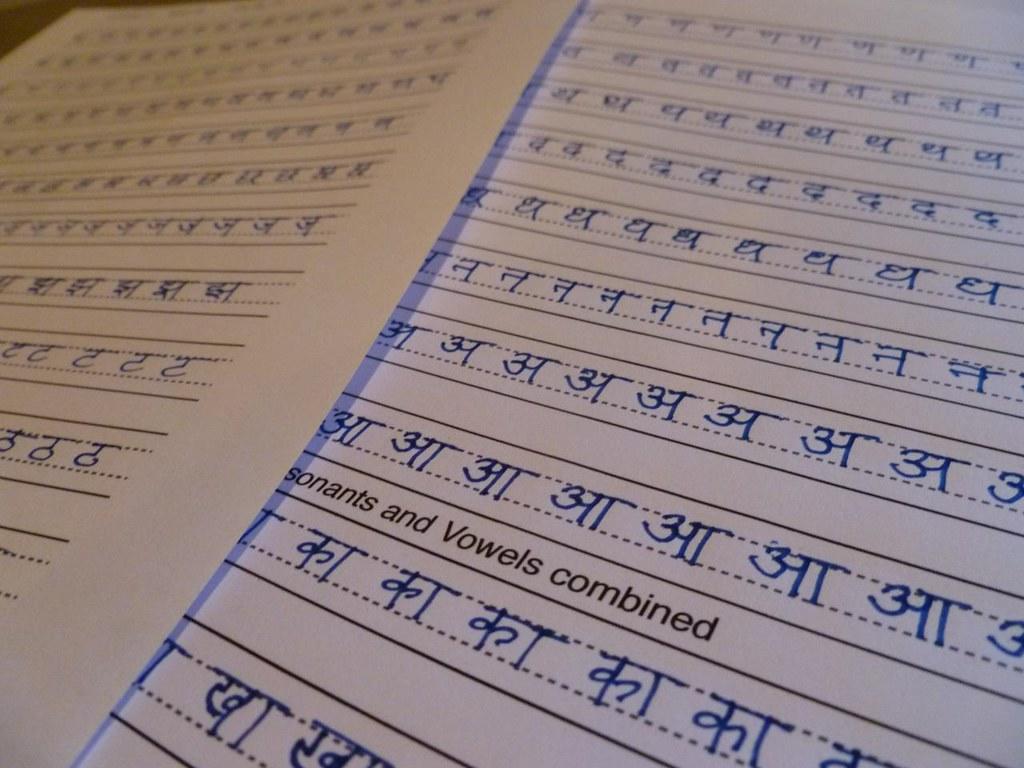
Hindi Language Alphabets
Vowels (स्वर - Swar):
अ (a) - pronounced like "u" in "but"
आ (aa) - long "a" sound, like "a" in "father"
इ (i) - similar to "i" in "ski"
ई (ii) - long "ee" sound, like "ee" in "feet"
उ (u) - akin to "u" in "ruler"
ऊ (uu) - long "oo" sound, like "oo" in "food"
ऋ (ṛ) - pronounced like "ri" in "riddle"
ॠ (ṝ) - long "ri" sound
ए (e) - similar to "e" in "let"
ऐ (ai) - pronounced like "ai" in "fair"
ओ (o) - akin to "o" in "go"
औ (au) - similar to "ou" in "house"
अं (ṅ) - nasal sound, like the "ng" in "sing"
अः (ḥ) - the visarga, indicating an exhalation, like "h" in "ah-ah"
Consonants (व्यंजन - Vyanjan):
क (ka) - like "k" in "kite"
ख (kha) - aspirated "k"
ग (ga) - like "g" in "go"
घ (gha) - aspirated "g"
ङ (ṅa) - nasal "ng"
च (cha) - similar to "ch" in "chat"
छ (chha) - aspirated "ch"
ज (ja) - like "j" in "jump"
झ (jha) - aspirated "j"
ञ (ña) - nasal "ny"
ट (ṭa) - retroflex "t"
ठ (ṭha) - aspirated retroflex "t"
ड (ḍa) - retroflex "d"
ढ (ḍha) - aspirated retroflex "d"
ण (ṇa) - retroflex nasal "n"
त (ta) - similar to "t" in "top"
थ (tha) - aspirated "t"
द (da) - like "d" in "dog"
ध (dha) - aspirated "d"
न (na) - similar to "n" in "nice"
प (pa) - like "p" in "pen"
फ (pha) - aspirated "p"
ब (ba) - similar to "b" in "boy"
भ (bha) - aspirated "b"
म (ma) - like "m" in "mother"
य (ya) - akin to "y" in "yes"
र (ra) - similar to "r" in "red"
ल (la) - like "l" in "light"
व (va) - similar to "v" in "victory"
श (śa) - similar to "sh" in "shoe"
ष (ṣa) - retroflex "sh"
स (sa) - like "s" in "see"
ह (ha) - akin to "h" in "house"
ळ (ḷa) - retroflex "l"
क्ष (kṣa) - a combination of "k" and "sh"
ज्ञ (jña) - a combination of "j" and "ny"
Basic Animal Names In Hindi
Learning Hindi animal names will help you expand your vocabulary and have a better knowledge of Indian culture, which has a tight connection to animals. Moreover, it will make it easier for you to converse.
Pets
- “Rabbit” = ख़रगोश (kharagos)
- “Squirrel” = गिलहरी (giLaharii)
- “Guinea pig” = गिनी पिग (giNii pig)
- “Cat” = बिल्ली (billii)
- “Dog” = कुत्ता (kuttaa)
Farm Animals
- “Cow” = गाय (gaay)
- “Buffalo” = भैंस (bhains)
- “Horse” = घोड़ा (ghodaa)
- “Donkey” = गधा (gadhaa)
- “Duck” = बत्तख़ (battakh)
Wild Animals
- “Lion” = शेर (ser)
- “Fox” = लोमड़ी (lomadii)
- “Bear” = भालू (bhaaluu)
- “Wolf” = भेड़िया (bhediyaa)
- “Owl” = उल्लू (ulluu)
Birds and Reptiles
- “Vulture” = गिद्ध (giddh)
- “Kite” = चील (chiil)
- “Hawk” = बाज़ (baaz)
- “Crocodile” = मगरमच्छ (magaramacch)
- “Lizard” = छिपकली (chipakalii)
Hindi Ginti [1 to 20]
The capacity to count in any language is extremely helpful in communication and also improves language learning. Therefore, learning Hindi numbers from 1 to 100 is an excellent way to learn Hindi. The number names in Indian numerals are written in the cursive Devnagari script and are modeled on the Indian-Arabic numerals.
Hindi Numbers 1 to 10
| number | गिनती | शब्दों में | in words | ordinal |
| 1 | १ | एक ek | one | पहला |
| 2 | २ | दो do | two | दूसरा |
| 3 | ३ | तीन teen | three | तीसरा |
| 4 | ४ | चार char | four | चौथा |
| 5 | ५ | पाँच paanch | five | पाँचवाँ |
| 6 | ६ | छ: chhah | six | छठवाँ |
| 7 | ७ | सात saat | seven | सातवाँ |
| 8 | ८ | आठ aath | eight | आठवाँ |
| 9 | ९ | नौ nau | nine | नौवाँ |
| 10 | १० | दस dus | ten | दसवाँ |
Hindi Numbers 11-20
| number | गिनती | शब्दों में | hints |
| 11 | ११ | ग्यारह eleven | gya+rah ग्या+रह |
| 12 | १२ | बारह twelve | ba+rah बा+रह |
| 13 | १३ | तेरह thirteen | te+rah ते+रह |
| 14 | १४ | चौदह fourteen | chau+dah चौ+दह |
| 15 | १५ | पंद्रह fifteen | pand+rah पंद्+रह |
| 16 | १६ | सोलह sixteen | sol+ah सोल+ह |
| 17 | १७ | सत्रह seventeen | satrah सत्+रह |
| 18 | १८ | अठारह eighteen | atha+rah अठा+रह |
| 19 | १९ | उन्नीस nineteen | unn-ees उन्नीस |
| 20 | २० | बीस twenty | bees बीस |
Proverbs in Hindi
Proverbs are a great way to enhance your Hindi vocabulary while also understanding Indian culture better. Here are our top picks in Hindi proverbs.

जब जागो तब सवेरा (jab jaago tab saveraa)
“Whenever you wake up, that’s your morning.”
अधजल गगरी छलकत जाये (adhajaL gagarii chalakat jaaye)
“A half-filled container spills more water.”
नाच न जाने आँगन टेढ़ा (naach na jaane aangan tedhaa)
“Not knowing how to dance but calling the courtyard crooked.”
उल्टा चोर कोतवाल को डांटे (ulataa cor kotwaal ko daante)
“When caught, the thief scolds the policeman.”
जान है तो जहान है (jaan hai to jahaan hai)
“If there is life, then there is the world.”
जिस की लाठी उसकी भैंस (jiskii laathii usakii bhains)
The buffalo belongs to the person who holds a stick.”
अब पछताए होत क्या जब चिड़िया चुग गई खेत (ab pachtaaye hot kyaa jab chidiyaa chug gayii khet)
“There’s no use repenting when the birds have already damaged the crops in the field.”
दूध का जला छाछ भी फूंक कर पीता है (Duudh kaa jalaa chaach bhii phuunk kar piitaa hai)
“The person who’s burned from milk is scared of buttermilk too.”
चोर-चोर मौसेरे भाई (chor-chor mausere bhaaii)
“Two thieves are just like cousins.”
जैसी करनी वैसी भरनी (jaisii karnii vaisii bharnii)
“What you receive is the consequence of your actions.”
ऊँट के मुंह में जीरा (uunt ke munh men jiiraa)
“A pinch of cumin seeds in the camel’s mouth.”
अंत भला तो सब भला (ant bhalaa to sab bhalaa)
“If it’s a happy ending, then everything was worth it.”
दूर के ढोल सुहावने लगते हैं (duur ke dhol suhaavne lagate hain)
“Distant drums sound pleasant.”
आगे कुंआ पीछे खाई (aage kunaan piiche khaaii)
“A well in front and a ditch behind.”
डूबते को तिनके का सहारा (duubate ko tinke kaa sahaaraa)
“To a drowning person, even a grain could be a great help.”
Hindi Sentence Structure: Basic Hindi Grammar
The basic Hindi sentence structure follows the SOV pattern. Here, S = Subject, O = Object, and V = Verb.
Declarative Sentences (Formal / Fixed)
मैं फल खाता हूँ। (main phal khaataa huun.)
(S + O + V) “I eat fruits.”
(S + V + O)
Declarative Sentences (Informal / Flexible)
मैं खाता हूँ फल। (main khaataa huun phal.)
(S +V+O) “I eat fruits.”
(S + V + O)
The S + V + O pattern in Hindi is never used in the formal context.
Negative Sentences
मैं फल नहीं खाता हूँ। (main phal Nahiin khaataa huun.)
(S + O + V) “I do not eat fruits.”
(S + V + O)
Interrogative Sentence
क्या मैं फल खाता हूँ? (kyaa main phal khaataa huun?)
(S + O + V) “Do I eat fruits?”
(Auxiliary verb + S + V + O)
Auxiliary verbs in Hindi do not come at the beginning of interrogative sentences. There are separate words for asking questions in Hindi.
Hindi is among the top three most spoken languages in the world. So, learning Hindi is unquestionably worthwhile. Some people worry that trying to learn multiple languages will mess up their heads and confuse them, but that isn't how it works. It will be simpler for you to continue learning languages from there on out if you study languages, in general, more.
Learn more with Hindi online classes on Superprof!
Summarise with AI:
Did you like this article? Leave a rating!

 Loading...