
The Atharvaveda (also called the Atharva Veda or Atharv Ved) is the fourth of the Vedas, having been added last. Many people resisted including the Atharvaveda in the set of the Vedas, and some still do, for a few reasons, which we will explore.
It’s unique from the other Vedas, which mostly have to do with mantras, hymns, and chants of a spiritual or meditative nature. The Atharvaveda, by contrast, reads more like a guidebook of solutions to problems for everyday life.
It draws some inspiration from the Rigveda, but most of the contents of the Atharvaveda are unique.
So, why have people been resistant to accepting the Atharvaveda? What does it contain, and how does it influence modern life? Let’s find out!


What is the Atharvaveda?
The first thing to know is that the Atharvaveda is one of the four Vedas, ancient Hindu texts that provide guidelines for life and spirituality.
The Vedas were written down (compiled) thousands of years ago, between 1500 and 900 BCE, however the wisdom of the Vedas had been verbally composed by hundreds (if not thousands) of Rishis for centuries before this time.
Before the compilation of the Vedas, the information was not separated into four distinct books. VedaVyasa (a title meaning the Sage granted by the Divines to write the Vedas) named Krishna Dvaipayana is credited with being the person to transcribe all the oral information into a written format for the first time and separating it into different books so that people would be able to understand the concepts in the Vedas easily.
The Vedas are meant to provide wisdom and guidance for living healthy, prosperous, happy, and righteous lives to the people of the world.
Other Names of the Atharvaveda
The Atharvaveda is currently called such because Athar is an ancient word for fire, and Atharvan was the name of the ancient sage who introduced fire to humans and taught about sacrificial fire rituals (which are also contained within the pages of this Veda).
The oldest name for this tome is Atharvangirasa Veda (Veda of the Atharvans and Angiras) because it was the foremost reference book for priests. Angiras were groups of schools and priests, and Atharvan was the name given to “a stable-minded [priest] who is immovably firm” like a yogi.
This Veda is also known as Bhaisajyaveda, because bhaisajya means medicine and this Veda offers a lot of medical advice.
It’s also known as Brahmaveda – the Veda of the Brahma Priest – because Brahma Ritvik was known for dispersing the wisdom of this Veda in his performances and practices. This Veda is also meant to help people attain Brahman.
Another sage who had a big part in the compilation of the wisdom in this Veda was Sage Bhrgu, so this text can also be referred to as Bhrgvangirasa or Bhrguvistara. Likewise, sage Angirasa was also a drastara, a sage who received divine knowledge to cultivate the Veda, and so it can also be called Angirasa.
Lastly, this Veda also reveals information about a warrior class called ksattriyas, so this text can be called the Ksattraveda.
Why Was the Athurvaveda Compiled?
The Atharvaveda gives people solutions to their daily problems in the form of definitive and actionable steps.
The other three Vedas deal with more ethereal and spiritual concepts, where, though one may believe and feel that their prayer and devotion are having an effect, the effect is mostly on one’s spiritual body and the experience they will have after death.
The Athurvaveda provides steps people can take to have effects on their daily lives, like familial relations, farming, and even helping to get rid of disease. This type of practice helps people feel like they have more control over their lives and what happens to them. Whether their actions have any real effect is unimportant when you’re talking about faith.
However, the Atharva Veda Samhita also contains information about philosophy and spirituality, making it the only Veda concerned with both worldly happiness and spiritual fulfilment. It is an encyclopaedia of many subjects in this life and the next.
The Mystery of the Fourth Veda
It is sometimes asserted that the Atharvaveda isn’t really one of the Vedas.
Some people point to the lack of mention of the Atharvaveda in the other Vedas as proof that it was not meant to be included as a foundational Veda. Others say it’s because this book was written last, so it must be more of an afterthought and has an entirely different structure than the first three.
After all, the Vedas were mentioned as being the Trayi Vedas – the Three Vedas. However, many think that trayi refers instead to the three types of mantras present in the collection: Rks (of the Rigveda), Yajus (of the Yajurveda), and Samans (of the Samaveda). The Atharvaveda contains examples of all three of these types of mantras; it collects wisdom from each book and gives the ideas practical applications.
Furthermore, the Atharvaveda may be mentioned in the Yajurveda, though some may argue that while the Atharvaveda was recognized as a book, that doesn’t mean it was meant to be a main Veda.
This is especially something to consider because the Atharvaveda was primarily meant for priests to learn from, not the average person, so they could lead the community by prescribing mantras, incantations, medications, and charms. Therefore, the average person may not have been meant to learn from the Atharvaveda the same way they could learn from the other three Vedas.
The Arthava priest should be well-versed in all the Vedas and be able to recognize if a mistake is made in a yajna so he can do a ritual/shanti to nullify the mistake (shantika karma). He can protect the yajna from all negative forces (paushtika karma). It was said that only the kingdom which had an Arthaveda priest (Brahma) would prosper without any difficulties because only such a priest knows shantika and paushtika karmas. (YouTube: Tattvam)
Perhaps the biggest reason people hesitated to accept the Atharvaveda is because the Atharva Veda deals with magic, and some consider all magic to be evil.
While a very small portion of the hymns in the Atharvaveda could be considered black magic by some, the vast majority of the book is dedicated to mantras that call upon the power of God or the self. Very few mantras call for “magic” and only a small percentage of those mantras call for anything that could be considered dark magic.
Eventually, the Atharvaveda became accepted as the fourth Veda simply because of the passage of time; it was referred to so much in relation to the first three books that it became synonymous with the Vedas. No one came forth and declared the fourth book to be an official Veda.
History of the Veda
At one point, there were 9 practicing schools, or recensions, called Shakhas, of the Atharvaveda:
- Paippalāda
- Stauda
- Mauda
- Śaunakīya
- Jājala
- Jalada
- Brahmavada
- Devadarśa
- Cāraṇavaidyā
Currently, only information about the Shaunakiya and Paippalāda Shakhas has been rediscovered by modern scholars.
The Structure of the Atharvaveda
Like all the Vedas, the Atharvaveda is comprised of four sections: Samhita, Brahmana, Aranyaka, and Upanishad (note: the Aranyaka of this Veda has not yet been rediscovered).
And, like all the Samhitas of Vedas, the primary wealth of knowledge in the Atharvavaeda is in the first section, here known as the Shaunaka Samhita and Paippalada Samhita.
There is one Brahmana, called Gopath Brahmin.
There are three notable Upanishads: the Mundaka Upanishad, the Mandukya Upanishad, and the Prashna Upanishad.
How Many Mantras Are in the Atharvaveda?
The Samhita of the Atharvaveda is made of 20 books (Kandas), which contain about 730 hymns (Suktas) and about 6000 mantras.
About 1200 of the mantras are directly from the Rigveda, and about ⅙ of the content of the entire Athurvaveda is written in prose, in the style of the other Vedas. The remaining ⅚ of the content is written unique poetic verse.
How Are the Suktas Organized?
The Suktas can be divided into 10 categories:
| Category | Concerning | Examples |
|---|---|---|
| Bhaishajyaani | Medicine, medicinal plants, germ theory, healing ailments and injuries | Incantations, rituals, surgical procedures, charms, blessings, prayers, mantras, and prescriptions for things like: easy delivery of a baby, remedies for maladies and diseases. How to identify the two different types of diseases |
| Ayushaani | Longevity, good health | Prayers for long life to be used during chaula, upananayam, etc |
| Paushtikaani | Warding off evil and hardship, inviting weath and prosperity | Prayers for farmers and cowherds, specifically about things like building a house, tilling the land, sowing the seeds, getting more yield, getting rid of worms and pests, etc |
| Abhichaarikaani | Protecting against malevalent forces, warding off curses, removing negative energy | Mantras to banish an evil spirit, repel an enemy king, invoke divine forces to guard against harm |
| Prayischittani | Penance, expiation, atonement, and redemption for mistakes made during religious rites or ceremonies | Mantras to nullify the mistakes made during religious rites |
| Streekarmani | Domestic happiness, women's roles in family and society | Marriage mantras, prayers for the birth of a child and their protection, prayer to pacify anger of a husband |
| Rajakarmani | The King or Societal Ruler's duties, health, and happiness | Mantras for health of the king, coronation of the king, destruction of the society's enemies, king’s influence in the country, etc |
| Papanirhaani | Eradication of sins and guilt | Mantras to remove sins. Example: If a younger brother gets married before his elder brother, he creates a sin on himself. A papanirhaani sukta would be used to atone for the sin. |
| Brahmanyaani | Spirituality, philosophy, religion & dieties, the cosmos, reflective thinking | Mantras about philosophy and spiritualty. They speak about the parabrahman, paramatman, Kaala, purusha, rohit, skambha, and vratyas. |
| Saumanasyani | Mental peace and clarity, harmony, tranquility. | Mantras for ending quarrels and misunderstandings, establishing peace in the house, mutual understanding, good thoughts and friendly feelings. Pacifying the anger of the king or head of the society. |
The specific division of the Suktas into these categories is different depending on the tradition you are studying since the book itself doesn’t divide the Suktas.
The 20 Books of the Atharvaveda
The 20 books are arranged from the shortest book to the longest (although some traditions arrange it in the opposite direction).
Perhaps intentionally, when arranged this way, it’s possible to loosely group the books together by general topic.
- Books 1 through 7 contain mostly magical prose for healing and sorcery.
- Books 8 through 12 are a variety of mixed topics.
- Books 13 through 18 are about the life cycle and different rites of passage over a person’s life.
- Books 19 and 20 were added later on and contain mostly content from the Rigveda.
The overall contents of all 20 books contain these prominent themes:
- Diseases and their cure
- Rites for prolonging life
- Rites for fulfilling one’s desires
- Building Construction
- Trade and commerce
- Statecraft
- Penances
- Propitiatory rites
- Black-magic
For this reason, the Atharvaveda is recognized as a guide for running a personal life as well as a society. It outlines how people ought to behave in their family, in their social circle, in their society, and in the world.
Everyone, from husbands, wives, children, priests, kings, warriors, farmers, and more are mentioned and advised on their behaviour.
What We Can Learn From the Atharvaveda
There is so much to be gleaned from all the Vedas, but the Atharvaveda can teach about some specific topics very thoroughly.
Early Medicine, Folk Medicine, and Surgery
Although Ayurveda is the Upa Veda of the Rigveda, the Atharvaveda is the tome that teaches about many medicinal concepts that were groundbreaking for the time, the fundamentals of which are still used in modern medicine.
The science of Ayurveda was largely informed by the truths revealed in the Athurvaveda, although Ayurveda doesn’t talk about germ theory or surgery.
Some of the medical concepts covered in the Athurvaveda include:
| Vedic Term | Meaning |
|---|---|
| Takman | Fever |
| Balaasa | Tuberculosis |
| Khaasa | Cough |
| Aasraava | Diarhhoea |
| Kankusha | Pain in the ears |
| Krimis | Germs that get in through the nose, ears, and teeth |
Diseases were attributed to germs, violating the laws of nature, angry deities, malevolent spirits, and karmic consequences.
Students of medicine were advised to examine dead bodies to understand anatomy and were taught to practice incisions on gourds. One of the most detailed procedures in the Atharvaveda is rhinoplasty, which must have been a regular occurrence to merit being recorded in the Vedas!
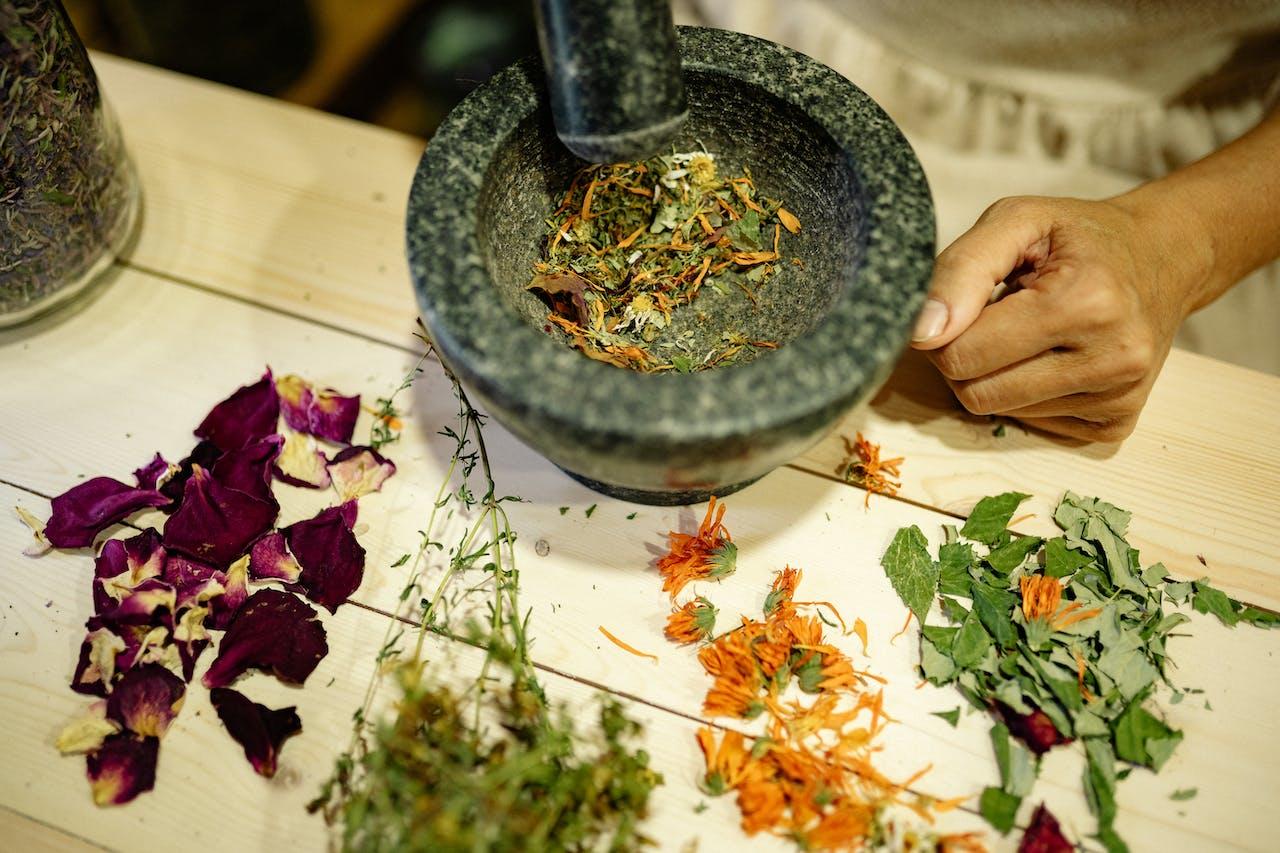
Many herbs and plants were described for their healing properties and it was indicated which plants should be used in certain situations.
| Vedic Name | Other Names |
|---|---|
| Shami | Jand |
| Palaasha | Flame of the Forest |
| Asakti | Winter Cherry, Asvagandhi, related to Ashwagandha |
| Kanva | Cannabis |
| Madhu | Madhuyashti, Licorice, or Yashtimadhu |
| Madhulaa | Stevia |
| Pippalee | Long Pepper |
| Darbha | Kusha Grass |
The Nature of Life
The Atharvaveda teaches through mantra, yantra, and tantra.
Mantra: Words spoken to invoke blessings
Yantra: A tool or instrument (literally: machine) used to assist in something (EX: A gong, a mobile phone, crystals, a geometric diagram, a pyramid, mala, Rudraksha, etc)
Tantra: The processes used in spiritual pursuits (the performing of mantras, the performing of hitting a gong, the awakening during meditation, etc)
The Atharvaveda provides all the tools (you could call it a Yantra) needed to learn the Mantra and participate in the Tantra needed to lead a long, healthy, prosperous, harmonious, happy life.
Magic and Sorcery
While the portion of this Veda that talks about spells and magic is very small, it’s often the part most focused on because it’s very different from the other Vedas, very interesting, and a little bit scary.
People do perform kala jadoo in this day and age, with ill intent, and some rituals are frankly violent and alarming. But, this is a very small minority of people and is certainly not what the Atharvaveda is advocating!
In fact, the Atharvaveda mostly guides readers to avoid using spells and instead use mantras to invoke God and seek help that way. If one must use magic, one should do so in a manner consistent with Sattvik (pure) and completely avoid using magic to harm others or in a Tamasik (dark or ignorant) way.
Economics and Societal Functions
While not anything like the political science, economics, or sociological texts we have today, the Atharvaveda did offer some guidance on these subjects.
Many of the Suktas discuss things like building construction, trade and commerce, statecraft, and the roles of different people in society.
The Upa Veda associated with the Atharvaveda is called the Arthashastra, which is a treatise on statecraft, political science, economic policy, and military strategy.
While the Atharvaveda is sometimes left out of being included with the Vedas, and some people fear the mention of spells and magic, the truth is that it provided a fantastic guidebook for the Atharvan priests and people of ancient India. To this day, it can offer much wisdom and allow people to practice religious and spiritual faith through rituals, mantras, and more.
References
- “Atharvaveda Samhitas.” Vedic Heritage Portal, 22 Nov. 2023, vedicheritage.gov.in/samhitas/atharvaveda-samhitas/.
- “Atharvaveda.” Hinduism4u.Com, 23 Apr. 2023, hinduism4u.com/vedas-atharvaveda/.
- “Atharvaveda.” Hindupedia, the Hindu Encyclopedia, 7 Apr. 2023, www.hindupedia.com/en/Atharvaveda.
- Griffith, Ralph T.H. “Hymns of the Atharvaveda.” Hinduwebsite.Com, www.hinduwebsite.com/sacredscripts/hinduism/athar/index.asp.
- “Read Atharva Veda in English.” Mahakavya, 4 Apr. 2023, www.mahakavya.com/atharv-veda-english/.
- “Veda Vyasa: The Sage Who Compiled the Vedas.” Hindu American Foundation, 21 Sept. 2020, www.hinduamerican.org/blog/veda-vyasa-the-sage-who-compiled-the-vedas.
Summarise with AI:
Did you like this article? Leave a rating!

 Loading...