
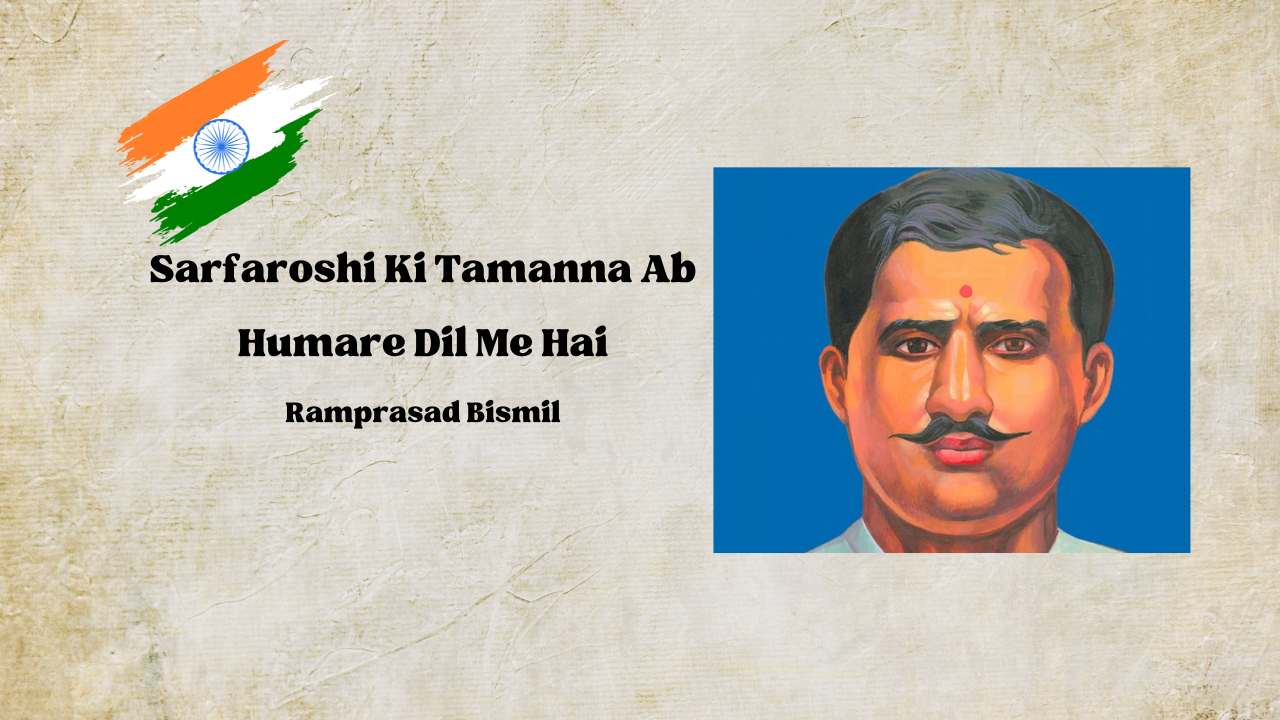

Some essential words, poems, and slogans played a vital role in instilling a strong sense of patriotism and love in the thoughts of the immortals fighting for India's independence from the British. Sarfaroshi ki Tamanna is a patriotic poem written in Urdu by Bismil Azimabadil in 1921 that was immortalized by the great independence fighter Ramprasad Bismil as a freedom battle cry during the British Raj period in India.
However, the slogan itself was first used by Ramprasad Bismil, co-founder of the Hindustan Republic Association.
It was initially published in the magazine "Saba" published in Delhi. The poem was composed as a tribute to the young freedom fighters in the Indian independence movement, including Ashfaqullah Khan, Shaheed Bhagat Singh, and Chandrashekhar Azad, who broke away from Gandhian politics to enforce direct action on the British colonialists.





Sarfaroshi Ki Tamanna Ab Hamare Dil Mein Hai Ghazal - Lyrics in Hindi and English
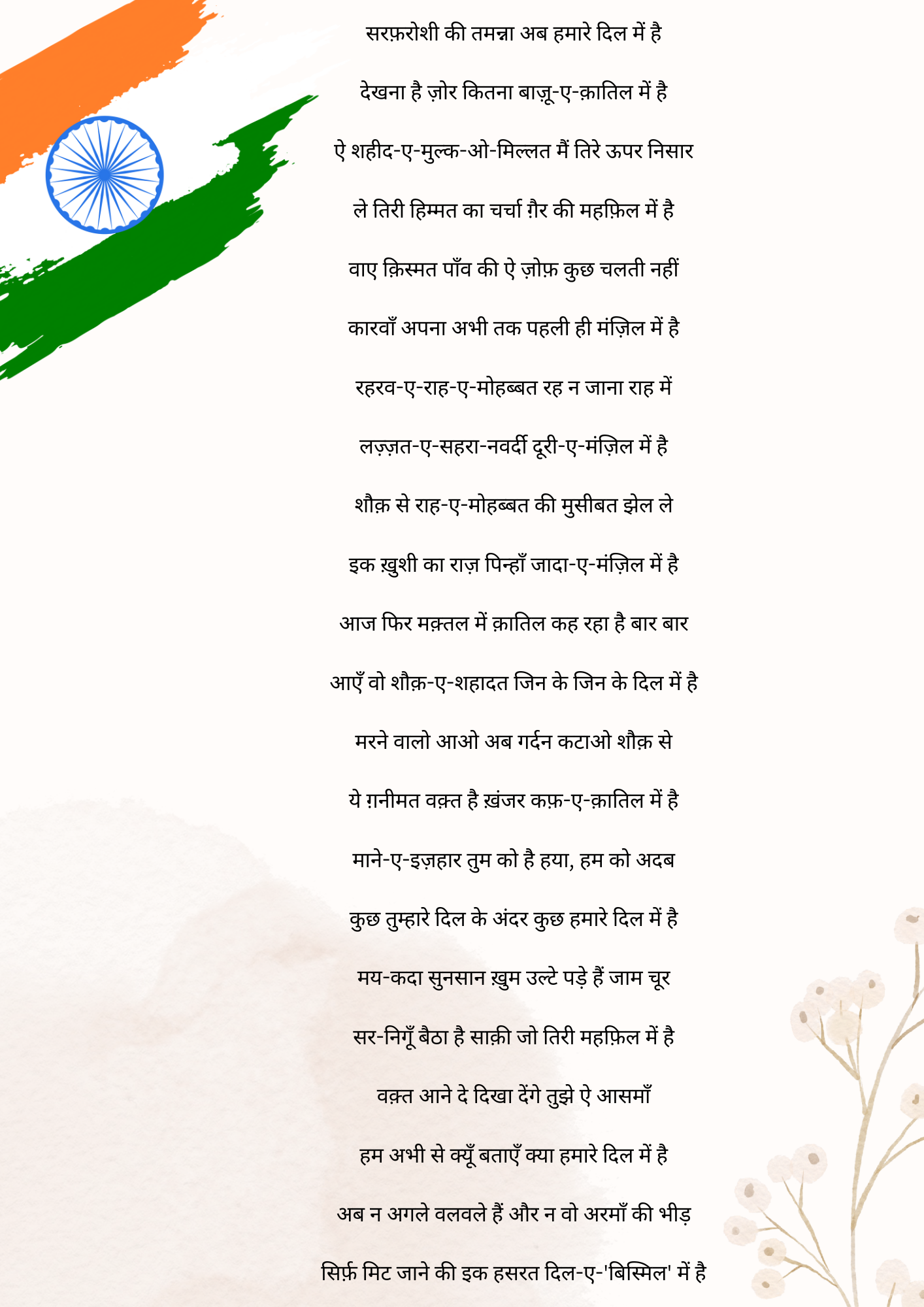
Sarfaroshi ki tamanna ab hamaare dil mein hai
Dekhna hai zor kitna baazu-e-qaatil mein hai
Karta nahin kyun doosra kuch baat-cheet
Dekhta hun main jise woh chup teri mehfil mein hai
Aye shaheed-e-mulk-o-millat main tere oopar nisaar
Ab teri himmat ka charcha ghair ki mehfil mein hai
Sarfaroshi ki tamanna ab hamaare dil mein hai
Waqt aanay dey bata denge tujhe aye aasman
Hum abhi se kya batayen kya hamare dil mein hai
Khainch kar layee hai sab ko qatl hone ki ummeed
Aashiqon ka aaj jumghat koocha-e-qaatil mein hai
Sarfaroshi ki tamanna ab hamaare dil mein hai
Hai liye hathiyaar dushman taak mein baitha udhar
Aur hum taiyyaar hain seena liye apna idhar
Khoon se khelenge holi gar vatan muskhil mein hai
Sarfaroshi ki tamanna ab hamaare dil mein hai
Haath jin mein ho junoon katt te nahi talvaar se
Sar jo uth jaate hain voh jhukte nahi lalkaar se
Aur bhadkega jo shola-sa humaare dil mein hai
Sarfaroshi ki tamanna ab hamaare dil mein hai
Hum to ghar se nikle hi the baandhkar sar pe kafan
Jaan hatheli par liye lo barh chale hain ye qadam
Zindagi to apni mehmaan maut ki mehfil mein hai
Sarfaroshi ki tamanna ab hamaare dil mein hai
Yuun khadaa maqtal mein qaatil kah rahaa hai baar baar
Kya tamannaa-e-shahaadat bhi kisee ke dil mein hai
Dil mein tuufaanon ki toli aur nason mein inqilaab
Hosh dushman ke udaa denge humein roko na aaj
Duur reh paaye jo humse dam kahaan manzil mein hai
Wo jism bhi kya jism hai jismein na ho khoon-e-junoon
Kya lade toofaanon se jo kashti-e-saahil mein hai
Sarfaroshi ki tamanna ab hamaare dil mein hai.
Dekhna hai zor kitna baazuay qaatil mein hai.
Sarfaroshi Ki Tamanna Ab Hamare Dil Mein Hai English Translation
The desire for revolution is in our hearts
Let us see what strength there is in the arms of our executioner
Why do you remain silent thus?
Whoever I see, is gathered quietly so…
O martyr of country, of nation, I submit myself to thee
For yet even the enemy speaks of thy courage
The desire for struggle is in our hearts…
When the time comes, we shall show thee, O heaven
For why should we tell thee now, what lurks in our hearts?
We have been dragged to service, by the hope of blood, of vengeance
Yea, by our love for the nation divine, we go to the streets of the enemy
The desire for struggle is in our hearts…
Armed does the enemy sit, ready to open fire
Ready too are we, our bosoms thrust out to him
With blood, we shall play Holi if our nation needs us
The desire for struggle is in our hearts…
No sword can sever hands that have the heat of battle within,
No threat can bow heads that have risen so…
Yea, for in our insides has risen a flame,
and the desire for struggle is in our hearts…
Set we out from our homes, our heads shrouded with cloth,
Taking our lives in our hands, do we march so…
In our assembly of death, life is now but a guest
The desire for struggle is in our hearts…
Stands the enemy in the gallows thus, asking,
Does anyone wish to bear testimony?…
With a host of storms in our hearts, and with revolution in our breath,
We shall knock the enemy cold, and no one shall stop us…
What is that body that does not have hot blood in it,
How can a person conquer a typhoon while sitting in a boat near the shore?
The desire for struggle is in our hearts,
We shall now see what strength there is in the boughs of the enemy.
Who Gave the Slogan Sarfaroshi Ki Tamanna Ab Hamare Dil Me Hai?
It was the great freedom fighter, Ram Prasad Bismil, who popularized this poem. When Bismil was being walked to his death, the first verses of this ghazal were on his lips. Born in 1897, Bismil spent his early years studying Urdu and English. Even at an early age, he was introduced to the Arya Samaj and soon embraced its worldview. Bismil was greatly affected by Swami Dayananda's Satyaartha Prakash and began following it religiously after reading it. He routinely engaged in the Arya Samaj's activities, although its ideals and techniques were quite conservative. Bismil was both radical and revolutionary. He broke away from the Arya Samaj to join the revolutionary group known as the Kumar Sabha.
Bismil and the Story of His Patriotic Valor
When Bismil learned of the 43 death verdicts for independence fighters in the Lahore Conspiracy case in 1916, he vowed to exact revenge on the vile British government. Bismil was dissatisfied with his countrymen's unwillingness to confront the British abuses. He believed that authoring novels would help individuals inspire their sleeping compatriots. He published two books, "How Did America Attain Freedom" and "A Message to My Countrymen". However, the British government outlawed these works.
Bismil took up farming and cowherding while in hiding. During this time, he spent most of his leisure time translating Bengali works into Hindi. He also published numerous books at this time. After World War I, the government dropped the accusations against revolutionaries, allowing Bismil to return to Shahjahanpur. Bismil and his companions looted British money near a railway head named Kakori. The British government was rattled by this well-planned heist. Investigations began quickly, and four persons were arrested in the Kakori Conspiracy case. Among them were Ram Prasad Bismil, the mastermind, and three of his loyal friends: Ashfaqullah Khan, Roshan Singh, and Rajendra Lahiri. They were sentenced to be executed.
Their conviction sparked a nationwide outrage. All governmental officials pleaded on behalf of the four young guns. It instilled a newfound vigor in the heart of a young Subhash Chandra Bose who became convinced of the futility of Gandhi's nonviolent methods and grew convinced of direct action as a means to gaining India's freedom. However, the British government was unmoved. On December 18, 1927, Rajendra Lahiri was hanged. Ram Prasad and Ashfaqullah were executed on the 19th, and Roshan Singh on the 20th. While awaiting death in Gorakhpur, Ram Prasad Bismil penned a heartfelt autobiography in Hindi.
Legacy of the Slogan, Sarfaroshi Ki Tamanna Ab Hamare Dil Me Hai
Waiting for death is a tremendously terrifying experience for most people, but, time and again, every patriot who gave their life for India did so with a smile and without fear. Their passion for the truth and commitment towards the cause of India's independence outweighed their love for life. Thus, when one patriot was slain, it sparked an army of even more passionate supporters. Reading about the lives of these great heroes should serve as a constant reminder of how much it took India to earn its freedom.
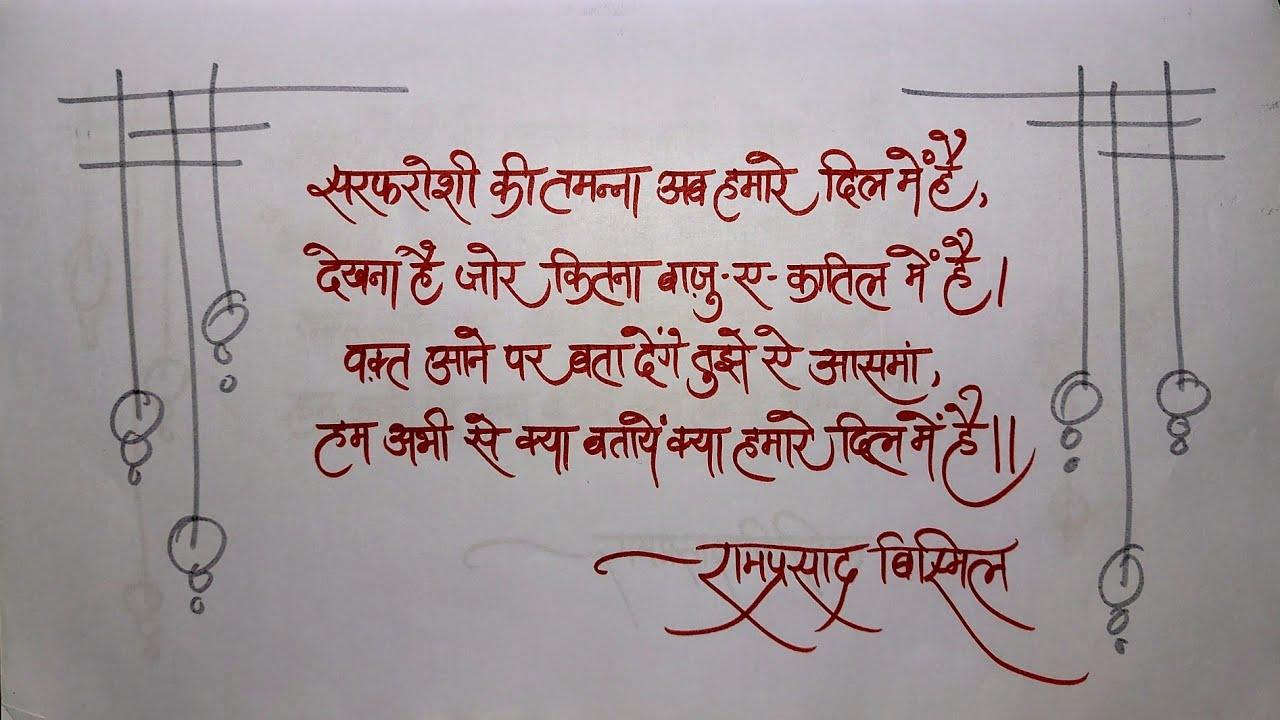
Bismil was executed on December 19, 1927, at the age of 30, leaving a legacy of sacrifice and commitment to the cause of freedom. The memory of the revolutionary freedom fighters Bismil and Ashfaq's camaraderie and comradeship has much to give us in these challenging times when hate-mongering politics strives to draw a communal wedge between people and justify the lynching and slaughter of Muslims in India. Bismil's poetry continues to inspire, and his call for Hindu-Muslim unity serves as a symbol of communal harmony. His revolutionary spirit and sincere concern for society, justice, and equality will be remembered.
Summarise with AI:
Did you like this article? Leave a rating!

 Loading...
