
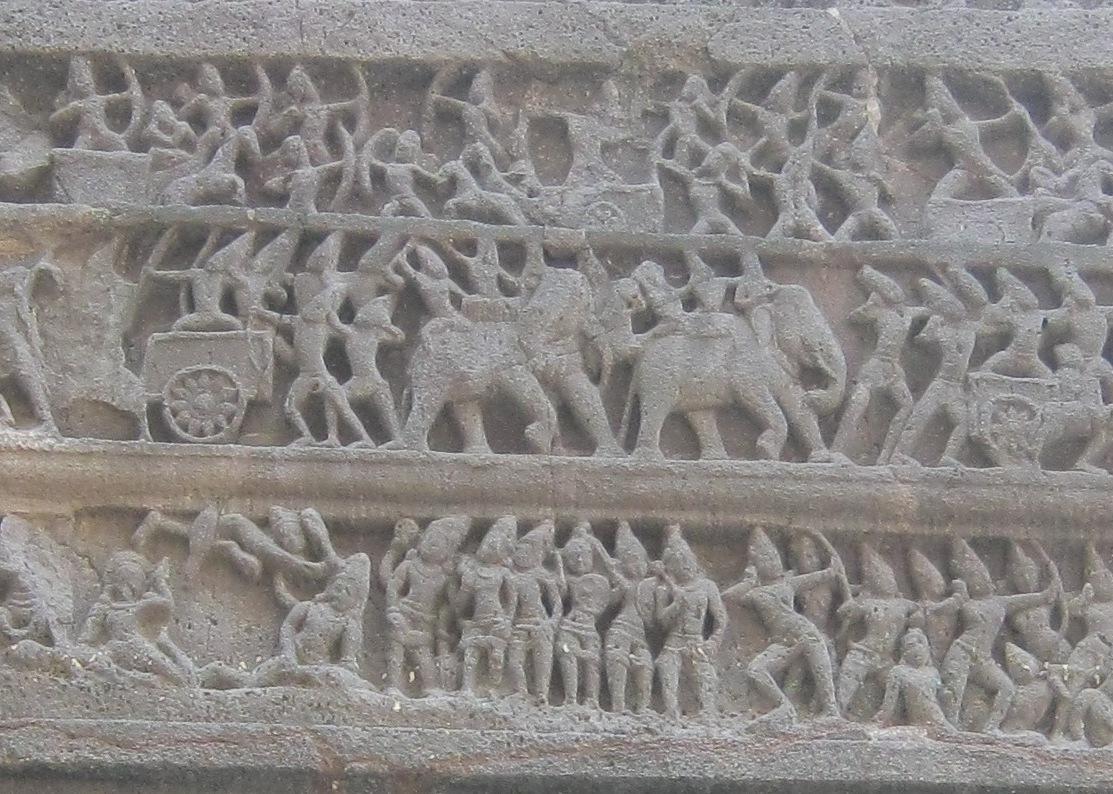

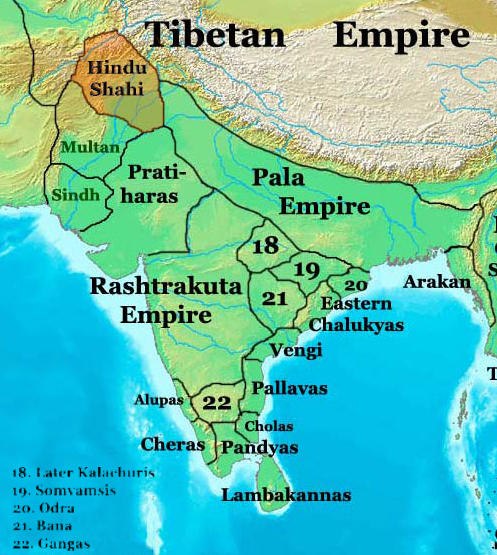
In South India, the Rashtrakuta Dynasty governed from the eighth to the tenth century CE. At its height, their kingdom comprised all of the present-day state of Karnataka as well as swathes of Tamil Nadu, Andhra Pradesh, Telangana, Maharashtra, and Gujarat in India. Numerous Islamic scholars and travellers, particularly Al-Masudi and Ibn Khordadbih (10th century CE) write that the Rashtrakutas were so influential and powerful that all other Indian kings at the time bowed down to them in reverence and prayed to them as a higher power.
The Rashtrakutas governed as several distinct but closely related clans during that time. The first known Rashtrakuta inscription dates to the seventh century and describes their control from Manpur in the Malwa region of present-day Madhya Pradesh. It is found on a copper plate grant. Other prominent Rashtrakuta clans from the same era that are referenced in inscriptions were the monarchs of Kannauj, modern-day Elichpur in Maharashtra, and Achalapur. Regarding the ancestry, native place, and language of those early Rashtrakutas, there are several disagreements.
Between the eighth and the tenth centuries, there was a three-way battle for control of the wealth of the Gangetic plains, with each of the three empires briefly annexing the capital at Kannauj. The Rashtrakutas of Manyakheta flourished during a period of political expansion, architectural marvels, and renowned literary contributions. Their huge kingdom stretched from the Ganga and Yamuna River doab in the north to Cape Comorin in the south. Although the latter monarchs of that dynasty were greatly inspired by Jainism, the earlier kings had been Hindu.



History of the Rashtrakutas UPSC Notes
In Sanskrit, the words "Country" (Rashtra) and "Chieftain" (Kuta) translate to "Rashtrakuta." This clarifies their ancestry from Ashoka the Great, the Mauryan Emperor, who ruled over them in the third century BCE. At that time, they were mostly tiny clan leaders spread over India.
Some of Ashoka's edicts (Mansera, Girnar, Dhavali) mention a woman named Rathika, who might have been the Rashtrakutas' forebears. Though many historians maintain that those inscriptions refer to older Rathikas, which many believe to be the Rashtrakutas, there is insufficient archaeological evidence to support this theory. Parts of their ancestry, believed to date back to the Mauryan era, can be found in medieval Sanskrit literature as tiny clan chiefs.
Discover the grandeur that was the Chola Empire.
But their ascent started in 753 CE when their King Kirtivarman II was vanquished by Dantidurga (also known as Dantivarman, r. until 756 CE), a feudatory of the Badami Chalukyas. Beginning in 731–739 CE, Dantidurga aided the Chalukyas in their victorious battle against the invading Arab army, which marked the beginning of his climb.
He soon made it clear that he was not content to be merely a vassal state and began using military force to impose his will. Before making the last attack on the Chalukya king in 753 CE and founding the Rashtrakuta Empire, he vanquished the kings of Kosala and Kalinga, subdued the Gurjaras of Malwa, defeated other kings of Central India, and forged a friendship with the Pallava king Nandivarman II Pallavamalla of Kanchi by marrying his daughter.
Prominent Rashtrakuta Empire Rulers
Dantidurga (735–756 AD)
Dantidurga is credited with founding the Rashtrakuta Empire. His capital was in the Karnataka region of Gulbarga. In 753 AD, he vanquished the Chalukyas and assumed the titles of Parameshvara and Rajadhiraja. In addition, he carried out a great deal of penance and vanquished the rulers of central India, Lata, Malwa, Tanka, Kalinga, and Sheshas (Nagas). Even after overthrowing the Chalukya Empire, Chalukya Emperor Kirtivarman II remained in charge of his southern territories until 757 AD.
Krishna I (756–774 AD)
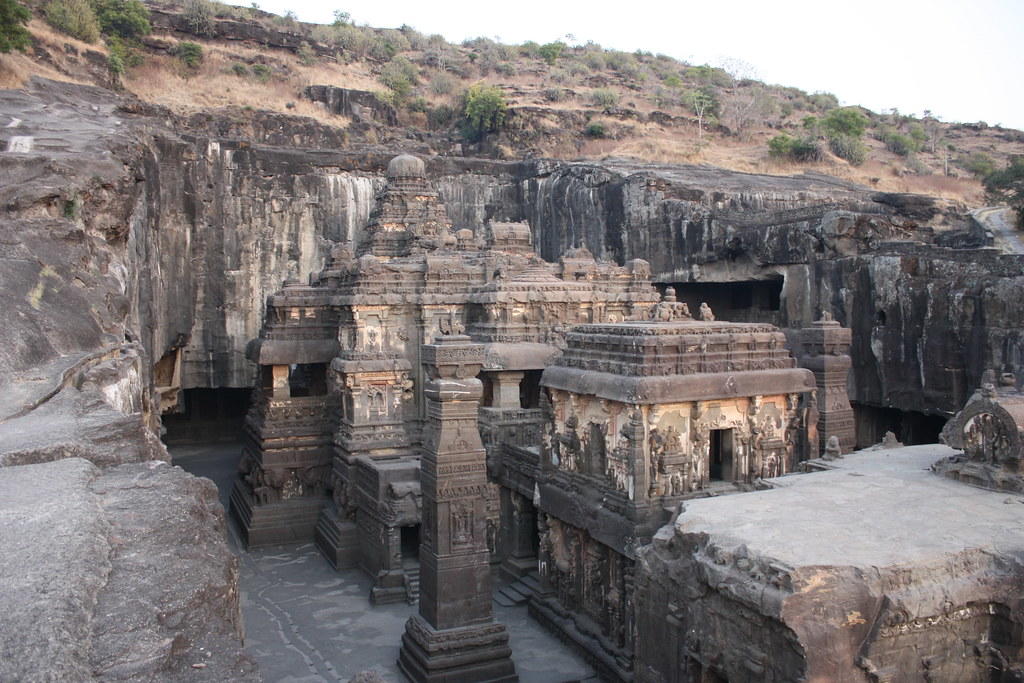
As Dantidurga's uncle, Krishna I took on the task of overthrowing Kirtivarman II, the final Badami Chalukya emperor, to establish the Rashtrakuta Empire in 757 AD. He defeated the Shilaharas of South Konkan and the Western Ganga Dynasty King Sripurusha, gaining some dominion in Gangavadi, modern-day Southern Karnataka. He vanquished Vishnuvardhana IV, the monarch of Eastern Chalukya. During his reign, the Kailasanatha Temple was established in Ellora. He oversaw the construction of eighteen Shiva temples. Following his death, Govinda II, his eldest son, assumed the throne.
Govinda II (774–780 AD)
Govinda II gave his younger brother, Dhruva Dharavarsha, administrative duties. Very little is known about Govinda I, except for his devotion to exotic pleasures, a Vengi invasion, and the subsequent destruction of Eastern Chalukya monarch Vishnuvardhana IV (at the time when his father Krishna I was still the Rashtrakuta emperor).
Dhruva (780–793 AD)
Dhruva was one of the Rashtrakuta Empire's most remarkable emperors. He ascended to the throne by deposing his elder brother Govinda II. Because of his several misdeeds as a ruler, Govinda II had come to be despised by his subjects, combining extreme liberality in evoking joy.
Matching the Vijayanagara Empire in style and magnificence, the Chalukyas also maintained a rich tradition of temple architecture.
Govinda III (793–814 AD)
Govinda III was the son of Dhruva Dharavarsha. From Banaras in the east to Broach (Bharuch) in the west, he achieved great military triumphs, making him the best monarch of the tradition from Cape Comorin in the south to Kannauj in the north. In the year 800 AD, Govinda III led his northern army from his capital located in the Bidar region of Mayurkhandi. He successfully gained the consent of Dharmapala of the Pala Empire, Kannauj's monarch Chakrayudha, and Gurjara-Pratihara Nagabhata II. Following the death of Govinda III in 814 AD, his son Amoghavarsha took over.
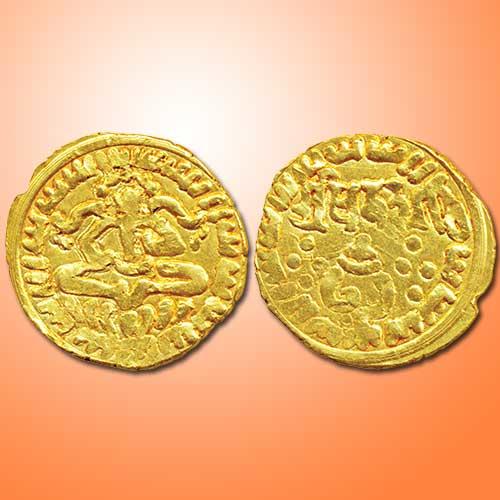
Amoghvarsha or Sarva (Amoghavarsha I) (800–878 AD)
Amoghavarsha was one of the most virtuous Rashtrakuta monarchs. His sixty-four-year reign is among the most clearly dated monarchical reigns ever documented. I was a skilled scholar and writer, Amoghavarsha I. He wrote the Sanskrit religious work Prashnottara Ratnamalika and the Kannada abstract work Kavirajamarga, which is the most punctual of its kind that has survived. He relocated the magnificent capital of Rashtrakuta from Mayurkhandi in the Bidar region to Manyakheta in the Gulbarga region of the developed state of Karnataka.
All of the South Indian dynasties of the Sangam era were celebrated patrons of art and architecture, led by the mighty Vijayanagara Empire.
Krishna II (878–914 AD)
Following the passing of his famous father Amoghavarsha I, Krishna II assumed the Rashtrakuta kingdom. Even though Krishna II's rule was mixed when it came to matters of domain growth, his rule saw enormous advancements in literature. He suffered several setbacks at the hands of King Gunaga Vijyaditya III of the Eastern Chalukyas, whose chief pursued Krishna II in central India.
Krishna III (939 – 967 AD)
Krishna III was the last formidable warrior and skillful king of the Manyakheta Rashtrakuta Dynasty. He was a competent military strategist and manager. He waged multiple wars to restore the glory of the Rashtrakutas and played a crucial role in reconstructing the Rashtrakuta kingdom. At the height of his power, he governed an unfathomable territory that stretched from the Kaveri canal delta in the south to the Narmada stream in the north.
Rashtrakuta Administration
The kingdom was divided into Rashtras (regions) and Mandalas. A Rashtrapathi, who was occasionally the emperor himself, reigned over a Rashtra. 16 Rashtras were present in Amoghavarsha I's kingdom. A Vishaya (district) governed by a Vishayapathi existed under a Rashtra. Now and then, the ministers had more power than a Rashtra. Under the Vishaya was the Nadu, administered by the Nadugowda or Nadugavunda; sometimes there were two such officials, one centrally appointed and the other inherited the post. A Grama, or hamlet, headed by a Gramapathi or Prabhu Gavunda, was the smallest division.
Rashtrakuta Art and Architecture
The Karnata Dravida style is an aesthetically pleasing architectural type that was established in large part thanks to the Rashtrakutas. The spectacular rock-cut Kailasa Temple at Ellora is the pinnacle of Rashtrakuta architectural achievement, but the Rashtrakutas were also responsible for the creation and renovation of many of the caves at Ellora and Elephanta (in the modern state of Maharashtra). Following the Chalukyas' defeat, the Rashtrakutas also took control of the temples at Pattadakal, another UNESCO World Heritage Site, and repaired and extended them. It is stated that the Rashtrakuta Dynasty was the only one to construct the Jain Narayana Temple.
Fall of the Rashtrakuta Empire
The Rashtrakuta dynasty's decline started during the reign of Khottiga Amoghavarsha, who was overthrown and assassinated in 972 CE by a monarch of the Paramara dynasty. The dynasty's prestige was severely damaged when the capital city of Manyakheta was pillaged and destroyed. Indra IV, the final king of the realm, committed himself in 982 CE by engaging in the Jaina ritual of sallekhana, which involves fasting till one's death.
Even after the Rashtrakuta Dynasty ended, their influence persisted. The later Cholas and other dynasties conquered parts of their realm, but the succeeding empires also adopted their political structure and many other cultural customs. Culturally, the Pattadakal temples, the Ellora constructions, and a plethora of medieval literary works attest to the refined tastes and patronage of the Rashtrakutas.
Rashtrakuta Dynasty for UPSC: FAQs
Who was the founder of the Rashtrakuta dynasty?
Dantivarman, also known as Dantidurga, established the Rashtrakutas dynasty.
Who defeated Rashtrakutas?
Taila, also known as Tailapa, the Chalukya ruler of Kalyani, defeated and overthrew the Rashtrakuta ruler Karka.
What are the sources of the Rashtrakuta dynasty?
Rashtrakuta history is derived from a variety of sources, including records made by Arab explorers, medieval inscriptions, ancient Pali literature, and contemporary Sanskrit and Kannada literature.
Summarise with AI:
Enjoyed this article? Leave a rating!


 Loading...
