
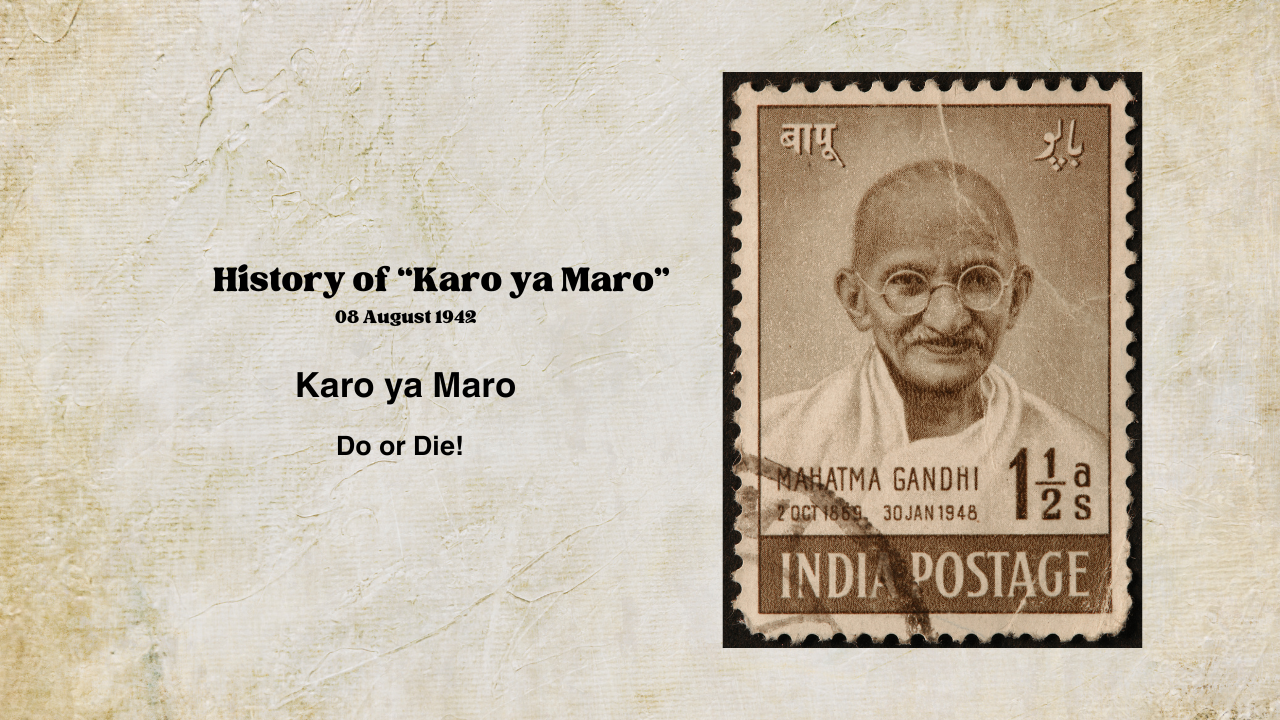

Mahatma Gandhi delivered the Quit India address on August 8, 1942, the day before the Quit India campaign began. His talk was given soon before midnight in Bombay's Gowalia Tank Maidan, now known as August Kranti Maidan (August Revolution Ground). The speech was delivered in support of Indian independence and the cessation of British colonial control. He advocated for resolute but passive resistance and civil disobedience, unlike the extremist freedom fighters who believed in direct action, based on the ideals of satyagraha ("truthful request"), which represented Gandhi's vision for the movement, best shown by his demand to "Do or Die".
“Karo ya Maro” means “Do or Die,” a powerful call for total commitment to India’s freedom struggle. This slogan became iconic during the Quit India Movement of 1942, launched by Mahatma Gandhi as a mass civil disobedience campaign demanding an immediate end to British rule. The movement saw nationwide protests, strikes, and arrests, marking one of the most decisive phases of India’s independence struggle.





Key Facts About “Karo ya Maro” & the Quit India Movement
“Karo ya Maro” was given by Mahatma Gandhi in his historic Quit India speech on 8 August 1942.
The slogan inspired Indians to fight fearlessly, even at the cost of their lives.
The Quit India Movement demanded the immediate withdrawal of British rule from India.
The British responded by arresting almost all top national leaders within hours.
Despite leader arrests, the movement spread spontaneously across the country.
Students, workers, peasants, and women played a major role in organizing protests.
- The movement witnessed the disruption of railways, communication lines, and government offices.
- “Karo ya Maro” became a symbol of unity, courage, and unwavering resolve in India’s freedom struggle.
Quit India Movement: India's 'Do or Die' Moment (Karo Ya Maro)
For nearly 200 years, Britain had imposed its iron will on India. From the East India Company levying taxes in the 18th century to Britain imposing direct rule over two-thirds of the country in the mid-19th century, India had been extorted for centuries, and when World War II began, India was declared at war with Germany without consulting any Indian political leaders. The country would later supply an army of 2.3 million men, as well as food and other supplies, to assist the Allies in defeating the Axis Powers.
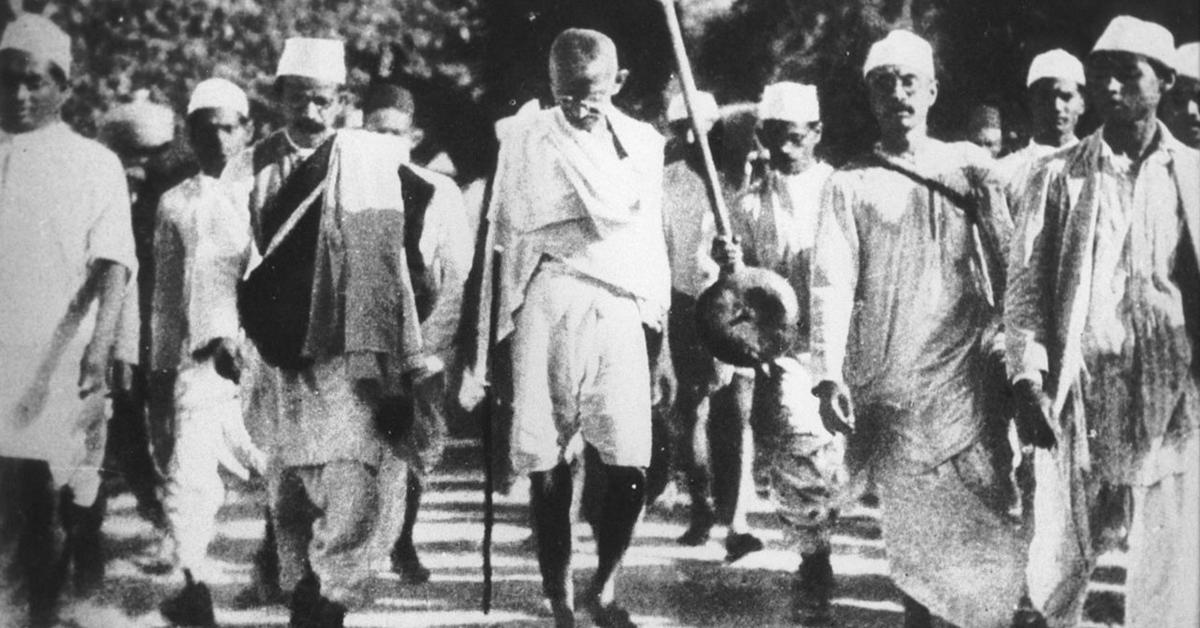
The Indian National Congress sympathized with the defeat of fascism, but they were opposed to their nation being pillaged further for resources. The Quit India Movement was begun at a time when the globe was in upheaval. There was a war going on in the West, and in the East, anti-colonialist forces had grown stronger. On the one side, India was looking to Mahatma Gandhi's leadership, which sought to alter society via nonviolent measures such as Satyagraha.
Subhash Chandra Bose, the 'Tiger of Bengal', marched with an army to free India with the motto 'Dilli Chalo'. The breeding ground of India's independence movement had accumulated enough manure from mass actions to be fertile for the planting of freedom seeds. Gandhi urged his fellow leaders that now was the time to capture power:
Here is a mantra, a short one, that I give to you. You may imprint it on your hearts and let every breath of yours give expression to it. The mantra is ‘Do or Die.’ We shall either free India or die in the attempt; we shall not live to see the perpetuation of our slavery. Every true Congressman or woman will join the struggle with inflexible determination not to remain alive to see the country in bondage and slavery.
M. K. Gandhi
The Congress decided that Gandhi should lead a nonviolent mass movement and passed the "Quit India Resolution" on August 8. Gandhi was about to deliver a public talk on the matter the next day when word spread that British officials were intending to arrest him and other Congress members.
All major leaders were arrested within 24 hours of the movement's announcement; there was no one to direct the movement, but it continued to be supported by leaders from all levels of society. Large protests and rallies were staged around the country. People demonstrated against British official emblems, displaying the Congress flag on government buildings.
People offered arrests and interrupted daily operations, students and workers went on strike, peasants in Bengal protested against tax increases, and government officials disregarded the law. It was a historical occurrence. It was not just a campaign against foreign domination, but also an awakening of the Indian people. The history of this movement is replete with unsung heroes. There are untold stories about farmers, factory workers, journalists, artists, students, educators, religious saints, and Dalits.
The movement saw the rise of figures such as Dr. Ram Manohar Lohia, Jai Prakash Narayan, Pandit Madan Mohan Malviya, and Aruna Asaf Ali. Parallel governments were created around the country. Chittu Pandey established a government in Balia, and YB Chavan and Nana Patil in Satara. The Quit India movement was remarkable in that it included women, who not only participated as equals but also led the campaign.
Matangini Hazra led a parade of 6,000 people, most of whom were women, as they ransacked a nearby police station. She was shot by cops and died holding the Tricolour. Then there was Sucheta Kripalani, who subsequently became India's first woman Chief Minister. Nandini Devi and Sashibala Devi represented Orissa, while young girls such as Kanaklata Baruah and Kahuli Devi, who died as a result of police brutality, participated in Assam. Usha Mehta's contribution was unusual since she established a Secret Congress Radio in Mumbai.
Gandhi's 'Karo ya Maro' Speech
Ours is not a drive for power, but purely a non-violent fight for India’s independence. In a violent struggle, a successful general has often been known to effect a military coup and to set up a dictatorship. But under the Congress scheme of things, essentially non-violent as it is, there can be no room for dictatorship.

A non-violent soldier of freedom will covet nothing for himself; he fights only for the freedom of his country. The Congress is unconcerned as to who will rule when freedom is attained. The power, when it comes, will belong to the people of India, and it will be for them to decide to whom it is entrusted.

We shall either free India or die in the attempt; we shall not live to see the perpetuation of our slavery. Every true Congressman or woman will join the struggle with an inflexible determination not to remain alive to see the country in bondage and slavery. Let that be your pledge.

Let every man and woman live every moment of his or her life hereafter in the consciousness that he or she eats or lives for achieving freedom and will die, if need be, to attain that goal. Take a pledge, with God and your own conscience as witness, that you will no longer rest till freedom is achieved and will be prepared to lay down your lives in the attempt to achieve it. He who loses his life will gain it; he who seeks to save it shall lose it. Freedom is not for the coward or the faint-hearted.
The Indian tricolour was proudly raised for the first time in the country by freedom fighter Aruna Asaf Ali at the Maidan, which has now been renamed as August Kranti Maidan.
Gandhi's Quit India Speeches
Gandhi's Quit India speeches began in Hindi and subsequently in abbreviated English. Gandhi pledges non-violent protest throughout the address, saying this movement will follow suit. In his speech, Gandhi began by explaining his plans for Indian independence to the All India Congress Committee. He emphasized two important points in this portion of the speech: a resolution based on "ahimsa," an ancient Indian philosophy of non-violence, and no hate of the British. Gandhi initially told the audience that their battle was for India's freedom, not power. He said, “There had never been a more democratic struggle for freedom in world history than India's”.
Gandhi gave his second address after the resolution passed. Gandhi described what the resolution required of the many subgroups of participants in the struggle. Gandhi addressed the West in the third section of the speech in English. This part explained how the resolution called for India's independence from British colonial authority, declaring that “this overthrow of British Rule would begin immediately.” It also depicted a united India and the movement's trajectory. The English address ended with the Quit India Movement's motto, "Karo ya maro" (Do or Die).

Speech Audience
Gandhi's address drew 40–100,000 people, according to various estimates. Gandhi addressed India's Muslims first to encourage “a unity of hearts and a joint effort by Hindus and Muslims in the fight for freedom.” He believed religious differences should be set aside for the movement's benefit and that India's liberation would benefit all Indians. Gandhi also addressed “journalists, princes, landlords, soldiers, government officials, and students,” encouraging them to oppose British colonialism nonviolently in unity and to continue working and attending courses with the passive resistance of free subjects and social groupings, contrary to prior addresses.
Impact of 'Karo Ya Maro'
Indians responded to the Quit India speech with “mass upheaval of unprecedented dimensions,” just as martyrs like Bhagat Singh, Bismil, Azad, and Ashfaq had envisaged for the nation a decade earlier. The All India Congress Committee passed the Quit India Resolution and reinstated the non-violence and non-cooperation policy after the speech. The British colonial administration received the speech as a threat and initiated several significant crackdowns on the Indian National Congress and its sympathizers. They detained Gandhi and other Indian nationalist leaders, who were later released.
Indian support for independence increased after the speech. Indian independence was widely believed to be imminent. This was erroneous because the British would see it as a challenge to their rule. Despite Gandhi's non-violence, colonial crackdowns led to Indian nationalist bloodshed. After the speech, pro-independence demonstrations and violence erupted.
Gandhi's speech choices affected numerous Indian subgroups: switching from Hindustani to English was essential for reaching a wider audience. The linguistic change conveyed unity and informed the West of India's determination to gain independence. The sharp linguistic disparity in Gandhi's speech highlighted the fact that the strongest India was a multicultural one.
Response and Reception of 'Karo Ya Maro'
After the Quit India speech and Congress's acceptance of the Quit India Resolution, Gandhi and other Congress affiliates, from top leaders to rank-and-file members, were arrested and imprisoned under the Defense of India Act. This statute authorized the government to detain people for apparently preventive reasons, resulting in 20,000 arrests. Additionally, news coverage of the address was scarce. It was illegal to print Gandhi's address, endorse the Congress's call to action, or criticize the British colonial administration.
Due to the rapid prohibition, press coverage of the address and Gandhi's parting message did not threaten the British colonial authorities.[ The AIWC and AICC arrests prevented widespread circulation of the speech and resolution. That meant the colonial administration had controlled the Indian press and stripped Congress of its leadership from the start, leaving the movement “directionless at its inception”.
The underground press helped Gandhi's "Do or Die" motto succeed. Letters and fasting allowed an imprisoned Gandhi to communicate with the Viceroy of India. This conversation did neither free Gandhi nor advance the movement. However, the underground press informed Indians that a negotiation was underway, giving them hope of a settlement. Founded in August 1942, the Quit India movement swept across the Indian subcontinent and had enduring repercussions until September 1944, toward the end of WWII.
Legacy of the Quit India Movement
While the Quit India Movement did not result in an immediate end to British rule, it had a lasting impact on India's struggle for independence. The movement demonstrated the power of the Indian people's will and unshakable commitment to self-government. The British government's use of force to repress the movement drew condemnation both locally and internationally, undermining support for colonial authority.
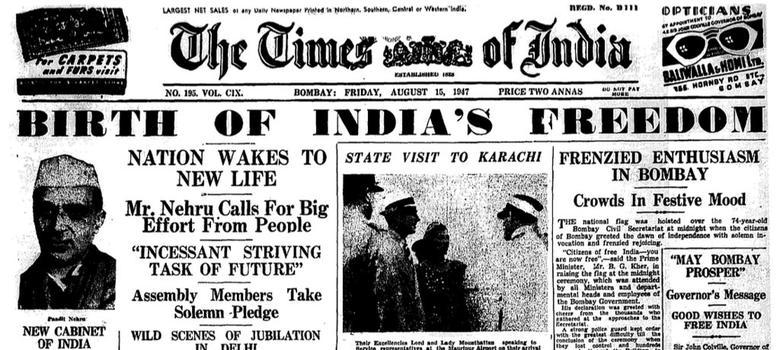
The Quit India Movement also helped to shape the post-war world. World War II's economic and political weariness forced the British government to reconsider its colonial policies. The movement, among other causes, helped India gain independence in 1947. The movement demonstrated India's united front against the forces of fascism and colonialism. The immortal words, karo ya maro, continue to inspire generations of transformative action even when the odds seem insurmountable.
Summarise with AI:
Did you like this article? Leave a rating!

 Loading...
