
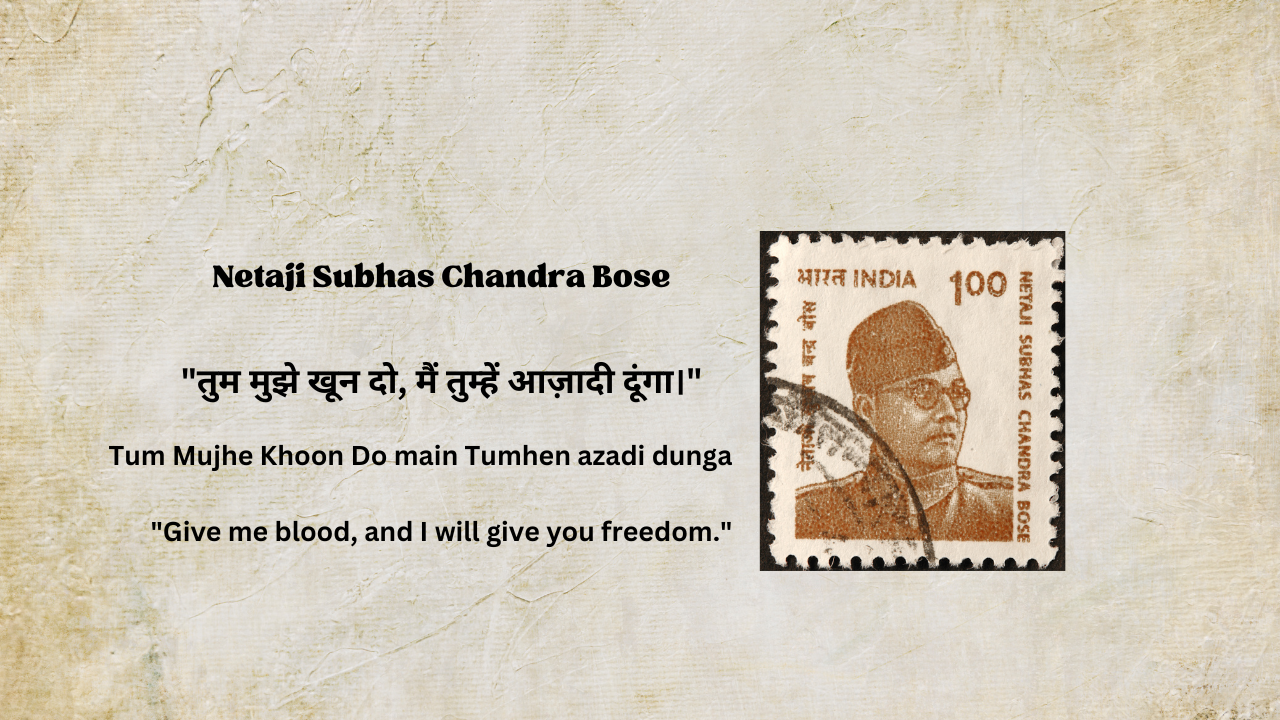

Netaji Subhas Chandra Bose was an Indian nationalist whose enthusiasm for India's freedom has left an imprint on the hearts of countless Indians. He is most known as the originator of 'Azad Hind Fauj', with the iconic motto 'Tum Mujhe Khoon Do, Main Tumhe Aazadi Dunga' (Give me blood and I will give you freedom). Netaji's birthday is celebrated as Parakram Diwas. His steadfast commitment, creative leadership, and innovative ideas established him as a symbol of heroism and patriotism. Subhas Chandra Bose's life and accomplishments continue to inspire and captivate millions of people today.





Subhash Chandra Bose: Early Life
Subhas Chandra Bose was born on January 23rd, 1897, in Cuttack, British India. He hailed from a well-known Bengali family with a long history of public service. His father, Mr. Janakinath Bose, was a prominent attorney. Prabhavati Devi, his mother, was a social and educational activist. He graduated from the Presidency College and began to take a stand against the British at this time. Subhas allegedly assaulted Oaten with his slippers and tossed him down Presidency College's historic main staircase, outraged by reports of Oaten's discriminatory remarks to Indians and his arrogant manner toward his Indian pupils.
Bose was influenced by Swami Vivekananda and Ramakrishna's ideas of purity, patience, and persistence. He worshipped Sakti and Kali. At the age of sixteen, he read the whole Vedas and Upanishads. Then his parents sent him to the University of Cambridge in England to prepare for the Indian Civil Service. He passed the civil service test in 1920, but he refused to work as a "Chakri" for the British government. He resigned from ICS in April 1921, amid the height of India's nationalist struggle. Subhas Chandra Bose had early signs of leadership and a strong sense of patriotism throughout his school and college years. Bose was an exceptional student who was well-versed in Indian history and literature from a young age.
Ideology of 'Netaji'
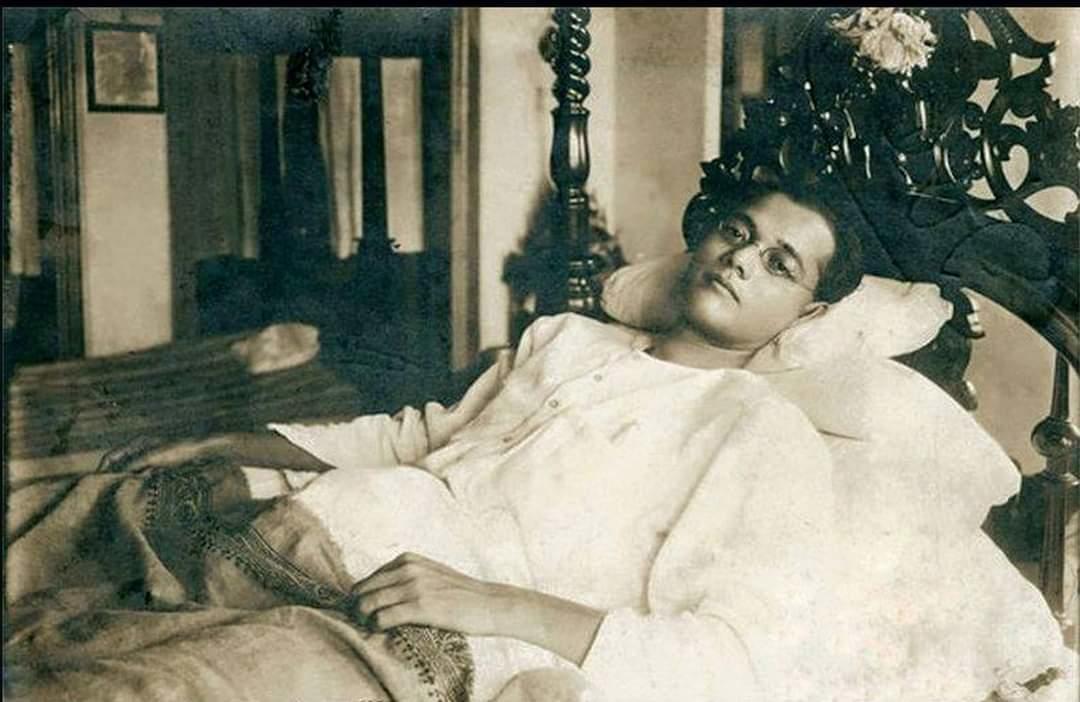
Bose joined Gandhi's noncooperation movement, which had established the Indian National Congress as a formidable nonviolent organization. Gandhi recommended Bose to serve under Chitta Ranjan Das, a Bengali politician. Bose later became a youth educator, journalist, and commandant of Bengal Congress soldiers. His acts resulted in his arrest in December 1921. In 1924, he was named chief executive officer of the Calcutta Municipal Corporation, with Das as mayor. Bose was immediately deported to Burma (Myanmar) because he was suspected of involvement in hidden revolutionary movements.
After being released in 1927, he returned to find the Bengal Congress in disarray following Das' death, and Bose was chosen president. Shortly after, he and Jawaharlal Nehru were appointed as the Indian National Congress' general secretaries. They stood together to symbolize the party's more militant, left-wing side against the more accommodating, right-wing Gandhian faction. Subhas Chandra Bose took a novel approach to India's liberation movement.
Fallout with Congress and Formation of Forward Bloc
The Motilal Nehru Committee, created by the Congress, supported Domination Status, whilst Subhas Chandra Bose and Jawaharlal Nehru opposed it. Both claimed that only total independence for India was acceptable. Bose also declared the foundation of the Independence League. Subhas Chandra Bose was imprisoned during the Civil Disobedience Movement. He eventually became the Mayor of Calcutta.
Bose was released once the Gandhi-Irwin agreement was struck. He condemned the Gandhi-Irwin deal and the suspension of the Civil Disobedience campaign, particularly when Bhagat Singh and his friends were executed. Following this, he traveled around Europe, establishing centers in several European capitals to encourage political and cultural relations between India and Europe. He returned to India and was released when the Congress party won the general election.
Bose was chosen President of the Haripura Congress Session (Gujarat), and in October of that year, he discussed planning and establishing a National Planning Committee. He also won the presidential election for the Tripuri Congress session, defeating Dr. Pattabhi Sitaramayya, who was supported by Mahatma Gandhi and the Congress Working Committee. This resulted in the Tripuri Crisis in Congress, which was caused by ideological conflicts between Bose, a strong socialist, and older politicians who were more right-wing.
As a result, Bose quit and founded the 'Forward Bloc', a left-wing faction inside the Congress based in Unnao, Uttar Pradesh. When the INC staged Individual Satyagraha, Subash Chandra Bose hosted an 'Anti-Compromise Conference' at Ramgarh, Bihar. He was imprisoned shortly after for organizing a rally to remove the Holwell Monument (Memorium for the Calcutta Blackhole Tragedy). He was eventually freed and put under house arrest in Calcutta.
Netaji and Azad Hind Fauj
Bose evaded house arrest via disguise and left India. He began to get backing from Nazi Germany and even met Adolf Hitler. He established the Free India Center in Berlin and formed the Indian Legion (composed of around 4500 troops) from Indian prisoners of war who had previously fought for the British in North Africa before being captured by Axis forces. In 1942, Indian Legion troops and Special Bureau personnel in Berlin bestowed the honorary title of Netaji on Bose.
World War II was underway, and Nazi Germany was losing ground in the West. Japanese forces advanced quickly in the east. In India, the Bengal Famine and Quit India agitation were raging. Bose traveled to Japan following his failure in Germany. Japanese Major (and post-war Lieutenant-General) Iwaichi Fujiwara, chief of the Japanese espionage force, founded INA. His objective was "to raise an army to fight alongside the Japanese army."
In December 1941, Fujiwara contacted Pritam Singh Dhillon, head of the Indian Independence League's Bangkok branch, and used Pritam Singh's network to recruit a captured British Indian army commander, Mohan Singh, on the western Malayan peninsula. Fujiwara and Mohan Singh discussed forming the First Indian National Army, which resulted in its formation.
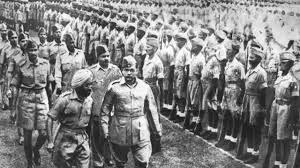
Rash Behari Bose, another expatriate nationalist leader, was also involved with the INA. Rash Behari Bose transferred the authority of the INA to Subhas Chandra Bose. Netaji was able to restructure the young army and rally tremendous support from the expatriate Indian community in Southeast Asia, who responded to Bose's demands for sacrifice for the independence cause by both participating in the Indian National Army and contributing financially.
The Rani of Jhansi Regiment (named after Rani Lakshmi Bai) of the Indian National Army, led by Capt. Lakshmi Swaminathan is regarded as Asia's first such force. Bose was able to keep his support for the Azad Hind Movement throughout. Bose's most famous phrase, "Give me blood, and I shall give you freedom!" was delivered as part of a motivating address for the Indian National Army during a gathering of Indians in Burma on July 4, 1944. He implored the people of India to join him in his struggle against the British Raj.
Bose established India’s first free government at Andaman & Nicobar Islands, which he renamed Shaheed and Swaraj, respectively. INA General AD Loganathan was appointed its first Governor. The Azad Hind Government was no longer exiled; it still retained its land, currency, civil code, and stamps.
The INA forces unfurled an Indian tricolor for the first time at the town of Moirang, Manipur, while supporting the Japanese in their push towards the Eastern Indian boundary. The Japanese suffered losses as a result of aerial bombing by the US and its allies. The Japanese withdrawal effectively cut off INA. Many INA personnel were captured during the Battles of Imphal and Kohima. Japan's surrender after the war resulted in the capitulation of the surviving components of the Indian National Army. The INA captives were eventually deported to India, where some were convicted of treason.
Most Famous Quotes by Netaji
- It is blood alone that can pay the price of freedom. Give me blood and I will give you freedom.
- Freedom is not given - it is taken.
- No real change in history can be achieved through discussions.
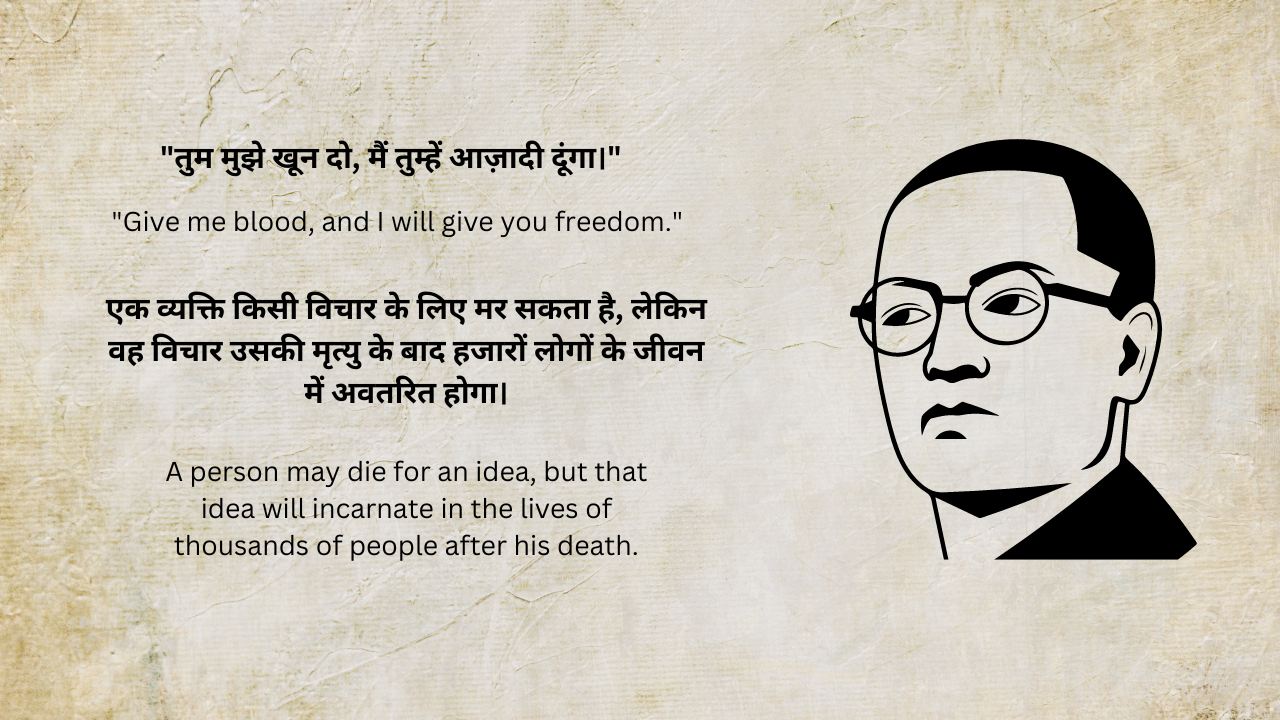
- One individual may die for an idea, but that idea will, after his death, incarnate itself in a thousand lives.
- Life loses half its interest if there is no struggle or if there are no risks to be taken.
- Men, money, and materials cannot by themselves bring victory or freedom. We must have the motive-power that will inspire us to brave deeds and heroic exploits.
- The secret of political bargaining is to look more strong than what you really are.
- Never lose your faith in the destiny of India. No power on Earth can keep India in bondage. India will be free and, that too, soon.
- Forget not that the grossest crime is to compromise with injustice and wrong. Remember the eternal law: You must give if you want to get.
- Nationalism is inspired by the highest ideals of the human race, Satyam [the truth], Shivam [the god], and Sundaram [the beautiful].
Death and Legacy of Netaji
The 'Death' of Netaji
Subhas Chandra Bose passed away on August 18, 1945, from third-degree burns sustained when his overloaded Japanese plane crashed in Japanese-controlled Formosa (now Taiwan). However, many of his admirers, particularly in Bengal, refused to accept either the truth of his passing or the circumstances surrounding it at the time, and many continue to do so now. Several martial myths about Subhas Chandra Bose have survived thanks to conspiracy theories, which surfaced shortly after his passing and have lasted for a very long time.
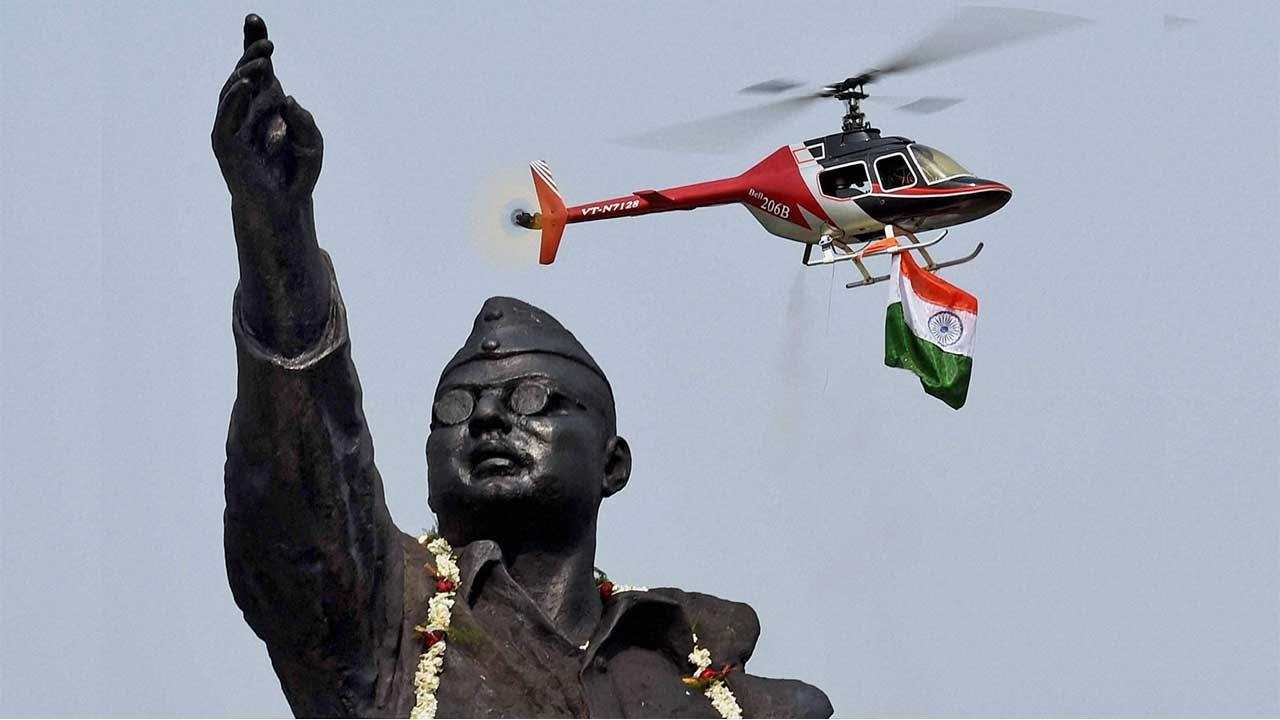
Subhas Chandra Bose Jayanti
Subhas Chandra Bose was born on January 23, 1897, in Cuttack, Orissa (now Odisha), India. Netaji Jayanti or Netaji Subhas Chandra Bose Jayanti, also known as Parakram Diwas or Parakram Divas (literally, “Day of Valor”), is held to commemorate the birthdate of the illustrious freedom fighter, Netaji Subhas Chandra Bose, every year on January 23. Netajis' legacy lives on in the same vein as those of Shaheed Bhagat Singh, Ramprasad Bismil, Chandrashekhar Azad, and Mahatma Gandhi.
Summarise with AI:
Did you like this article? Leave a rating!

 Loading...
