
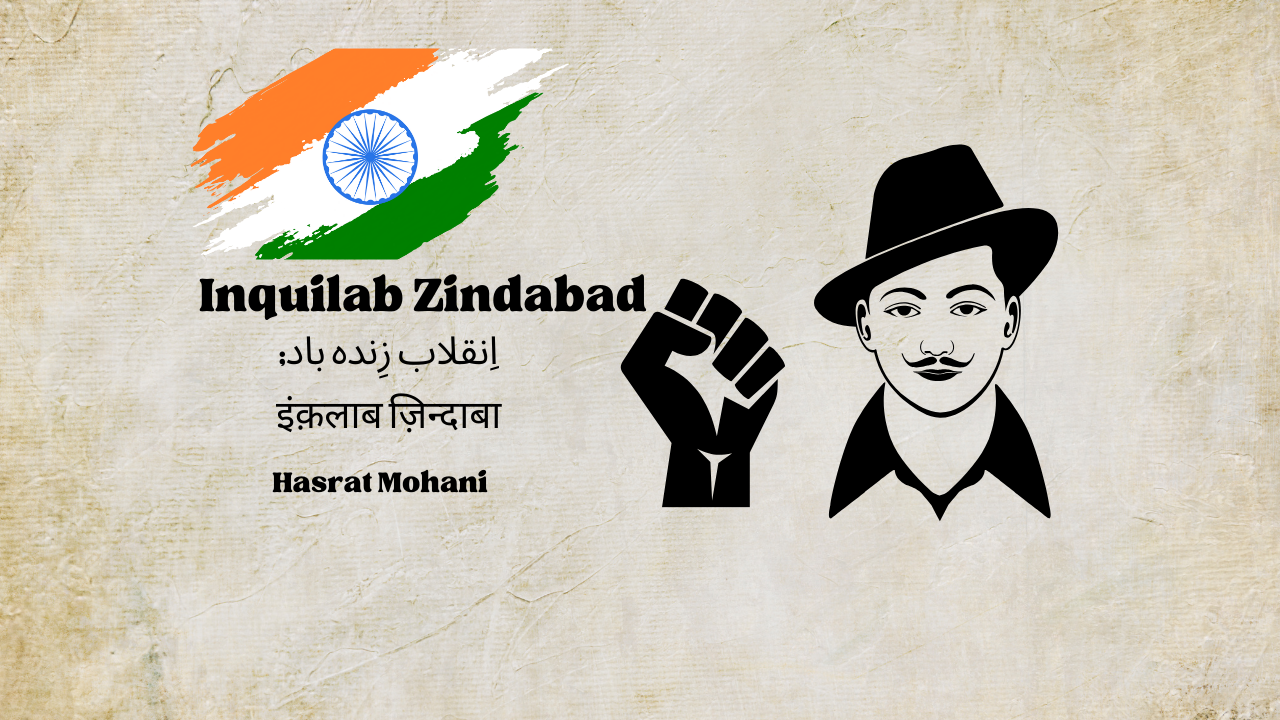

“Inquilab Zindabad” is one of the most recognisable slogans of the Indian freedom struggle. It captures the revolutionary mood of an era when many young Indians believed political freedom needed not only negotiation—but transformation.





“Inquilab Zindabad” Meaning & Translation
Inquilab Zindabad (Urdu: اِنقلاب زِنده باد) is a Hindustani phrase that translates to “Long live the revolution.”
How to write it in Indian languages (common spellings):
- Hindi: इंक़लाब ज़िन्दाबाद
- Bengali: ইনকিলাব জিন্দাবাদ
- Malayalam: ഇൻക്വിലാബ് സിന്ദാബാദ്
In a movement dominated by Mahatma Gandhi's appeal for non-violence, the revolutionaries appear to have functioned mostly on the edges. However, it was this revolutionary spirit that Subhash Chandra Bose imbibed later on and formed the Azad Hind Fauj. It was also this revolutionary fervor that pushed thousands of Indians to take to the streets and demand that the British 'quit India.'
Meaning: Long live the revolution
Coined by: Maulana Hasrat Mohani (1921)
Popularised by: Bhagat Singh and the HSRA in the late 1920s
Iconic moment: 8 April 1929 (Central Legislative Assembly bombing; pamphlets thrown)
History of the Slogan 'Inquilab Zindabad'
Discontent in India was building just as World War I came to a close in 1918. The post-war self-governance that had been promised never materialized. Street agitation had spread among the Indian population, who had previously rallied behind the British war effort with the vain aim of achieving Swarajya. In exchange, the Indians faced a slew of harsh regulations and, in 1919, the terrible slaughter at Jallianwala Bagh.
Inquilab Zindabad Slogan Given By A Poet-Revolutionary: Hasrat Mohani
Hasrat Mohani, whose real name was Syed Fazl-ul-Hasan, rose from a humble birth in the sleepy town of Mohan on a cold winter morning in 1875 to become a symbol of hope, a poet, and a liberation warrior. A man of passion, perseverance, and unfaltering commitment to freedom, Hasrat Mohani had an inspiring life. He stunned his teachers and classmates with his extraordinary intelligence when he was a little child. Even in the face of impending danger, his insatiable hunger for knowledge and devotion to his hometown served as compass points.
Hasrat Mohani was completely dedicated to his schooling, even though he encountered several obstacles along the way. He won honors and awards for his academic prowess. He found others who shared his desire for independence at Muhammadan Anglo-Oriental College, which is today called Aligarh Muslim University, thanks to his insatiable need for knowledge. He would develop lasting connections with exceptional individuals among them, such as Shaukat Ali and Mohammad Ali Jouhar.
But Hasrat Mohani was expelled from the institution three times due to his ardent criticism of the British authorities and his thirst for independence. Refusing to stay quiet in the face of oppression, he persisted in voicing his opposition. He was revered by his contemporaries and the general populace for his bravery and determination.
Name: Syed Fazl-ul-Hasan (pen name: Hasrat Mohani)
Born–Died: 1875–1951
Known for: Urdu poetry + political activism
Key legacy: Coined “Inquilab Zindabad” (1921)
Later role: Member of India’s Constituent Assembly
Amid the anarchy of the independence movement, Hasrat Mohani's lyrical spirit blossomed. Both his love for India and his devotion to Krishna were conveyed in his poetry. Going to Mathura to celebrate Krishna Janmashtami allowed him to put aside his religious differences and embrace the commonality of love and harmony.
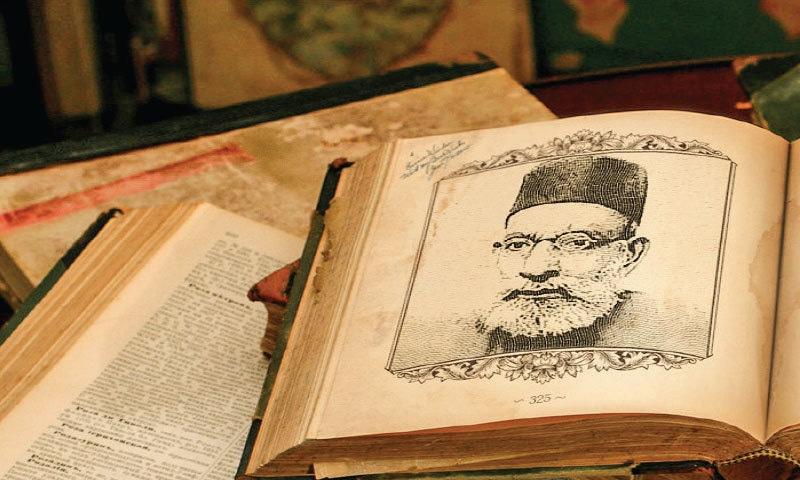
Hasrat Mohani is also frequently remembered as one of the early voices to call for complete independence (Poorna Swaraj/Azadi-e-Kaamil) well before it became Congress’s official objective at the end of the 1920s.
Adopting Inquilab Zindabad as a War Cry
The Indian revolutionaries took heart from all this, believing that they could do the same by arming themselves and that this was the only path to independence for their country. The year 1922 was the last straw that finally caused this desire to be channeled into action. The next March, the youth of that year were enraged and furious. A huge mob had just arsonated a police station in Chauri Chaura, Uttar Pradesh, murdering 22 Indian officers; in response, Mahatma Gandhi abruptly withdrew the Non-Cooperation movement. People in India were not prepared for independence, according to Mahatma Gandhi. A minority of young Indians, however, had the opposite view.
Among these young men was the poet Ram Prasad Bismil of Uttar Pradesh, who had previously been a member of the Congress party. October 1924 saw him go to Allahabad where he officially founded the Hindustan Republican Association (HRA). The group set up branches in many cities across northern India and even had a bomb factory in Calcutta. They sought to acquire weapons and generate money for their cause.
1921: Hasrat Mohani coins “Inquilab Zindabad”
1928: HRA reorganises as HSRA; revolutionary politics intensify
8 Apr 1929: Assembly bombing; slogans shouted; pamphlets thrown
1929 (later): The slogan becomes widely reported and repeated through trials, speeches, and print culture
23 Mar 1931: Bhagat Singh, Rajguru, and Sukhdev executed; the slogan becomes part of martyr memory
The most audacious undertaking of HRA occurred on August 9, 1925, during the 'Kakori Train Conspiracy,' when a band of revolutionaries snatched government funds from a train near Lucknow's Kakori railway station. The British government cracked down severely on the leaders after the incident, leading to the imprisonment of many of them from various regions of India. Only one leader, Chandra Shekhar Azad, managed to avoid capture. Notable figures such as Ashfaqulla Khan, a fellow revolutionary, and Ram Prasad Bismil were among the key leaders who were sentenced to death for their roles in the plot. The execution took place in 1927. The passing of Ram Prasad Bismil was tragic for HRA, but his writings served as an inspiration to many young people.
In 1928, HRA changed its name to 'Hindustan Socialist Republican Association' (HSRA) and took up the slogan 'Inquilab Zindabad' after being influenced by a young revolutionary called Bhagat Singh. Bhagat Singh and Batukeshwar Dutt's bombing of Delhi's Central Legislative Assembly on April 8, 1929, to draw attention to the HSRA cause, was the group's most daring attack. They turned themselves in to the authorities after directing the device onto a vacant bench to avoid damage. HSRA tossed copies of their pamphlet titled "To Make the Deaf Hear" into the Assembly, which outlined their reasoning for the bombing.
Pamphlet: “To Make the Deaf Hear”
Linked to: Central Legislative Assembly protest (8 April 1929)
Purpose: Explain motive; turn arrest and trial into a public platform
After this, a great number of revolutionaries were arrested, and all HSRA enterprises and bomb manufacturers were raided. Despite his death in a battle with police in Allahabad's Alfred Park on February 27, 1931, Chandra Shekhar Azad, a prominent figure in the HRA and HSRA, persisted in his activities. Bhagat Singh, Sukhdev, and Rajguru were executed the next month, on March 23, 1931.
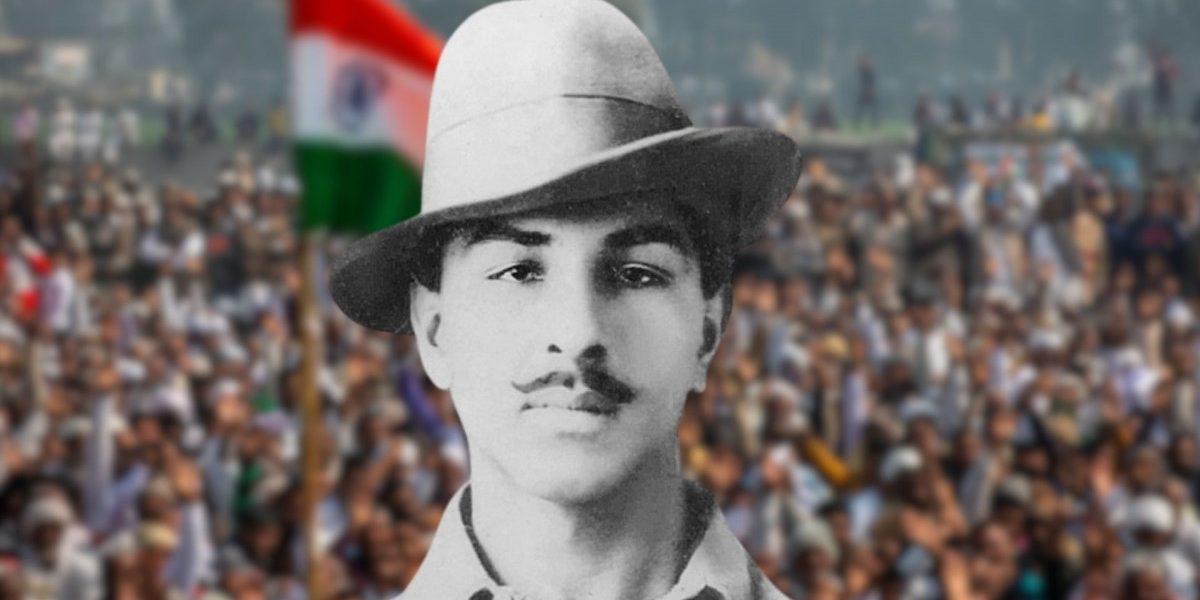
The revolutionaries' life, noble beliefs, compositions, ardent pursuit of the truth, and most crucially, their motto, 'Inquilab Zindabad,' remain relevant today, even though HRA and HSRA were unsuccessful in their aim. The writings of Bhagat Singh from 1930 are the most relevant elements of his legacy in contemporary India:
Any man who stands for progress has to criticize, disbelieve and challenge every item of the old faith. Item by item he has to reason out every nook and corner of the prevailing faith. If after considerable reasoning one is led to believe in any theory or philosophy, his faith is welcomed. His reasoning can be mistaken, wrong, misled and sometimes fallacious. But he is liable to correction because reason is the guiding star of his life. But mere faith and blind faith is dangerous: it dulls the brain, and makes a man reactionary.
Bhagat Singh (Why I Am an Atheist)
Inquilab zindabad in Modern Times
The slogan "Inquilab Zindabad" has been adopted by various movements and organisations worldwide, including those fighting for human rights, environmental protection, and economic justice. It represents a universal yearning for a better future and a rejection of the status quo.
In many modern movements, “Inquilab Zindabad” is less about one historical group and more about a broad idea:
“We want change that is structural, not cosmetic.”
The slogan "Inquilab Zindabad," meaning "Long Live the Revolution," has transcended its historical context to become a powerful symbol of resistance against oppression and injustice. It continues to resonate with activists and revolutionaries around the world who fight for social change.
Let the fight never die!?
Conclusion
“Inquilab Zindabad” survived because it is more than a slogan. It is a compact political statement: freedom is not just a flag change—it is a transformation of power and society.
Hasrat Mohani gave the phrase its first life. Bhagat Singh and the HSRA gave it national fire. And a century later, its continued use shows that the language of justice and change still needs words that feel fearless.
If you are studying India’s freedom struggle in detail, it helps to explore not only what happened—but how leaders and movements used language to build mass emotion, solidarity, and courage.
Summarise with AI:
Did you like this article? Leave a rating!

 Loading...
