


India has a population of about 1.3 billion, ranking it the second most populated country globally. From the expansive deserts of Rajasthan and the serene beaches of Goa to the lively Keralan tea plantations and the bustling metropolitan capitals of Mumbai and Kolkata. India's vast landscapes, religions, and cultures make these facts about the country highly stimulating to the senses. From the official language of India to the global ranking of Bollywood in terms of film production, explore further insights into this captivating nation with these amazing facts about India.


Learn About India - Geographical & Known Facts
| Particulars | Description |
|---|---|
| Location | The Indian peninsula is separated from mainland Asia by the Himalayas. The Country is surrounded by the Bay of Bengal in the east, the Arabian Sea in the west, and the Indian Ocean to the south. |
| Geographic Coordinates | Lying entirely in the Northern Hemisphere, the Country extends between 8° 4' and 37° 6' latitudes north of the Equator, and 68° 7' and 97° 25' longitudes east of it. |
| Indian Standard Time | Indian Standard Time (IST) is the time observed throughout India and Sri Lanka, with a time offset of UTC+05:30. It is used as the official time in the country |
| Area | 3.3 Million sq. km, 7th Largest In The World |
| Telephone Country Code | 91 |
| Border Countries | To the north-west, it borders Afghanistan and Pakistan. To the north, it borders China, Bhutan, and Nepal. To the east, it shares borders with Myanmar and Bangladesh. Additionally, it has water boundaries with Sri Lanka in the south-east and the Maldives in the south-west. |
| Coastline | 7,516.6 km encompassing the mainland, Lakshadweep Islands, and the Andaman & Nicobar Islands. |
| Climate | The climate of India can broadly be classified as a tropical monsoon one. The Indian Meteorological Department (IMD) designates four official seasons:Winter, from December to early April Summer or pre-monsoon, from April to June (April to July in north-western India) Monsoon or rainy, from June to September Post-monsoon, from October to December |
| Terrain | The mainland comprises of four regions, namely the great mountain zone, plains of the Ganga and the Indus, the desert region, and the southern peninsula. |
| Population Growth Rate | As of 2022, India's population stands at 1,417,173,167 and is projected to increase by 18% to reach 1,670,490,587 by the year 2050. |
| Birth Rate | The total fertility rate of India, which indicates the average number of births per woman, dropped significantly from almost 6.2 in 1950 to slightly below 2 in 2021. It is anticipated to decrease even further to 1.29 by 2050 and 1.04 by 2100, as per a recent global research published in The Lancet journal last week. |
| Life Expectancy Rate | Life expectancy at birth in India has increased by 5.2 years, rising from 62.1 years in 2000 to 67.3 years in 2021. 69 for Females and 65.8 for Males |
| Sex Ratio | 940 according to the 2011 census |
| National Anthem | Jana Gana Mana is the national anthem of India, originally written by Rabindranath Tagore in Bengali. It was adopted as India's national anthem post-independence |
| Ethnic Groups | All the five major racial types - Australoid, Mongoloid, Europoid, Caucasian, and Negroid find representation among the people of India. |
| Religions | According to the 2001 census, out of the total population of 1,028 million in the Country, Hindus constituted the majority with 80.5%, Muslims came second at 13.4%, followed by Christians, Sikhs, Buddhists, Jains, and others. |
| Languages | 22 Official Languages. Article 343(3) empowered Parliament to provide by law for continued use of English for official purposes. |
| Literacy | According to the provisional results of the 2011 census, the literacy rate in the Country stands at 74.04 per cent, 82.14% for males and 65.46% for females. |
| Administrative Divisions | 28 States and 8 Union Territories. |
| Independence | 15th August 1947 (From the British Colonial Rule) |
| Constitution | The Constitution of India came into force on 26th January 1950. |
| Flag Description | 🇮🇳 The saffron color at the top of the Indian flag symbolizes courage and sacrifice, the white middle band represents truth and peace, and the green at the bottom signifies growth, fertility, and auspiciousness. The navy-blue wheel in the center, known as the chakra, represents progress and the wheel of law. |
| National Holidays | 26th January (Republic Day) 15th August (Independence Day) 2nd October (Gandhi Jayanti; Mahatma Gandhi's Birthday) |
100 Amazing Facts About India
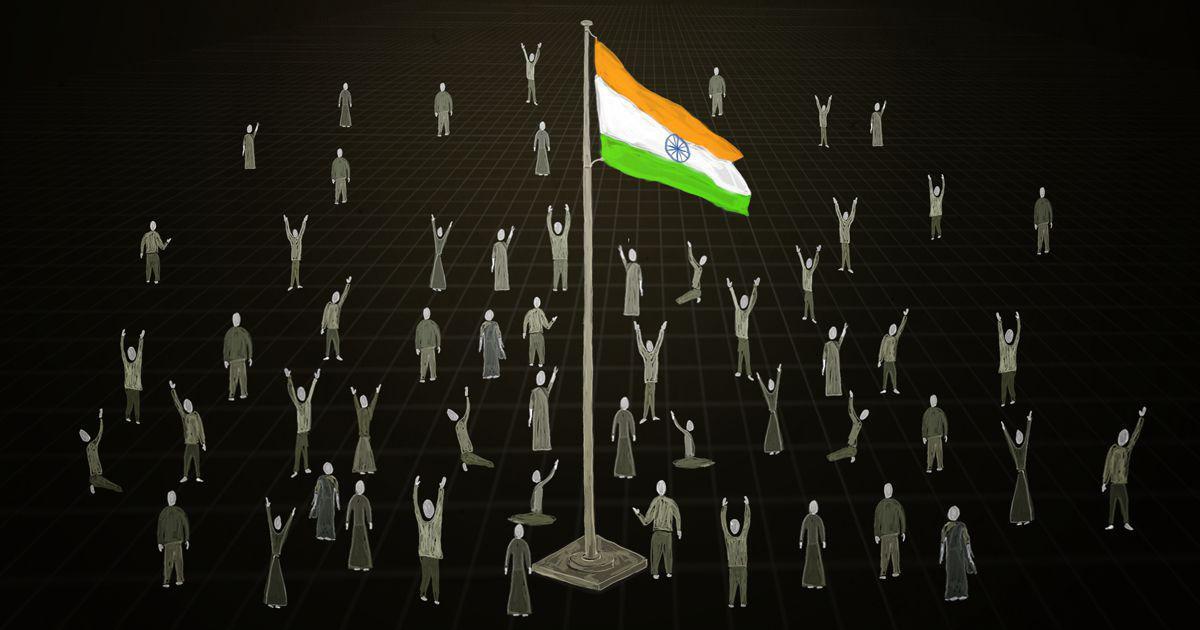
Explore the political landscape of India after the Lok Sabha 2024 elections.
- India has 1.4 billion people (1,441,719,852)
The population of India is projected to reach 1,441,719,852 in 2024, representing a 0.92% increase from the previous year. In 2023, the population was 1,428,627,663, which was a 0.81% increase from 2022.
- India is the 7th biggest country and the largest democracy globally.
India, the 7th largest country in the world, is distinguished from the rest of Asia by its mountains and sea, creating a unique geographical identity for the country.
- The Indian constitution currently acknowledges 22 primary languages of India within the "8th Schedule" of the Constitution.
- The name India comes from the Indus River.
- The Guinness Book of World Records ranks India third in record applications worldwide.
- India is the only country with a cow bill of rights.
- India has the world's biggest vegetarian population.
- India has the world's largest postal network.
On 1st July 1876, India joined the Universal Postal Union, making it the first Asian country to do so. Simultaneously, the Indian government set up a postal department on 1st October 1854.
- Bollywood, also known as Indian cinema, is the biggest film industry in terms of both the number of films made and tickets sold. It sells 3.5 billion tickets annually, which is more than Hollywood's 2.6 billion tickets sold annually. Additionally, Bollywood produces 1,986 feature films each year.
- India has the 3rd largest army behind the US and China.
- India holds the largest human gathering during Kumbh Mela, visible from space.
- Mawsynram has the greatest average rainfall worldwide.
According to the Guinness Book of World Records, Mawsynram recorded 26,000 millimeters (1,000 in) of rainfall in 1985.
- India has 125,226,449 English speakers, making it the second-biggest English-speaking nation.
- We owe India decimals and zero.
- The 1st Indian rocket was transported by bicycle.
In 1963, the parts of India's inaugural rocket launch were transported to the launch site, a church in Thiruvananthapuram, on a bicycle. The launch successfully sent a NASA-made Nike-Apache rocket into space, ultimately leading to the establishment of the Indian Space Research Organisation (ISRO) by Vikram Sarabhai on August 15, 1969.
- Indians invented shampoo.
- On May 26, Switzerland honors A.P.J. Abdul Kalam on Science Day.
- India created chess before 600 AD.
- India produces nearly 16% of global milk.
- India has the second-largest road network at 4,865,000 kilometers.
- The world's highest cricket ground is at Chail, Himachal Pradesh, at 2,144 meters.
- India's first satellite was tested on a bullock cart in 1980.
- Indian railroads employ over a million.
- Before the British entered, India was one of the richest nations.
- The Himalayas have 9 of the world's 10 tallest peaks.
- India discovered water on the moon.
- The world's tallest rail bridge is in Jammu Kashmir, India (1,178 feet across the Chenab River).
The Mainline Electric Multiple Unit (MEMU) train, consisting of eight coaches, successfully completed its first journey across the Chenab Bridge. The bridge, towering at a remarkable height of 1,178 feet above the Chenab River, surpasses the iconic Eiffel Tower in Paris by 35 meters. It serves as a vital link between the towns of Bakkal and Kauri in the Reasi district.
- An Indian-American computer architect designed the USB.
- The Bandra-Worli sea connection in Mumbai contains steel wires equivalent to the Earth's circumference.
- India has won all World Cups in Kabaddi.
- India's first president, Dr. Rajendra Prasad, got 50% of his salary. He took 25% after his term.
- Kerala drinks the most alcohol in India.
- 3% of Indians pay income tax.
- India has a high abortion rate.
- Over a million Indians are millionaires, while most survive on less than $2 a day. An estimated 35% of India's population is impoverished.
- India's longest river, Ganga, flows for 2525 kilometers.
- India has the largest family—39 women, 94 children, and 33 grandkids.
- India contributes the most troops to UN peacekeeping missions.
- India produces around 4700 daily publications in 300 languages.
- Khari Baoli, New Delhi, is Asia's largest wholesale spice bazaar.
- Kerala has an elephant spa.
- The tallest mountain in India is Kanchenjunga at 8,586 meters.
- The Indian Railways carry as many people as Australia daily.
The railway network spans 115,000 km of track and operates 12,617 trains daily, transporting over 23 million passengers, which is equivalent to the entire population of Australia. It connects over 7,172 stations and also runs more than 7,421 freight trains, carrying 3 million tonnes of freight each day.
- Magnetic peak, an anti-gravity peak in Ladakh, is a mystery in India.
- Historians think that ancient Indian Sanskrit scriptures include the first known narrative of cosmetic surgery
- In 2011, the City Montessori School in Lucknow had 9,437 students and 2,500 teachers, making it the world's largest school.
- Shakuntla Devi won the title of the 'human calculator' after calculating two random 13-digit numbers: 7,686,369,774,870 × 2,465,099,745,779, answered properly in 28 seconds.
- Yoga has been around for almost 5000 years and began in India.
- India has one of the top 5 space programs in the world, despite funding restrictions.
- Ben Kingsley, an actor of Indian origin, was born Krishna Pandit Bhanji.
- Rabindranath Tagore composed Bangladesh's national anthem.
- After winning the 1936 Berlin Olympics 8-1, Major Dhyan Chand, the hockey genius, was invited by Hitler to become a German citizen.
- Only Indian KFC introduced a "vegetarian" menu.
- The game of snakes and ladders was created in India in the 13th century by poet Saint Gyandev.
- Freddie Mercury was Indian by birth.
- The Langar at the Golden Temple in Amritsar provides free meals to 100,000 people daily.
- Brihadeswara Temple in Thanjavur, Tamil Nadu, is the first granite temple. The temple Shikhara is built from an 80-tonne granite block.
- Emperor Ashoka propagated Buddhism from India, especially in South East Asia.
- India has the second-most sheep (75,000,000) behind New Zealand.
- India sells software to 90 nations.
- Ganges dolphins are India's national aquatic mammal.
- India alone has the Himalayan blue sheep.
- Tirupathi's Vishnu temple receives almost $6 million in donations. The building dates back to the 10th century.
- The Pentium Chip was invented by an Indian.
- In 100,000 years, India has never engaged in the invasion of another sovereign nation to acquire territory or establish colonies to the extent that European powers have done so.
- Havell's is an Indian brand named after its founder.
- India has 1300 magnificent bird species.
- The Lifeline Express (Jeevan Rekha Express) is the world's first hospital train, providing operations, cancer treatment, and distant village services.
- The first university was founded in 700 BC in Takshila. Over 60 courses were studied by 10,500 international students. The University of Nalanda, founded in the 4th century, was a significant educational achievement in ancient India.
- The earliest diamond mine was in India.
- In the past, the Indian five-rupee coin was smuggled to Bangladesh and used to create razors.
- Benaras (now Varanasi) is the world's oldest continually inhabited city. Buddha also visited it.
- Navigation began about 6000 years ago in the Sindh River. Navigation comes from the Sanskrit term ‘Navgatih'. Navy comes from the Sanskrit word ‘Nou’.
- A single voter in Gir Forest has a dedicated voting booth.
During the Lok Sabha elections, a sole voter, Mahant Haridas, a temple priest in Banej within the Gir forest region in Gujarat, cast his ballot, resulting in 100% voter turnout at the polling station.
- Banjaran, the first Indian folk CD, featured songs from Gujrat and Rajasthan.
- The veena, a stunning musical instrument, originated in India.
- The Ladybirds were the first Indian band with solely female members.
- India invented the tabla. Gandharva Mahavidyalaya was India's first music school.
- India celebrates Ganesh Chaturthi in honor of Lord Ganesha, especially in Mumbai.
- Northern Hindu women celebrate Karwa Chauth, a holiday where they pray for their husband's long life.
- Over 60% of India's basmati rice comes from Haryana.
- Dum biryani was created by the Nawab of Awadh to provide a cost-effective meal for the impoverished.
- India produces the second-most number of pharmaceutical pills in the world behind China.
- 100 Fortune 500 firms have R&D centers in India.
- More Indian students attend U.S. colleges than any other nation.
- Over 6,600 firms are listed on the Bombay Stock Exchange, second only to NYSE.
- Dolphins are considered non-human people in India.
- Approximately 49% of high-tech start-ups in Silicon Valley and Washington, D.C. are owned by Indians or Indian Americans.
- Plastic bags were not available in India until 1985.
- India is the top producer of vegetarian cheese globally.
- The longest Indian Railway station name is Venkatanarasimharajuvariapeta.
Discover India's unique geographical features, including the Deccan Plateau, her rivers, and mountains.
Proud Facts About India Before Independence
- The first war for freedom happened in 1857. It was led by Mangal Pandey and was known as the Sepoy Mutiny or the Indian Rebellion of 1857. Other people who led the fight against British forces in 1857 were Rani Laxmi Bai of Jhansi, Bahadur Shah Zafar, Tatya Tope, and Nana Sahib.
- Then there was the Swadeshi Movement in the early 1900s. The Bombay Swadeshi Co-op Stores Co. Ltd. was started by Bal Gangadhar Tilak and JRD Tata to support Indian goods and steer clear of foreign ones. It was called the soul of Swaraj (self-rule) by Mahatma Gandhi.
- The first Indian flag was made in 1904 by Sister Nivedita, who was a student of Swami Vivekananda. The first Indian flag was raised on August 7, 1906, in Kolkata's Parsee Bagan Square. There were three main colors on the flag: red, yellow, and green.
- Bhagat Singh was known as the "Inspiring Soul of India." He spoke many languages very well, including French, Swedish, English, Arabic, Hindi, and Punjabi. He also read a lot.
- A historic decision was passed in 1931 that made the tricolor flag our national flag. This flag came before the current one. It was yellow, white, and green, and it had Mahatma Gandhi's rolling wheel in the middle.
- The Indian Tiranga was officially accepted on July 22, 1947, with a few changes. It was based on the Ashoka chakra from Emperor Ashoka's lion capital. It was raised for the first time on August 15, 1947.
- India did not have a national anthem when it became independent. "Jana Gana Mana" was written by Rabindranath Tagore in 1911, but it wasn't until January 24, 1950, that it was made the official national anthem.
- "Vande Mataram," the national song written by Bankim Chandra Chatterjee, was a part of his 1880s book Anandamath. Tagore sang this song for the first time in 1896. As of January 24, 1950, Vande Mataram became the national song.
- The Indian Freedom Act was signed into law on July 18, 1947, but Lord Mountbatten picked August 15, 1947, as the date of India's freedom because that was the same day that Japan gave up and ended World War II.
Summarise with AI:
Enjoyed this article? Leave a rating!

 Loading...
