
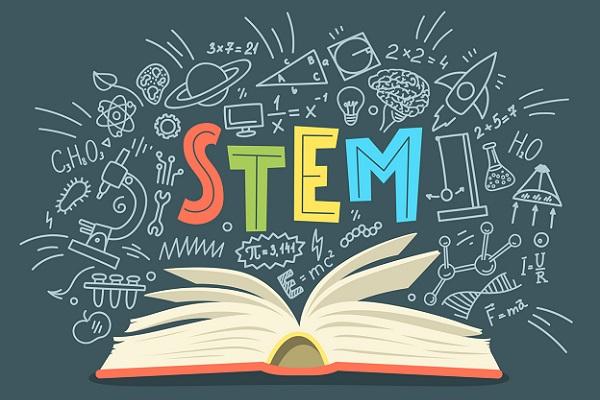

STEM represents Science, Technology, Engineering, and Mathematics. STEM Education, a curriculum focused on these disciplines, has increased in popularity due to its creative approaches to global issues. This teaching style extends beyond the study of theoretical subjects. It teaches the youngster how to apply principles learned in various courses to real-world situations.
The name, STEM, was coined in 2001 by scientific administrators at the National Science Foundation (an independent agency of the United States government that funds research).
STEM education and STEM subjects are now widely recognized as essential components of competency-based curriculum. It is included in our school curriculum beginning with the basic level of formal education.
In India, the education system has evolved and will continue to change over time. With a creative education strategy and the complexity of the new normal following the epidemic, teaching and learning processes have been irrevocably altered. India is keeping up with creative advancements, such as online schooling. Educators have also recognized the importance of STEM education and adopted this pedagogical strategy, consistent with the world's best school systems. Furthermore, to succeed in the workforce/career, learners must have STEM skills.




Benefits of STEM Education
STEM education is more than simply a fashionable educational term; it is a systematic strategy that provides students with skills applicable to several areas and businesses. Here are some major reasons why STEM education is beneficial.
Critical Thinking & Problem Solving
STEM education promotes critical thinking and analytical problem-solving. Hands-on projects and real-world challenges teach students how to deconstruct difficult problems, examine data, and design new solutions. This skill set benefits students academically and prepares them for the complexity of a quickly changing labor market.
Innovation and Creativity
STEM education fosters creativity via open-ended exploration and experimentation. When kids are encouraged to look outside of the textbook and explore their ideas, they get the confidence to create. This approach, such as that followed in countries like the USA, UK, and Japan, creates the groundwork for future inventors, entrepreneurs, and trailblazers who will push progress in a variety of disciplines.
Prepare for the digital age
As technology continues to transform every profession, STEM education provides students with the digital literacy and technological skills they need to succeed. Students develop skills in digital tools, programming languages, and software programs, preparing them for a technologically aware future.

Real-World Applications
STEM education fills the gap between academic understanding and actual application. Students gain a better understanding of the real-world application of their studies by participating in practical projects. This relationship helps individuals comprehend how classroom principles transfer into real-world difficulties encountered by companies and communities.
Interdisciplinary Approach
STEM education breaks down topic divisions to reflect the collaborative character of today's environment. Students learn that real-world challenges need a comprehensive strategy that draws on insights from other disciplines. This interconnectivity promotes a better grasp of the complexities of issues.
Career Opportunities
STEM areas provide several job options in industries such as engineering, health care, technology, and environmental science. STEM education prepares students to seek these varied and well-paying jobs, hence closing the STEM employment demand gap.
Diversity & Inclusion
STEM education courses promote diversity by allowing students from diverse backgrounds to interact with these disciplines. Creating an inclusive STEM learning environment strengthens disadvantaged groups while promoting equitable opportunity for all.
Solving Global Challenges
STEM-based education is required to address many of the world's most serious concerns, including climate change and healthcare. STEM education prepares students to face these issues and contribute to a better society.
Information About STEM Fields
STEM includes the following key fields of study:
- Natural, physical, and life sciences (sometimes including medicine)
- Computer, electronics, and other technology-related disciplines
- All types of engineering
- Mathematics, or any field involving a heavy application of mathematical principles
Many people question whether some fields qualify as STEM. Some STEM definitions include social sciences like psychology, economics, and anthropology. Most publications, however, treat these as independent groups.
U.S. Immigration and Customs Enforcement maintains a list of collegiate STEM majors that includes the four primary areas mentioned above, as well as architecture, psychology, digital communication, and certain medicinal and social sciences. This list specifically excludes areas such as accounting, political science, and nursing.
Architecture is a very new addition to STEM, having only received formal recognition from the United States government in 2019.
Many people argue over whether health and medical occupations, such as nursing and dentistry, should be called STEM. ACT Inc.'s 2016 Condition of STEM study includes several health and medical areas, designating physicians, nurses, and dentists as STEM workers.
STEM Career Options
STEM occupations include the application of science, technology, engineering, and/or mathematics. STEM jobs include mechanical engineers, math teachers, biologists, and computer programmers.
STEM, as a range of academic courses, seeks to develop crucial hard and soft skills such as computer literacy, critical thinking, and problem-solving.
STEM provides a variety of career pathways, each with its own set of difficulties and benefits. Here are several computer, science, engineering, and math occupations to consider.
STEM Careers in Science
Science entails comprehending and studying the natural and physical worlds around us. As a science major, you can work in subjects such as biology, astronomy, environmental science, physics, and more. Some scientific areas may require you to obtain a graduate degree.
| Type of Job | Degree Required |
| Agricultural and Food Scientist | Bachelor's |
| Astronomer | Doctoral |
| Atmospheric Scientist | Bachelor's |
| Chemical Technician | Associate |
| Environmental Scientist | Bachelor's |
| Epidemiologist | Master's |
| Medical Scientist | Doctoral |
| Nuclear Technician | Associate |
| Physicist | Doctoral |
| Zoologist and Wildlife Biologist | Bachelor's |
STEM Careers in Technology
Technology occupations provide the opportunity to work at the forefront of innovation. According to the Bureau of Labor Statistics, positions for computer and technology experts are expected to rise far faster than the overall labor market between 2022 and 2032.
As a software developer, you would be able to design and construct software. As a cybersecurity analyst, you may defend computer systems against cyber attacks. Here are some common computer and technology positions to consider.
| Type of Job | Degree Required |
| Computer and Information Research Scientist | Master's |
| Computer Network Architect | Bachelor's |
| Computer Programmer | Bachelor's |
| Computer Support Specialist | High school diploma or associate |
| Computer Systems Analyst | Bachelor's |
| Database Administrator | Bachelor's |
| Database Architect | Bachelor's |
| Information Security Analyst | Bachelor's |
| Software Developer | Bachelor's |
| Web Developer | Bachelor's |
STEM Careers in Engineering
Engineering is all about applying math and science to create computers, machines, buildings, and other things. Civil, mechanical, and electrical engineering are three popular engineering disciplines. And the best part is that being an engineer usually just requires a bachelor's degree.
| Type of Job | Degree Required |
| Aerospace Engineer | Bachelor's |
| Chemical Engineer | Bachelor's |
| Civil Engineer | Bachelor's |
| Electrical Engineer | Bachelor's |
| Environmental Engineer | Bachelor's |
| Industrial Engineer | Bachelor's |
| Marine Engineers and Naval Architect | Bachelor's |
| Mechanical Engineer | Bachelor's |
| Nuclear Engineer | Bachelor's |
| Petroleum Engineer | Bachelor's |
STEM Careers in Math
Math occupations often include employing mathematical foundations to evaluate, compute, and interpret data. You may become an actuary for a firm, analyzing costs and risks. You might also teach math as a secondary or postsecondary instructor. To become a mathematician or statistician, you must first complete a graduate or post-graduate degree course.
| Type of Job | Degree Required |
| Actuary | Bachelor's |
| Data Scientist | Bachelor's |
| High School Math Teacher | Bachelor's |
| Math Professor | Doctoral |
| Mathematician | Master's |
| Operations Research Analyst | Bachelor's |
| Statistician | Master's |

Why Choose a Career in STEM?
Jobs in STEM are ideal for brilliant minds like yours. Whether you've never considered a STEM profession, are undecided, or are completely committed, these are all compelling reasons to succeed in the industry.
You're a creative person.
Creativity takes various forms and is not restricted to the arts. Being creative implies you can come up with innovative solutions to tough challenges and think beyond the box. Does this sound like you?
Although many people believe STEM is only about hard sciences, this could not be further from the truth. Scientists, engineers, developers, and others are continuously confronted with complex challenges that need innovative answers. STEM is looking for those who want to extend their imagination!
You enjoy hands-on learning.
Do you learn via doing? If so, you learn through kinesthetic learning, which is the process of absorbing knowledge via trial and error. Whether you're evaluating the qualities of different chemicals in a lab or traveling to remote regions to explore unusual rock formations, STEM offers countless chances for hands-on learning.
You care about the environment.
STEM education is responsible for much of our understanding of climate change. Given that climate justice is one of the most significant topics for young people, you may have already considered pursuing a STEM profession to make a difference. If you want to protect our natural environment, STEM is the perfect professional path to turn your enthusiasm into climate action.
STEM experts are leading the way in combating climate change with innovative solutions. They're making enormous progress to safeguard the environment by creating biodegradable packaging and sustainable energy solutions.
You want to discover the world.
You don't have to be a travel influencer to travel the world for work! Picture getting paid to travel the world while also doing something you enjoy. STEM might be the answer to all your vacation ambitions. Many employment in the area entails fieldwork, which means you will travel to different locations to conduct research and complete projects. Furthermore, certain STEM careers can be completed entirely remotely, allowing you to travel or live overseas.
You want to make the world a better place.
Many STEM workers are motivated by a similar goal to make the world a better place, whether they're building life-changing prostheses, testing novel medications in a lab, or making applications for vision-impaired people. As an added plus, diversifying STEM ensures that technology works for everyone and helps to prevent negative algorithmic biases.
New technologies are emerging across the world, produced by scientists, engineers, technologists, mathematicians, and others who seek to discover long-term answers to some of the world's most serious problems.
Summarise with AI:
Did you like this article? Leave a rating!

 Loading...
